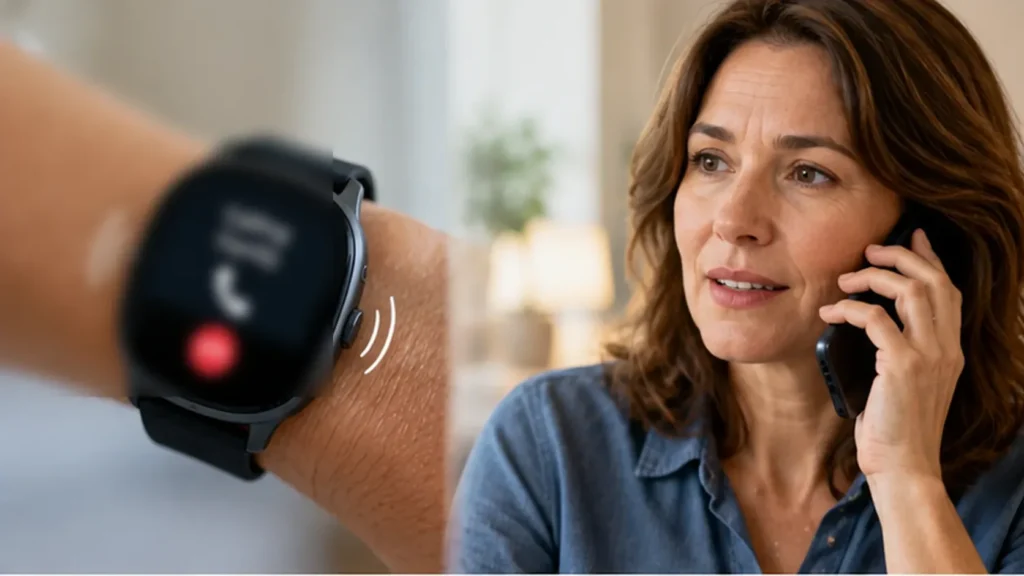
A fall detection watch that calls family does more than dial a number after detecting movement. A complete service confirms that an automatic fall event should progress, routes it through a configured channel, identifies who owns the response, and records whether anyone acknowledged it. Depending on the device and service design, notification may use a direct voice call, an app, SMS, or a monitoring platform. These routes provide different evidence. The workflow must therefore keep event creation, delivery, human acknowledgement, and final response separate rather than treating “calls family” as one completed action.
Start After the Fall Event Has Passed Local Confirmation
An automatic workflow usually begins with a suspected fall detected by the watch. Where configured, the device then prompts the wearer and provides time to cancel a false alarm. If the wearer confirms the event or does not respond before the local window ends, the system creates an event that is ready for remote handling.
That handoff is the starting point for caregiver notification. A sensor trigger is not yet a call, message, or request accepted by another person. Buyers should be able to see which state was reached and why the workflow advanced. Teams that need the wearer-side sequence can review how to confirm or cancel a fall detection watch alert without repeating the sensing logic here.
Decide Who Owns the First Response
“Notify family” does not define operational responsibility. The first recipient might be a relative, an internal care team, a professional monitoring center, or the customer’s own safety platform. Each model needs a named owner and a clear meaning for acknowledgement.
- Family-first model: A designated relative receives the first call or notification and may become the named owner by acknowledging it.
- Care-team model: An on-duty team receives the event, then assigns an individual caregiver.
- Monitoring-center model: A professional queue receives the event before an operator accepts it.
- Customer-platform model: The buyer’s backend chooses the first recipient and records ownership under its own service rules.
The recipient and response owner can be different. An app may notify several people while only one assigned operator owns the incident. A family member may answer but hand responsibility to a care organization. The service should record that assignment rather than infer it from delivery.
Buyers should define which destination receives the event first and which action assigns responsibility. A phone number, app account, shared queue, or monitoring endpoint is a destination; ownership begins only after the approved acknowledgement or assignment action.
Compare Notification Routes
Automatic fall alerts can use several routes, either individually or in a controlled sequence. None proves the same thing.
| Route | What it can prove | What it cannot prove | Common dependency |
|---|---|---|---|
| Direct voice call from the watch | A call attempt was made; call setup or connection may be recorded | That the right person answered, understood the situation, or arranged help | Voice entitlement, operator support, firmware, number rules, coverage, and audio path |
| Caregiver app notification | The backend attempted delivery; the app may report received or opened states | That a caregiver accepted ownership or responded appropriately | Data connectivity, push service, app permissions, account status, and background behavior |
| SMS or data message | A message was submitted or delivered where receipts are supported | That the recipient read it or is available to act | Network service, destination format, messaging provider, handset state, and market rules |
| Monitoring-platform event | The service endpoint received a structured incident for workflow processing | That an operator has reviewed, accepted, or owns it | Event contract, authentication, recipient permissions, assignment rules, and operator process |
The route should reflect the organization’s operating model, not just the hardware. A family-first service may prioritize a direct call, while an institutional program may send a structured event to a shared queue. Platform routing improves auditability only when the receiving role, acknowledgement action, and ownership rule are defined. If several channels carry the same event, they should share an event identifier so recipients can recognize one incident rather than several unrelated alerts.
What Information Should Travel With the Alert?
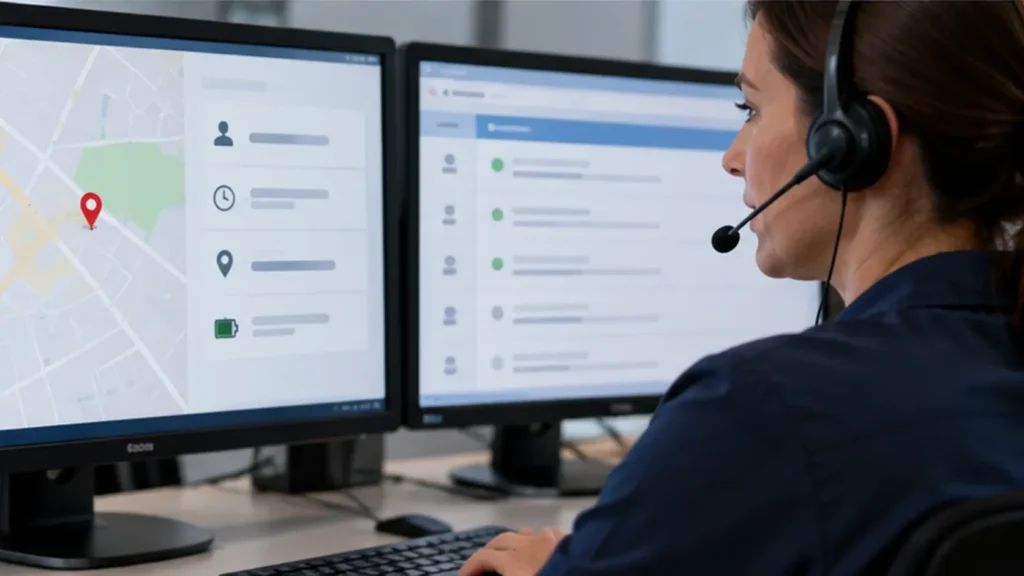
A caregiver needs enough context to identify the incident and decide the next approved action. The alert should avoid both extremes: a vague message with no operational value and an oversized payload containing unrelated personal or health data.
Useful fields may include:
- a stable event identifier;
- event type and source, such as automatic fall detection rather than manual SOS;
- device and user identifiers appropriate to the service and privacy model;
- the time the device created the event;
- local confirmation, cancellation, or no-response state;
- location status, source, and timestamp where location is part of the workflow;
- battery or connectivity context when it changes the response; and
- the channel, recipient, and current delivery or acknowledgement state.
The data must not turn an inference into a fact. “Fall detected” does not mean injury, and “call connected” does not mean the responder understood. Include only fields needed to identify, route, or manage the incident and match them to authorized recipients.
Recipient information varies by channel. A voice call may provide an audio connection with limited context. SMS may carry a concise notice and approved callback instruction. An app can show identity, event time, location status, and an acknowledgement control, while a platform can receive a structured record for assignment. Buyers should specify the minimum payload for each route.
The recipient view should state the available action. “Open event,” “accept responsibility,” and “call wearer” are not interchangeable. If acknowledgement creates ownership, record the person and time; if it only means “seen,” assignment remains separate.
What Happens If the First Family Contact Does Not Respond?
An unanswered call, voicemail connection, or unacknowledged notification must not be recorded as caregiver ownership. The configured service may take another action, but its retry counts, fallback sequence, network-failure handling, and unresolved-event process are separate design topics.
For those exception paths, use the guide to smart watch SOS escalation when no one answers. The automatic fall workflow should simply preserve the original event, show that no caregiver has acknowledged it, and hand control to the approved exception policy.
Keep Voice, Notification, and Acknowledgement States Separate
Clear states protect both the wearer and the service team. A single label such as “alert sent” hides too much: it may describe a local event, a backend receipt, an app delivery, or a call attempt. These are different milestones, and none alone identifies the response owner.
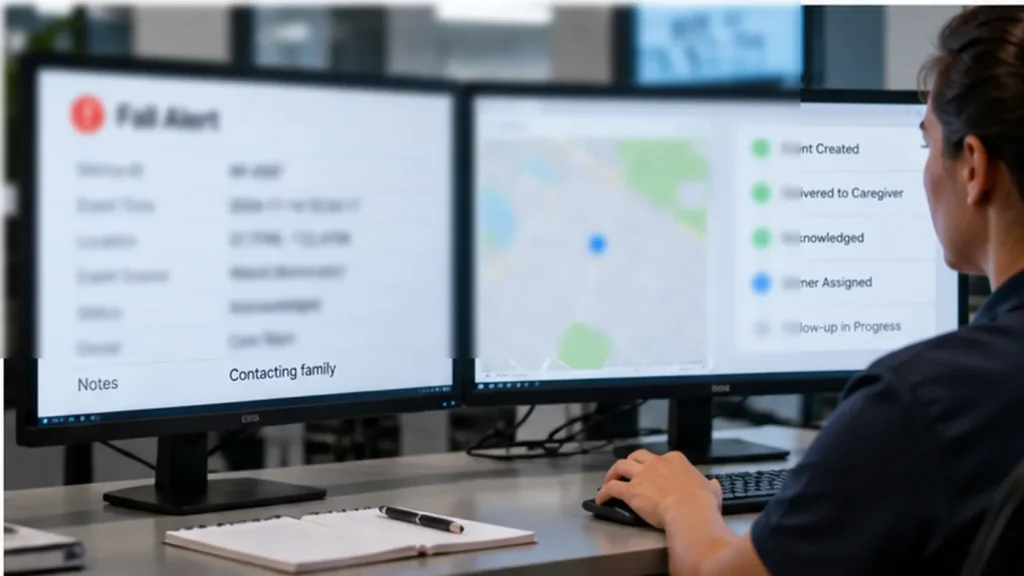
A useful model distinguishes transmitted, delivered or connected, presented to a person, acknowledged, assigned, and response started. The labels can vary, but each transition needs evidence. A platform receipt can prove “received,” while an in-app acceptance may prove acknowledgement. Assignment should identify the person or team now responsible; it should not be inferred from a delivery receipt.
With multiple channels, the event should retain one identity and one authoritative ownership state. If two caregivers view or accept the incident, the system should show whether one person owns it, whether responsibility is shared, or whether a formal handoff is required. The medical alert watch monitoring platform integration guide covers the broader event-contract considerations.
The acknowledgement record should capture who acted, when, through which channel, and what the action meant. “Seen,” “accepted,” “assigned,” and “response started” should remain distinct unless the service deliberately combines them.
Test the Family and Caregiver Workflow End to End
Testing should follow the complete event-to-owner path on the exact watch, firmware, network, backend, app, and contact configuration planned for deployment. A successful test is not merely a ringing phone.
Create cases for:
- an automatic fall event delivered to the designated first family contact;
- the same event delivered to an internal care-team or monitoring queue;
- a voice call that connects without a recorded caregiver acknowledgement;
- an app notification that is delivered, opened, and then explicitly accepted;
- an SMS or data notice that provides only the information approved for that route;
- one event delivered through two channels with a shared event identifier;
- two caregivers viewing the incident while only one accepts ownership; and
- a formal handoff from a family recipient to a care team.
For every case, record the first destination, information displayed, technical delivery evidence, acknowledgement action, acknowledgement time, and assigned owner. Confirm that each channel describes the event consistently and that recipient permissions expose only the approved data.
Acceptance criteria should state which person or role receives the event first, what they see, which action counts as acknowledgement, whether that action creates ownership, and how the responsible person or team is displayed.
Conclusion
The useful feature is not simply a family call. An automatic fall event must reach the intended recipient with usable context and a clear acknowledgement action, then become owned by a named person or team. A created event or connected channel alone does not prove that help was arranged.
For a fall detection watch project, share who should receive automatic alerts first, which channels are required, what information each recipient should see, and how acknowledgement assigns ownership. WearIntell can review the event-to-owner workflow and turn those requirements into pilot acceptance cases.
Frequently Asked Questions
Can a fall detection watch call more than one family member?
It may support an ordered list, parallel notifications, or platform-controlled routing. Define who receives the event first, whether others see the same information, and which acknowledgement assigns ownership when several people are notified.
Does a caregiver notification mean the alert has been acknowledged?
No. Notification delivery shows that a technical route reached an endpoint where that evidence is available. Acknowledgement should require the human action defined by the service, such as accepting the incident in an app or through an operator workflow.