
A SIM choice that works in one medical alert watch pilot can become difficult when the service expands across operators, countries, replacement devices, and support teams. Comparing eSIM vs SIM for medical alert watch deployment therefore means following the subscription through its full lifecycle: activation, network and voice support, reassignment, suspension, recovery, and retirement. The physical format matters, but the workable service around it determines whether the architecture can scale.
What the Two SIM Architectures Change
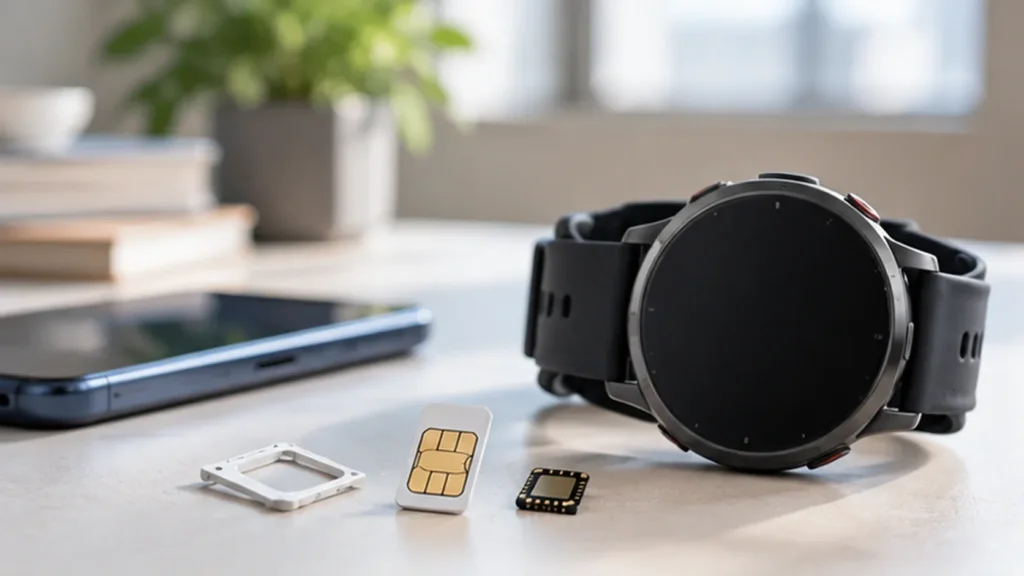
A physical SIM stores subscription credentials on a removable card inserted during manufacturing, staging, or deployment. Changing service may require a card replacement, record update, and device retest.
An eSIM implementation typically uses an eUICC capable of securely storing and managing downloadable operator profiles. Credentials still exist, but they are delivered and managed as profiles rather than supplied only on a removable card. Available remote operations depend on the eSIM architecture, provisioning service, and operator support.
Neither option determines radio coverage. SIM architecture is separate from LTE bands, modem capability, antenna design, operator certification, and network availability. An eSIM watch can still lack the bands or approvals for a country, while a physical-SIM watch may support several markets with the right hardware and plan.
Deployment teams evaluating a medical alert watch should treat the SIM choice as one layer of a broader cellular and response system.
Those dependencies need to be documented before the device architecture is selected.
Check Target Markets and Operators First
A multi-country program needs a market matrix covering bands, device variant, operators, subscription owner, activation, coverage, data, voice, and roaming.
A global profile or roaming plan must be checked in every market. Permanent roaming policies, operator restrictions, and local requirements can differ. A visible network does not prove that a subscription may be used indefinitely or supports every required service.
eSIM may allow profile changes without opening the watch when suitable local profiles and operations exist. Physical-SIM programs may use regional cards or managed roaming. Neither model is best for every geography.
The standalone 4G medical alert smartwatch requirements should be reviewed alongside the SIM plan. Modem, bands, antenna, firmware, APN, operator onboarding, certifications, and backend configuration all contribute to usable cellular service.
Compare Provisioning and Activation
Provisioning begins before delivery. The deployment team needs to know who supplies and activates the subscription, how the device is assigned, and how staff confirm data and voice.
| Operational question | Physical SIM | eSIM |
|---|---|---|
| How are credentials installed? | A card is inserted into the correct device and slot | An authorized profile is downloaded or enabled on the eUICC |
| What must be tracked? | Card identifier, subscription, device identifier, and physical inventory | eUICC and device identifiers, profile status, subscription, and provisioning records |
| How is an operator changed? | The card may need to be replaced, followed by configuration and testing | A supported new profile may be downloaded and enabled under the agreed lifecycle rules |
| What can block activation? | Wrong card, poor contact, locked tray, inactive plan, configuration, or operator issue | Unsupported profile path, authorization failure, platform state, inactive plan, configuration, or operator issue |
| What should acceptance testing cover? | Correct card, registration, data, voice, SMS where used, emergency workflow, and backend assignment | Correct profile, registration, data, voice, SMS where used, profile-state behavior, emergency workflow, and backend assignment |
Physical SIM Provisioning
Physical SIM deployment can simplify local handling when trained staff and replacement stock are available. It also creates logistics: the correct card must reach the correct device, identifiers must match platform records, and unused or returned cards must be controlled.
For water-resistant watches, tray handling and ingress protection require validation. A SIM installed internally during manufacturing may still require depot service for replacement.
eSIM Provisioning
eSIM can support remote profile operations, but “remote” is not automatic or universal. The program needs a provisioning platform, supported operators, authorized roles, an initial connectivity path where required, and rules for download, enablement, disablement, deletion, and recovery.
The workflow must cover devices without a usable connection, incomplete downloads, and profiles that are present but not enabled. Status should distinguish an ordered, downloaded, or enabled profile from successful registration and a tested service.
An eSIM is not credential-free. Profile identifiers, access controls, subscriptions, and lifecycle records remain necessary. Confirm that the eUICC, modem, software, provisioning service, and operator profiles work together in the final product.

Verify Voice, Not Just Data
A watch can register for data and still fail two-way voice. Calls may depend on operator service, IMS and VoLTE support, subscription entitlement, firmware, audio behavior, dialing rules, and the target network.
An app sync or heartbeat does not prove voice readiness. Validate incoming and outgoing calls, caller identity, controls, audio, setup time, and weak-coverage behavior. Test SMS separately where used.
SIM format does not guarantee voice. An eSIM profile may lack voice entitlement, and a physical SIM may fail with an incompatible device or operator configuration. Use a dedicated medical alert watch two-way voice testing plan with the commercial subscription.
Plan Replacement, Returns, and Reassignment
With a physical SIM, a service team may move the card to a replacement watch if design, policy, and security controls allow it, or issue a new card and update the mapping. Both routes require inventory control and removal of the old assignment.
With eSIM, the team may disable or delete a profile and provision the replacement. Feasibility, timing, and authorization depend on the provisioning service and operator. A damaged device complicates any process that requires the old watch to complete a profile action.
The return-material authorization process should define:
- how the replacement is linked to the correct wearer and response plan;
- when the old subscription or profile is suspended, disabled, or retired;
- how queued events and historical records remain associated with the incident record;
- who verifies data, voice, SOS, location, and notifications on the new watch; and
- how returned hardware, removable cards, and embedded profiles are handled securely.
Reassignment must separate device, subscription, and wearer identities and remove the previous user’s contacts, history, account data, and response settings.
Assign Subscription Lifecycle and Security Responsibilities
The connectivity program must assign control of each service layer. Responsibilities may be divided among the watch manufacturer, operator, connectivity provider, eSIM provisioning provider, monitoring-platform provider, distributor, and care organization.
Physical-SIM controls include inventory, storage, activation, suspension, and disposal. eSIM controls include profile-order permissions, download authorization, lifecycle rights, administrator roles, and audit logs. Both need least-privilege access and a process for staff changes.
Records should connect device, SIM or profile, subscription, user, firmware, market, and service status without treating them as one value. Record who requested and approved each change and whether the watch passed acceptance tests.
For shared status, define the authoritative source and update method through the medical alert watch monitoring platform integration. Conflicting records can route an alert to the wrong account even when connectivity is healthy.
Security and compliance cover the complete configuration. Use the smartwatch certification requirements as a starting point, then confirm applicable standards, operator approvals, cybersecurity controls, data obligations, and market claims.
Pilot the Production Configuration
A useful pilot uses production-intent hardware, firmware, antenna, SIM architecture, operator subscription, APN, voice entitlement, backend, and response workflow. An engineering SIM or temporary profile cannot validate the commercial service.
Test activation, registration, coverage loss and recovery, data, voice, SOS, location, low battery, reboot, update, and replacement. For eSIM, add profile download, interruption, lifecycle changes, and recovery. For physical SIM, add insertion error, wrong-card mapping, replacement, tray handling, and inventory reconciliation.
Run scenarios in each intended country and operator. Record network, timestamp, signal context, card or profile state, platform result, and staff action. Repeat critical tests after relevant changes.

Use a Buyer Decision Framework
The operating model determines the fit. The decision team should answer:
- Which countries and operators must the watch support at launch and later?
- Are data, voice, SMS, roaming, and callback behavior required?
- Who owns the subscription and pays for service throughout the device lifecycle?
- Can trained staff access the device to replace a physical SIM?
- Which remote eSIM operations are supported by the chosen operator and platform?
- How will a new watch be activated if it has no usable local connection?
- How are failed, lost, returned, and reassigned devices removed from service?
- Which identifiers and status changes must synchronize with the monitoring platform?
- What audit, access-control, certification, and data requirements apply?
- Can the complete replacement process meet the service’s recovery target?
A physical SIM may suit a regional service with established logistics and local support. eSIM may suit a program with confirmed remote profile support across compatible markets. A hybrid strategy may fit different regional constraints. The decision should follow verified lifecycle requirements, not claims that one format is always easier, cheaper, or more secure.
Decision Rule: Make the Complete Lifecycle Work
Choose the SIM architecture that makes the complete service lifecycle workable in the target markets. That means activation can be completed, operators support the required data and voice services, replacements and reassignments remain controlled, security ownership is clear, and failed states can recover without breaking the wearer or response assignment.
Bring the target markets and lifecycle requirements to WearIntell to align the watch, connectivity architecture, and production pilot before deployment scales.