
A specification stating that a watch supports voice calls does not show that a wearer can complete a useful conversation during an alert. A medical alert watch two-way voice test must examine call setup, speaker intelligibility, microphone pickup, wearer interaction, cellular conditions and the states visible to the service team. It should also produce repeatable evidence across representative devices and users. The goal is not to prove that one successful call is possible. It is to determine whether the complete service—watch, firmware, SIM, network, call routing and operating process—performs acceptably in the situations the program is designed to handle.
Define a Successful Voice Call Before Testing
Write the expected call flow before preparing test cases. For the selected medical alert watch, define both the device behaviour and the service outcome:
- which destination receives a wearer-initiated call;
- whether inbound calls are required and which callers are permitted;
- what sound, vibration or screen feedback confirms that initiation has started;
- how the wearer knows the call is ringing, connected, ended or failed;
- whether the speaker is intelligible at the intended wearing position;
- whether the other party can understand the wearer without special handling;
- who may end the call and what accidental actions can disconnect it; and
- what event state, timestamp or failure information the platform records.
Do not define success as “the call connected.” A usable result requires the intended participants to exchange understandable information and the service to record the relevant state. Keep the voice test focused on communication performance; alert escalation and no-answer procedures need their own operational validation.
Build a Repeatable Voice Test Matrix
A test matrix turns subjective impressions into comparable evidence. Record the following for every run:
- watch model, hardware revision and firmware version;
- SIM profile, operator and relevant service configuration;
- test location and observed network conditions;
- wearer or tester and any relevant hearing, speech or dexterity considerations;
- watch position, sleeve coverage and selected volume;
- incoming or outgoing direction and call destination;
- initiation, ringing, connection, conversation and termination results;
- issues heard by both parties; and
- logs, timestamps, recordings or observations permitted by the test protocol.
Include more than one watch and repeat important cases. A single device may hide assembly variation, microphone obstruction or speaker inconsistency. Use normal conditions first to confirm the basic flow, then add challenging but realistic environments. Keep variables identifiable: if the operator, firmware and location all change at once, the team may know that a call failed without knowing why.
Test Call Setup and Connection
Start with the complete sequence a wearer follows. Observe the SOS or call action, confirmation feedback, dialling or routing state, ringing, connection and end state. Note the elapsed time to a usable conversation as a measured project result, not as a universal pass number. Test accidental short presses, repeated presses and attempts to cancel or end the call according to the approved product behaviour.
Run outbound calls to every supported destination type. If inbound calling is part of the service, test approved and unapproved callers, caller identification behaviour, answering actions and missed-call states. Confirm that the wearer receives clear feedback when setup fails, the destination is unavailable or the call ends unexpectedly.
Repeat setup after a restart, after a period of inactivity and after recovery from lost coverage. The purpose is to find state-dependent failures that a demonstration on an already connected device may not reveal.
Test the Speaker in Real Wearing Conditions
Speaker testing should represent how people actually wear and use the watch. Test on the wrist with the arm lowered, raised and resting. Include a sleeve partly covering the device and positions in which the wearer cannot bring it close to the ear. Use quiet rooms, typical household noise and the expected care or service environment.
For each condition, assess whether speech is understandable rather than merely audible. Record insufficient volume, distortion, clipping, buzzing, harshness and words lost when the wearer changes position. Check all user-accessible volume levels and confirm whether prompts or alert tones mask the beginning of a conversation. Avoid inventing a universal decibel threshold; the acceptance method should reflect the target users, environment and test equipment.
Test Microphone Pickup and Conversation Quality
Ask testers to speak at a natural volume without aiming the watch directly at the mouth. Repeat with a quiet voice and with the wrist in common positions. The remote party should record intelligibility, missing words, unstable level, echo, clipping and background noise that competes with speech.
Conversation is interactive, so test turn-taking rather than reading isolated phrases. Check whether the start of a reply is cut off, whether simultaneous speech causes long dropouts and whether either party must repeatedly ask the other to stop or reposition. Test longer exchanges to expose behaviour that appears only after the first few seconds.
Include representative older or soft-spoken participants in a controlled pilot where appropriate and consented. Their results should inform program-specific acceptance criteria, not be used to make a universal claim about every wearer. If testers consistently need to hold the watch near the face, document that as a usability limitation rather than training it away.
Test Different Cellular Conditions
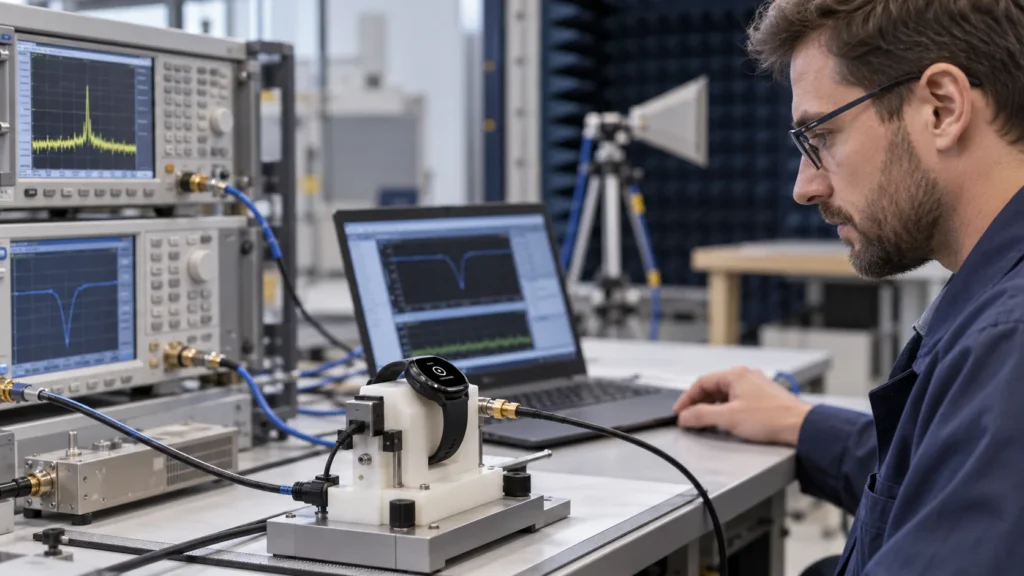
Voice performance depends on the watch hardware and antenna, firmware, SIM, operator, local coverage, call routing and network service. Supporting 4G does not guarantee a successful call in every building or location. Build cases for:
- strong outdoor or indoor service;
- representative weak-signal indoor areas;
- rooms, corridors or lifts commonly encountered in the deployment, where safe and permitted;
- transitions between outdoor and indoor conditions;
- movement through areas with changing coverage;
- call-setup failure, dropped calls and interrupted audio; and
- recovery, retry or user feedback after service returns.
For LTE deployments, confirm how voice service is provisioned on the target operator rather than assuming that successful 4G data registration also proves voice capability. Where the project depends on VoLTE or another operator-supported voice configuration, verify the SIM profile or service entitlement, network support, device firmware and target-operator settings together. Test the exact commercial connectivity configuration planned for deployment.
Record the network and location context without claiming a result for operators or sites that were not tested. When assessing standalone 4G medical alert smartwatch requirements, separate device capability from operator provisioning, SIM policy and local service availability.
When a test fails, isolate the stage before changing the acceptance criteria. Confirm whether the watch registered for service, whether call setup reached the intended destination, whether the connection stayed active and whether the audio path worked in both directions. Compare the failed run with a controlled reference device or location where practical. Repeating the same action without recording these stages can turn an intermittent network, routing or firmware issue into an unexplained “no call” result.
Also repeat the case after a normal device restart and after the approved recovery action. Record whether recovery is automatic, requires wearer input or needs service-team intervention. The expected response must be realistic for the target user; a technically effective procedure is not acceptable if it requires a wearer to navigate settings they cannot reliably access. Any fallback route should be tested independently rather than assumed to work because the primary route failed as designed.
Verify Call States and Service Visibility
The wearer and response team need an accurate picture of what happened. Where the product and platform support these states, verify that initiated, ringing, connected, ended and failed events are distinguishable. Compare device feedback, network or call information, platform records and timestamps.
Do not equate a connected state with an acknowledged alert or a meaningful conversation. A call can connect while audio is unusable, the wrong party answers or the wearer cannot respond. Conversely, a failed call should not disappear from operational visibility if the service is designed to record attempts and exceptions.
Test duplicate events, delayed updates and discrepancies between the watch and platform. Define which source is authoritative for each operational decision. If a state is not available from the product, record the limitation and design the workflow around evidence the system can actually provide.
Create Voice Acceptance Criteria for the Pilot
Convert the results into a controlled acceptance plan. It should identify:
- required inbound and outbound call cases;
- representative users, devices, locations and network conditions;
- the approved firmware, SIM and service configuration;
- observable pass, fail and conditional-pass criteria;
- evidence required for setup, intelligibility, termination and failure handling;
- the owner and priority of each defect;
- retest rules after hardware, firmware, audio or network-related changes; and
- regression cases that must remain stable before rollout.
Avoid a conclusion such as “voice sounded fine.” A pass decision should point to test records and explain any remaining limitations. Plan the pilot as part of the broader healthcare and medical wearable deployment so that wearer onboarding, monitoring operations and response responsibilities are tested alongside the device.
Summarize failures by scenario and cause, not only as an overall pass rate. A program may accept occasional user retraining but reject an unclear failure state, one-way audio or repeated loss of speech in a critical environment. Any conditional acceptance should name the limitation, owner, mitigation and retest date. This gives procurement and operations a decision they can defend and prevents unresolved defects from being hidden inside a favorable average.

Treat Two-Way Voice as a Service Capability
Reliable two-way voice is produced by a chain of components and people, not by a feature label. A sound acceptance process tests call setup, conversation quality, cellular variation, visible states and recovery as one service, while keeping the results tied to the exact configuration and deployment conditions.
WearIntell can review target users, inbound and outbound call requirements, proposed network conditions and pilot acceptance inputs for a medical alert watch project. Bring the intended workflow, markets, SIM or operator assumptions and representative environments to the discussion. The outcome should be a testable plan with explicit evidence—not a promise that one configuration will perform identically for every wearer or location.