
Wearable health monitor sensors determine which physical or physiological signals a device can capture. They do not, by themselves, determine whether the final data will be accurate, useful, or suitable for a particular claim. Firmware, algorithms, mechanical design, wearing conditions, and validation all influence what can responsibly be derived from the signal.
For healthcare brands, remote-monitoring providers, system integrators, and wearable product teams, a longer sensor list is therefore not evidence of a better product. Adding PPG, motion, temperature, or ECG hardware does not automatically establish metric performance or support a medical claim.
This guide compares common wearable health monitor sensors at the component and measurement level, explains their practical limitations, and provides a requirement-led selection process. For the broader path from sensing through firmware, connectivity, apps, and cloud platforms, see how a wearable health monitoring device works.
Start With the Metric, Not the Sensor
Sensor selection should begin with the decision or workflow the product must support. “Include a health sensor” is not a sufficient requirement. A useful specification identifies:
- the intended user and wearing location;
- the signal or metric required;
- whether measurement is continuous, periodic, on demand, or event triggered;
- the conditions in which data must remain usable;
- acceptable invalid-reading behavior and the required output;
- the product claim and target-market requirements.
The same sensor can serve different purposes. An accelerometer may support steps, inactivity, gestures, or fall-related logic, but each use requires different sampling, algorithms, and acceptance criteria. Likewise, a PPG waveform and the metric derived from it are not interchangeable requirements.
A practical product rule is:
Sensor capability does not equal a validated metric, and a validated metric does not automatically support a medical claim.
Validation should match the intended population, operating conditions, reference method, device configuration, and claimed output. A test conducted at rest cannot establish performance during movement or loose wearing.
Common Wearable Sensors at a Glance
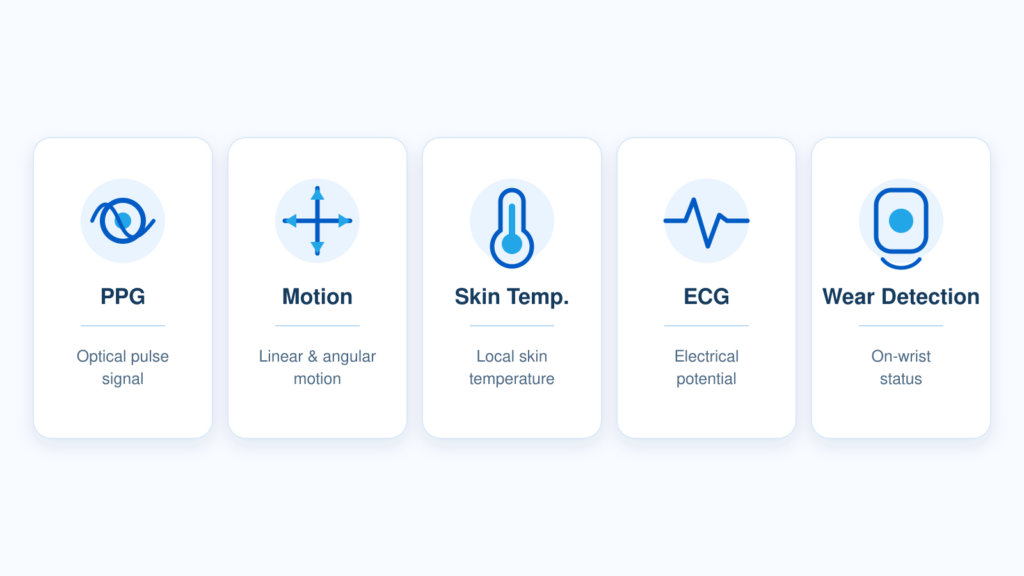
| Sensor | Signal captured | Common product uses | Important limitations |
| PPG | Optical changes associated with blood-volume pulses | Pulse rate, waveform, and selected derived features | Motion, contact, ambient light, skin characteristics, optical design, and algorithms affect quality |
| Accelerometer | Linear acceleration along one or more axes | Activity, steps, gestures, posture-related features, and event logic | Placement and algorithms determine meaning; different movements can overlap |
| Gyroscope | Angular velocity | Rotation, orientation change, gesture detail, motion classification | Uses additional power and cannot identify an activity or event without suitable logic and context |
| Skin temperature | Local temperature near the skin interface | Trends and context for other measurements | Wrist skin temperature is not core temperature; environment and contact affect it |
| ECG electrodes | Electrical potential difference across a measurement path | On-demand single-lead waveform or rhythm analysis | Usually requires contact and stillness; it is not a clinical 12-lead ECG |
| Wear detection | Proximity, contact, optical, capacitive, or combined signals | On-wrist status, data validity, and power control | Loose contact can create uncertain states; it is not a health metric |
Modules in the same category can still differ in wavelength, range, noise, sampling, package design, power, calibration, and long-term availability.
PPG Sensors: Optical Signals and Derived Metrics
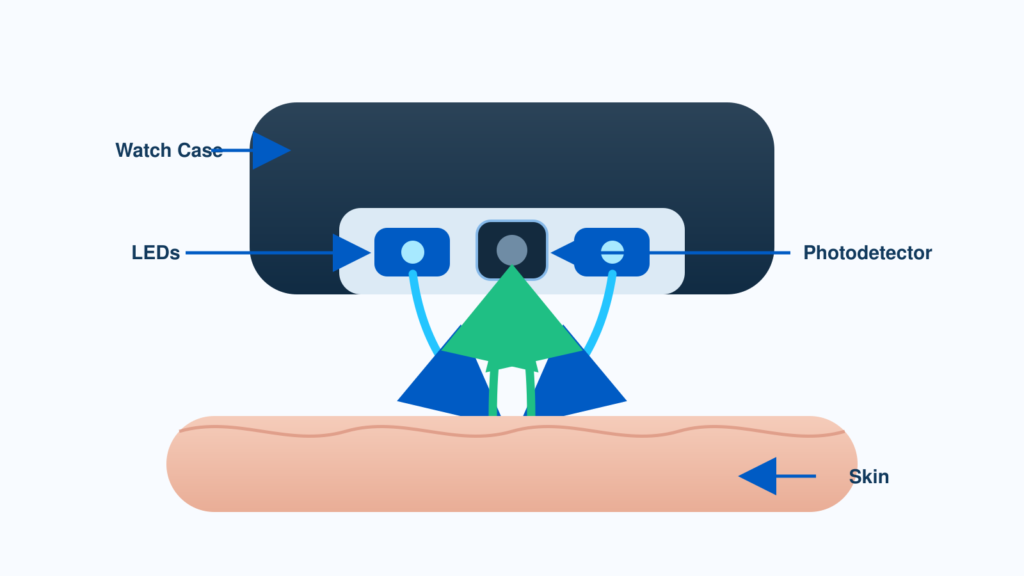
A PPG sensor in a wearable uses light emitters and a photodetector to observe changes in reflected or transmitted light as blood volume changes near the skin. Wrist-worn devices generally use a reflective arrangement: light enters the tissue and the detector measures returning light.
PPG can support pulse-rate estimation and other pulse-derived features. Multi-wavelength designs may support oxygen-saturation estimation when the hardware, mechanics, algorithms, calibration, and validation are appropriate. LED colors alone do not prove that a device can produce a reliable metric.
Signal quality depends on the complete optical and mechanical interface. Motion, strap pressure, placement, ambient-light leakage, emitter–detector geometry, skin characteristics, perfusion, temperature, filtering, and quality logic can all affect the result. Validation should therefore represent actual users, wearing conditions, and activities.
Buyers should define whether they need a displayed metric, quality flag, beat-to-beat information, or underlying waveform—and what happens when signal quality is poor. The device may suppress a value, mark it invalid, or request another measurement.
PPG is not a shortcut to every cardiovascular or metabolic metric. Blood pressure, blood glucose, arrhythmia, respiration, stress, and other derived outputs each need their own rationale and validation.
Motion Sensors: Accelerometers and Gyroscopes
An accelerometer measures linear acceleration, normally across three axes. It is widely used for activity and movement features because it is compact and can operate at relatively low power. A gyroscope measures angular velocity and adds information about rotation.
Together, they may form an inertial measurement unit. Sensor fusion can add context, but accuracy still depends on sampling, range, filtering, placement, features, and classification logic.
A motion sensor wearable may support steps, activity intensity, inactivity, gestures, posture-related features, sleep–wake estimation, or configured movement-event logic. In a medical alert watch, for example, motion sensing may contribute to fall-related event logic, but the product still needs confirmation, communication, location, and response rules appropriate to the service workflow.
The principal limitation is ambiguity. Wrist movement is not always whole-body movement, and activities can overlap. Pushing a cart can reduce wrist motion while walking; repetitive hand movement can resemble steps; a fall-like acceleration does not prove that a fall occurred.
Testing should use the intended wearing position, users, daily activities, edge cases, and enclosure. Event features should measure false alerts and missed events, not only successful demonstrations. Continuous gyroscope use should also justify its power demand.
Skin Temperature Sensors: Trends Need Context
A skin temperature sensor in a wrist wearable measures local temperature at or near the skin–device interface. That value can be useful for trend analysis or as contextual input to another algorithm, but it should not automatically be labeled body temperature or core temperature.
Ambient temperature, airflow, pressure, fit, perspiration, blood flow, activity, charging heat, and sensor location can affect readings. Mechanical design is therefore part of measurement design.
Teams should define whether they need an absolute reading, personal baseline, change from baseline, or context signal. If the output is an estimate of core temperature, the estimation method and inputs must be separately established and validated against an appropriate reference.
Testing can cover environmental transitions, strap fit, stabilization, repeated donning, exercise recovery, and production-unit variation. Stabilizing or off-wrist states should not be treated as valid measurements.
Wearable ECG Sensors: Electrical Measurement Is Different From PPG
A wearable ECG sensor measures electrical potential differences rather than optical blood-volume changes. In many smartwatches, one electrode contacts the wrist and the user touches another electrode with the opposite hand or finger to close the measurement path. The recording is typically on demand and requires the user to remain still.
Unlike PPG, which observes a peripheral pulse optically, ECG records cardiac electrical activity along a defined lead path. The signals can complement one another but are not interchangeable.
Design considerations include electrodes, skin contact, analog front-end performance, noise, sampling, filtering, lead configuration, instructions, and quality detection. Dry skin, movement, weak contact, and interference can reduce waveform quality.
A smartwatch trace is not a standard 12-lead clinical ECG. Rhythm analysis or clinical claims require specific review of intended use, algorithms, users, reference comparison, labeling, and regulation. Electrodes alone do not establish diagnostic performance.
Wear Detection and Other Supporting Sensors
Wear detection may use proximity, capacitance, PPG response, contact, temperature, motion, or combined logic. It can prevent off-wrist values from being treated as valid and reduce unnecessary sensing.
Loose straps, sweat, clothing, reflective surfaces, and movement can create ambiguity. Buyers should define on-wrist, off-wrist, and uncertain states, then specify how each affects measurement.
Other sensors require a specific purpose. Barometers add pressure or elevation context, magnetometers support heading, and GNSS provides position rather than a health signal. Bioimpedance and electrodermal sensing introduce additional contact, power, algorithm, and validation requirements.
The correct question is not “How many sensors can fit in the watch?” It is “Which signal materially improves the required output, and can that improvement be demonstrated under expected conditions?”
How to Select Sensors for a Wearable Project
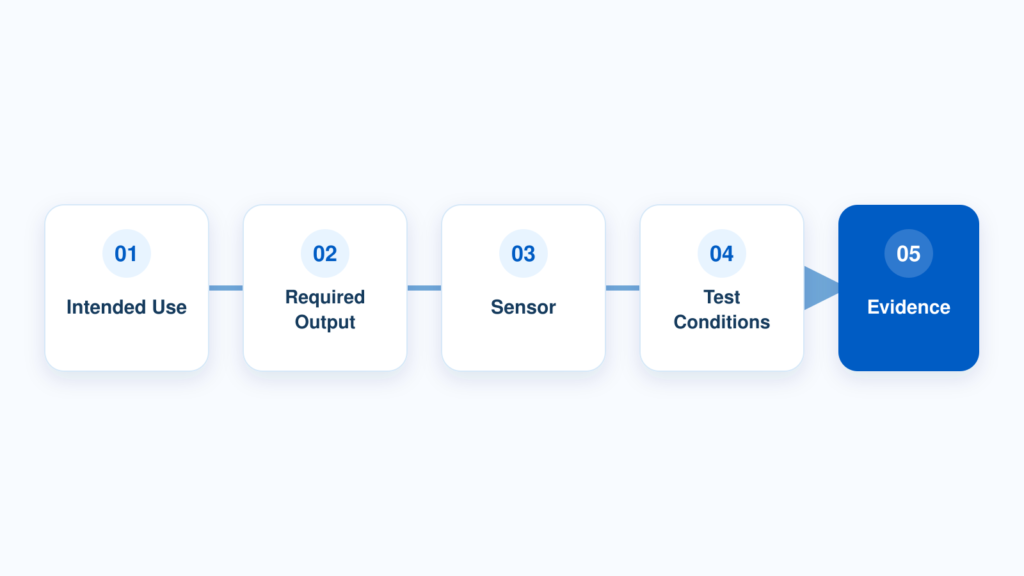
Use a requirement-to-evidence process before locking the hardware:
- Define intended use and claims. State what the product will do, for whom, and in which market.
- Specify the required output. Name the metric, event, trend, waveform, or quality flag—not just the sensor.
- Map the signal source. Determine which sensor or combination can provide the input and supporting context.
- Set operating conditions. Define activity, wear location, fit, contact, environment, and measurement duration.
- Define performance evidence. Set reference methods, participant groups, scenarios, error metrics, invalid-reading rules, and acceptance criteria.
- Evaluate tradeoffs. Review mechanics, sampling, processing, power, heat, waterproofing, cost, and component availability.
- Control the configuration. Link component, calibration, firmware, algorithm, and substitution records to validated and shipped units.
Regulatory status depends on the intended use, claims, device configuration, and target market—not simply on the presence of a health sensor. Product teams should define the claim strategy and required evidence before finalizing hardware, labeling, or commercial specifications.
The best sensor configuration is not the one with the longest feature list. It is the smallest controlled set of sensors that can produce the required output with evidence appropriate to the intended use.
For an OEM/ODM project, WearIntell can help product teams evaluate required signals, mechanical constraints, firmware behavior, power targets, test conditions, and production-transfer requirements before the sensor configuration is locked.
Frequently Asked Questions
Which sensors are most common in wearable health monitors?
PPG and accelerometers are common, while gyroscopes, skin temperature sensors, ECG electrodes, and wear detection may be added for specific requirements. Selection depends on the intended output, conditions, power, mechanics, and claims.
Is PPG the same as ECG?
No. PPG optically observes pulse-related blood-volume changes near the skin. ECG measures electrical potential differences along a lead path. They require different hardware, algorithms, and validation.
Does adding more sensors make a wearable more accurate?
Not necessarily. Another sensor can add context or redundancy, but also adds power, mechanical, calibration, software, and testing requirements. Accuracy depends on the complete measurement system and validation, not the number of sensors.