
How to Plan a Health Monitoring Wearable
Health monitoring wearable development should begin with a product requirement plan, not a sensor list. The first task is to define the intended user, operating environment, required output, and action that follows the data. These decisions shape the hardware, firmware, connectivity, power, interface, validation, and manufacturing requirements.
This guide helps healthcare brands and product teams prepare a practical brief before approaching an OEM or ODM partner. For a technical overview of the data path, see how a wearable health monitoring device works. Here, the focus is turning a product concept into requirements that engineers can evaluate and test.
What a Wearable Product Requirements Plan Must Achieve
A useful requirements document connects a business goal to observable product behavior. It should give product, engineering, software, quality, and manufacturing teams one agreed project definition.
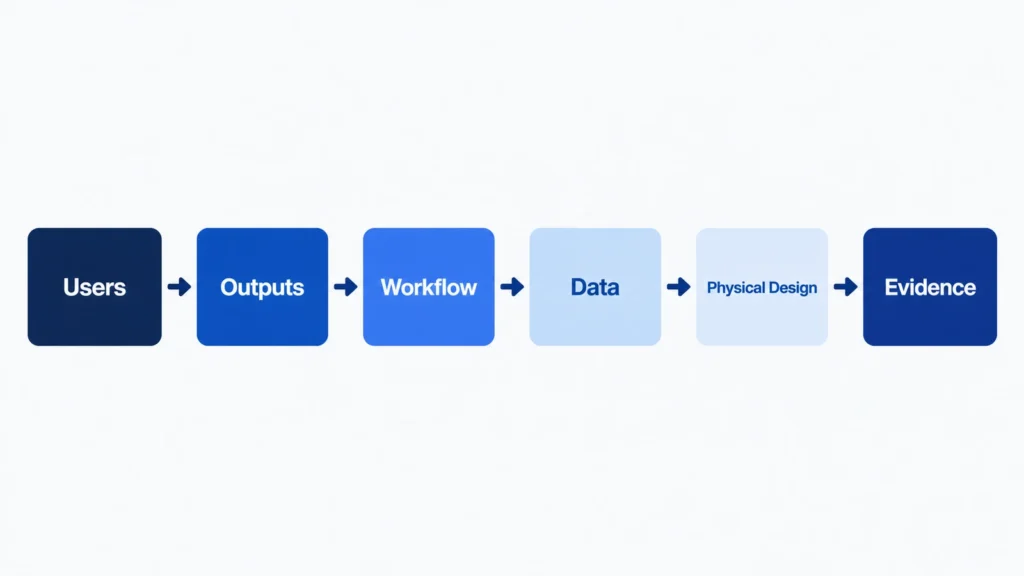
At minimum, the plan should define:
- Who will wear, configure, charge, and support the device
- What data, value, trend, or event the system must produce
- How information is collected, processed, stored, and transmitted
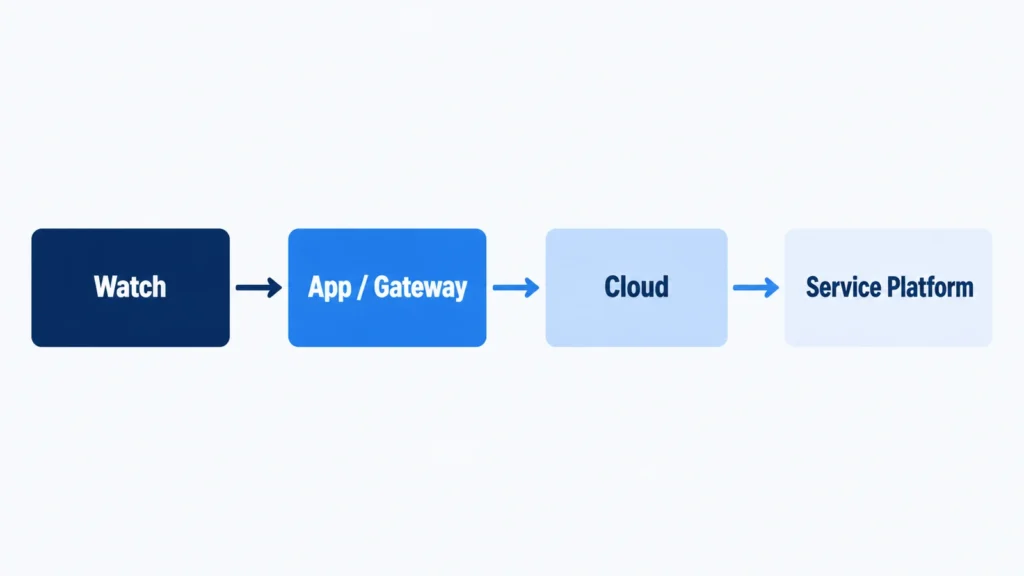
- What happens on the watch, app, cloud, and service platform
- How failure conditions are handled
- Which claims require evidence
- How samples, pilot units, and production units will be accepted
Avoid phrases such as “long battery life,” “accurate monitoring,” or “real-time data.” Replace them with operating conditions, expected behavior, and pass/fail criteria.
| Planning question | Required project output |
|---|---|
| Who is the user? | User profiles, abilities, limitations, and operating environments |
| What must the product do? | Prioritized use cases and system behaviors |
| What data is required? | Data type, format, frequency, latency, and availability rules |
| How will the system connect? | Device, app, gateway, cloud, and platform architecture |
| What are the physical constraints? | Size, comfort, charging, durability, and battery targets |
| How will it be verified? | Test methods, acceptance criteria, and required evidence |
Define the Intended Use and Users
Start with the problem the wearable is expected to support. “Monitor health” is too broad. A clearer use case might be collecting periodic wellness trends, reporting selected data to a remote-care dashboard, or creating an event for staff review.
Define the wearer and every other system user. A device may be worn by an older adult, configured by a family member, monitored by a service team, and maintained by an administrator. Each role creates different interface, permission, alert, training, and support requirements.
Document whether the device will be used at home, outdoors, in a care facility, during exercise, or across several environments. Consider network coverage, moisture, motion, charging access, and incorrect wearing.
Intended use also influences product claims and the evidence needed to support them. Product and regulatory teams should review proposed claims before the hardware specification is frozen.
Define the Required Output Before Choosing Sensors
Requesting every available health feature can add cost and power consumption without proving that the output is useful. Define the required output first.
For every proposed metric or event, specify:
- Raw signal, processed value, trend, or alert
- Continuous, scheduled, on-demand, or event-triggered collection
- Processing on the device, phone, gateway, cloud, or external platform
- Acceptable latency and offline behavior
- Rules for insufficient data quality
- Authorized users and expected follow-up action
A sensor only captures a physical signal. Firmware, algorithms, mechanical contact, calibration, quality rules, and validation determine whether the signal can support the required output. Describe the complete result, not merely the component.
Separate must-have outputs from optional features. This creates a stable baseline for feasibility, quotation, sample testing, and change control.
Map User Actions and Service Workflows
A wearable is one part of a larger process. Map what happens before, during, and after every important action or event.
For a manual measurement, define how it starts, how contact is confirmed, what feedback appears, and what happens if it fails. For scheduled collection, define how missed or low-quality data is recorded. For alerts, define confirmation, cancellation, delivery, acknowledgement, retry, escalation, and closure.
Professional care products involve more than the wearer. A medical alert watch may connect an emergency action with voice, location, caregiver notification, and a monitoring platform. That workflow requires different decisions from a watch that only displays a wellness value.
Document the responsibilities of each component:
- Watch: sensing, local processing, prompts, events, and temporary storage
- App or gateway: setup, synchronization, and user information
- Cloud: storage, accounts, device status, and event routing
- Service platform: dashboards, acknowledgement, escalation, and audit history
Define what users and operators see when a measurement fails, the battery is low, the device is removed, the network is unavailable, or an alert is not acknowledged.
Specify Connectivity and Data Requirements
Connectivity should follow the service model. BLE can synchronize through a nearby phone or gateway. Wi-Fi may suit managed locations. Cellular communication can support independent operation but adds network, SIM, carrier, antenna, and power requirements.
State which connection is primary and which paths are fallbacks. Phone-dependent products need defined operating systems, permissions, pairing, and reconnection. Direct-to-cloud products need provisioning, authentication, delivery, remote configuration, and status reporting.
For each data item, specify:
- Payload fields, units, and timestamps
- Upload frequency and maximum delay
- Offline storage and recovery rules
- Duplicate and synchronization handling
- API, SDK, webhook, or protocol requirements
- Access, retention, deletion, and export rules
Professional deployments may also need enrollment, remote configuration, firmware visibility, over-the-air updates, logs, device status, and account reassignment. These functions affect firmware and backend architecture from the beginning.
Balance Battery, Wearability, and Physical Design
Battery targets must reflect the final operating profile. Sensor sampling, screen use, cellular registration, location, calls, upload intervals, retries, and weak coverage all change runtime.
Create a battery-use scenario rather than specifying only a number of days. Define daily measurements, uploads, screen activations, calls, alerts, location events, and retries, plus the network and firmware conditions used for testing.
Charging is part of usability. Define who charges the device, how often, what confirms correct alignment, and whether service must continue during charging.
Physical requirements should cover:
- Case and strap dimensions for the target users
- Weight, skin contact, and long-duration comfort
- Button force, readability, sound, and vibration
- Sensor contact and ambient-light protection
- Expected moisture, dust, cleaning, and impact
- Charger, packaging, labeling, and accessories
A larger battery changes weight. A new radio affects antenna space and power. Tighter sensor contact may reduce comfort. Make these trade-offs visible before tooling begins.
Align Claims, Markets, Privacy, and Validation
Do not assume one certification package applies to every wearable. Requirements depend on intended use, claims, radio, battery, materials, software, data processing, and target markets.
Create a market matrix listing each country, sales channel, proposed claims, language, radio configuration, data route, and responsible legal entity. Specialists can then determine the applicable pathway and evidence.
Privacy and security requirements should identify what data is collected, why it is needed, where it is processed, who can access it, and how long it is retained. Assign responsibilities across the device, app, cloud, customer platform, and external services.
Tie validation to claims and operating conditions. Define the target population, reference method where relevant, environment, sample size, device configuration, exclusions, and acceptance threshold. A component specification is not a general performance claim.
Build a Prototype-to-Production Acceptance Plan
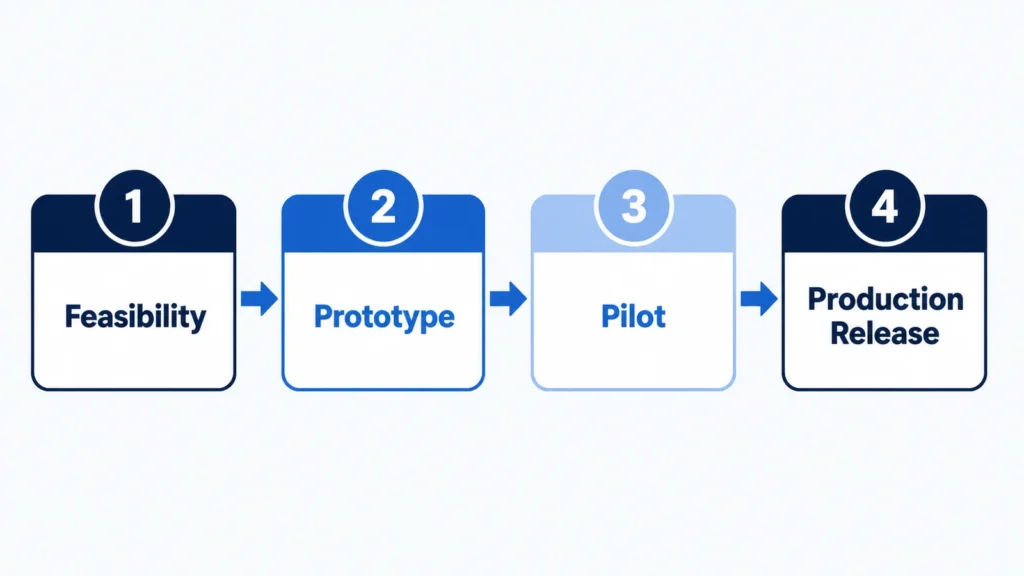
A project needs measurable exit criteria. Prototypes test feasibility and integrated functions. Pilot production evaluates repeatability, assembly, fixtures, firmware control, packaging, and field operation. Production approval confirms that the released configuration matches the approved design.
Use a traceability matrix to connect every requirement with its owner, design output, verification method, result, and release status.
| Stage | Main question | Typical approval evidence |
|---|---|---|
| Feasibility | Can the concept work on the proposed platform? | Technical evaluation and risk list |
| Prototype | Do core functions operate together? | Test results, logs, and issue closure |
| Pilot | Can the design be built and tested consistently? | Pilot yield, fixture results, and batch records |
| Production release | Is the approved configuration controlled? | Released BOM, firmware, procedures, and acceptance records |
Test normal use, edge cases, and failures, including poor connectivity, low battery, incorrect wearing, interrupted charging, delayed synchronization, invalid data, and update failure. Field pilots should represent the intended users and environments.
Every unresolved issue needs an owner, severity, workaround, and closure criterion. Later changes should be reviewed for their impact on hardware, software, testing, compliance, schedule, and cost.
A Practical Brief to Send an OEM or ODM Partner
Before requesting a quotation, prepare a concise package containing:
- Product purpose, users, and environments
- Prioritized use cases and outputs
- User roles, interfaces, and workflows
- Hardware, battery, and charging constraints
- Connectivity, platform, API, and fleet requirements
- Target markets, claims, and compliance responsibilities
- Data, security, and ownership expectations
- Sample, pilot, and production acceptance criteria
- Volume, schedule, support needs, risks, and open decisions
A capable supplier should separate available functions from new development, identify dependencies, explain trade-offs, and show how each requirement will be verified. Quotations prepared without these boundaries often hide assumptions.
Conclusion
Successful health monitoring wearable development begins with the user, required output, workflow, and acceptance evidence. Sensors and features come later. Testable requirements help teams compare options, control changes, and move toward production with fewer hidden gaps. WearIntell supports healthcare wearable projects across product planning, hardware, firmware, connectivity, applications, testing, and production transfer. A structured brief gives customers and engineers a stronger basis for selecting the right development path.
FAQs
What should be defined first in a health monitoring wearable project?
Define the intended use, users, environment, required output, and follow-up action before selecting sensors or requesting a quotation.
Should a wearable product requirements document include the app and cloud platform?
Yes. Include the responsibilities, interfaces, data rules, and failure behavior of every app, gateway, cloud service, API, or dashboard in the system requirements.
When is a health monitoring wearable ready for mass production?
It is ready after the released configuration meets acceptance criteria and pilot production demonstrates repeatable assembly, testing, firmware control, and performance under intended conditions.