
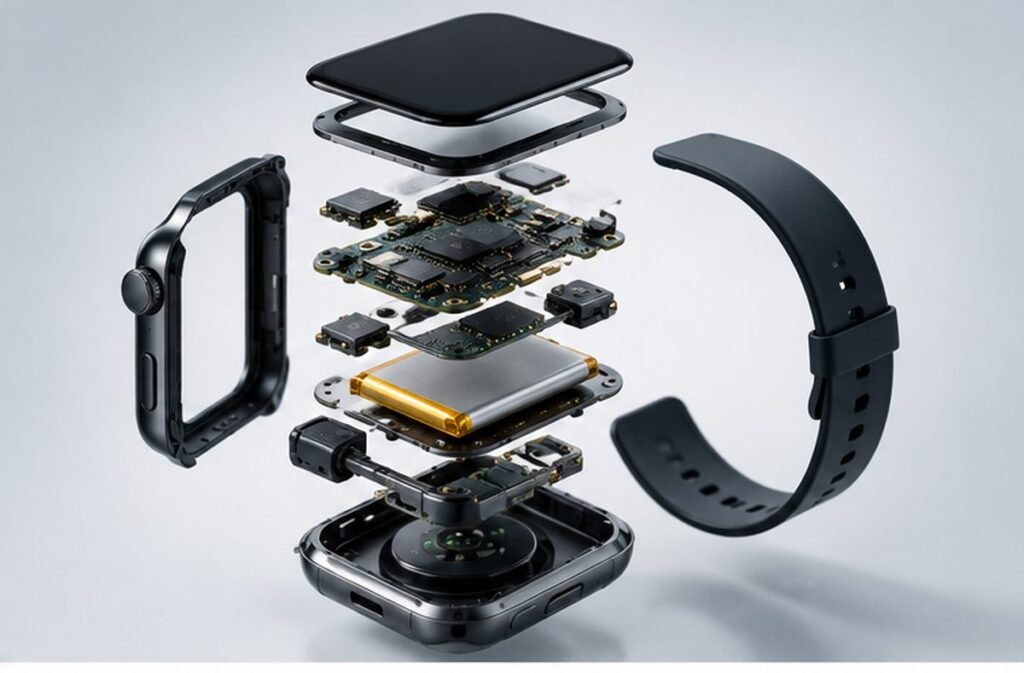
A smartwatch may contain a processor, memory, sensors, connectivity hardware, display, battery, antennas and multiple supporting circuits. The challenge is not simply identifying these parts. It is choosing an architecture in which they work together.
For a custom wearable, product requirements should drive component decisions.
Standalone cellular connectivity, frequent location use or continuous sensing can affect several parts of the hardware at once. This means component selection should begin only after the product team has defined what the watch is expected to do.
What Are the Main Hardware Components of a Smartwatch?
The exact architecture varies by product, but a connected smartwatch can include:
- MCU, application processor or SoC
- RAM and non-volatile memory
- PCB
- Display and touch interface
- Bluetooth, Wi-Fi or cellular hardware
- GNSS
- Motion and application-specific sensors
- Antennas
- Battery
- Power-management and charging circuits
- Speaker, microphone and haptic hardware
- Buttons and other physical interfaces
- Enclosure and sensor-facing mechanical parts
This list describes the building blocks.
It does not tell a product team which specific architecture is appropriate.
That decision depends on the intended application.
Translate Product Requirements Into Hardware Requirements
Before comparing components, define the product behavior.
Useful questions include:
- Must the watch operate independently of a smartphone?
- Is cellular connectivity required?
- Does it need location positioning?
- Is two-way voice required?
- What events must the sensors detect or measure?
- What type of display interaction is expected?
- What runtime target is required?
- What case dimensions are acceptable?
- What platform or application must the watch connect to?
This article assumes that the product concept and primary use case have already been defined.
The next task is translating those requirements into hardware.
For example, a fall detection watch may need motion sensing, cellular communication, positioning and an SOS workflow. Those functions influence the processor, connectivity architecture, antenna system, battery and mechanical design together.
That is why selecting components independently often leads to redesign later.
Processor: Match Computing Capability to the Workload
The processor can coordinate:
- User-interface logic
- Sensor processing
- Connectivity
- Audio
- Application logic
- Security functions
- Data handling
- Power states
The right processor should provide enough performance for the required tasks without adding unnecessary complexity.
Important selection criteria can include:
- Processing workload
- Peripheral interfaces
- Memory architecture
- Power modes
- Software ecosystem
- Connectivity integration
- Operating-system requirements
- Component availability and lifecycle
A higher-performance processor is not automatically a better choice.
If the product has limited UI, event-based sensing and relatively simple logic, excess processing capability may add cost and power requirements without improving the user experience.
On the other hand, a product with cellular communication, graphics, audio and multiple local applications may require considerably more processing headroom.
The component should match the architecture rather than a benchmark number.
Memory and Storage Should Follow the Software Architecture
RAM and storage requirements depend on what the watch must run and retain.
RAM may be influenced by:
- Operating system
- UI complexity
- Communication stacks
- Sensor processing
- Concurrent tasks
Storage may be needed for:
- Firmware
- Application assets
- Local records
- Device logs
- Offline data
- OTA update packages
A smartwatch that uploads most information immediately may have different storage needs from a device that has to continue recording through periods without connectivity.
Memory should therefore be specified from system behavior rather than copied from another product.
PCB Design Determines How Components Work Together
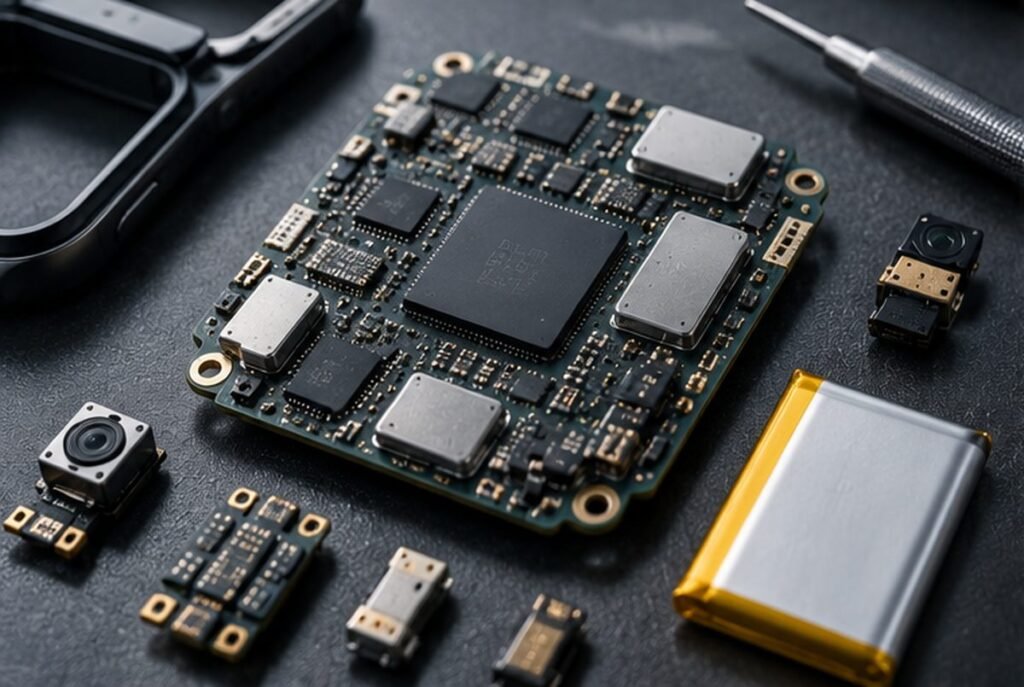
The PCB connects almost every electronic subsystem.
In a smartwatch, it has to fit into a very small volume while supporting:
- Processor and memory
- RF components
- Sensors
- Power management
- Charging circuitry
- Audio
- Display interfaces
- Antenna connections
- Test points
Board shape and component placement matter because the PCB shares the enclosure with the battery, antennas, display and sensors.
Engineers may need to evaluate:
- RF routing
- Power routing
- Antenna clearance
- Sensor placement
- Charging-interface position
- Manufacturing access
- Board-to-enclosure fit
A schematic can be electrically correct while still producing a difficult product if the PCB cannot coexist with the mechanical and RF architecture.
For this reason, smartwatch hardware customization should treat schematic design, PCB layout, component selection and enclosure requirements as connected engineering activities.
Display Selection Should Reflect the User Workflow
The display affects both user interaction and hardware integration.
Important requirements can include:
- Screen size
- Resolution
- Brightness
- Touch support
- Display technology
- Viewing conditions
- Frequency of interaction
The largest or highest-resolution display is not automatically the best option.
A safety-oriented watch used by older users may prioritize readability and simple interaction. A background-monitoring wearable may require much less screen activity.
Display selection also affects:
- Front-enclosure design
- Power consumption
- Internal space
- PCB layout
The component should therefore follow the intended user workflow rather than consumer-electronics specification trends.
Choose Connectivity Based on How the Watch Will Operate
Different wireless technologies solve different product problems.
Bluetooth
Bluetooth is commonly used for short-range communication with a smartphone or nearby device.
It can be suitable when the wearable does not need independent wide-area connectivity.
Wi-Fi
Wi-Fi may be useful where local network access is part of the product workflow.
Its inclusion also introduces RF, software and power requirements that need to be justified by the actual use case.
Cellular
Cellular connectivity allows a watch to communicate independently of a nearby phone.
That may be important for:
- Personal safety
- Telecare
- Standalone voice
- Remote monitoring
- Wide-area data communication
Cellular selection affects more than the modem. It also changes antenna, PCB, power and certification requirements.
GNSS
GNSS can provide satellite-based positioning.
The relevant design question is not simply whether GNSS is present, but how location is expected to support the product.
Frequent positioning and occasional event-based positioning can create different requirements for power, antenna integration and system behavior.
Connectivity architecture should therefore be selected as a complete system.
Choose Sensors From the Required Output
Sensor selection should start with what the product needs to detect or measure.
Possible sensor categories include:
- Accelerometer
- Gyroscope
- Optical sensing
- Temperature sensing
- Environmental sensing
- Application-specific sensors
Relevant selection criteria can include:
- Required signal
- Operating range
- Sampling behavior
- Power requirements
- Mechanical placement
- Interface
- Algorithm needs
For example, adding an optical sensor also creates requirements for the rear housing and wrist-facing optical path. A motion sensor used in an event-detection workflow may need appropriate placement and firmware logic.
The sensor itself is therefore only one part of the system.
For a deeper explanation of sensor roles, limitations and selection criteria, see our guide to wearable health monitor sensors.
Where a product is intended to support health-related functions, measurement performance and any associated claims should be verified separately rather than assumed from the presence of a sensor.
Battery and Power Management Should Follow the Architecture
The battery supports the complete system, including:
- Processor
- Display
- Connectivity
- GNSS
- Sensors
- Audio
- Haptics
At the component-selection stage, the main goal is not to calculate the entire power budget again. It is to make sure the selected hardware can support the intended runtime and fit within the available mechanical space.
Battery-related decisions may include:
- Cell capacity
- Physical dimensions
- Charging controller
- Protection
- Power regulation
Detailed system power budgeting should be handled separately from general component selection.
Antenna Requirements Need to Be Considered Early
A connected smartwatch may require antennas for:
- Cellular
- GNSS
- Bluetooth
- Wi-Fi
Antenna performance depends on more than the antenna component itself.
It can be influenced by:
- PCB geometry
- Ground structure
- Battery position
- Display
- Metal parts
- Enclosure material
- Available clearance
This is why antenna planning should start before PCB and enclosure layouts are frozen.
A product concept may appear mechanically attractive while leaving too little suitable space for RF integration.
Component selection therefore needs to account for where those components will actually operate inside the device.
The Enclosure Is Another System Component
The enclosure provides more than cosmetic packaging.
It can include:
- Housing
- Rear cover
- Sensor window
- Buttons
- Charging interface
- Speaker and microphone openings
- Seals
- Strap attachment
These mechanical elements affect how the electronics are integrated and how the finished product is worn.
Detailed decisions about materials, sealing, sensor contact and antenna interaction belong to mechanical enclosure design rather than general component selection.
The important point at this stage is simply to reserve appropriate physical interfaces for the selected electronic architecture.
Hardware Components Cannot Be Selected Independently
The dependencies between components become clearer when product requirements are compared directly.
| Product Requirement | Components Affected | Typical Trade-Off |
| Standalone cellular | Modem, antenna, PCB, battery | Connectivity vs. power and space |
| Frequent GNSS positioning | GNSS, antenna, battery | Location availability vs. energy demand |
| Large interactive display | Display, battery, enclosure | User experience vs. size and power |
| Continuous sensing | Sensors, processor, battery | Data availability vs. system load |
| Slim device | PCB, battery, antenna | Compactness vs. integration space |
| Two-way voice | Cellular, audio, processor | Communication features vs. hardware complexity |
This is the central principle behind custom smartwatch hardware design.
A component should not be judged only by how impressive its individual specification appears.
It should be judged by whether it helps the entire product meet its requirements.
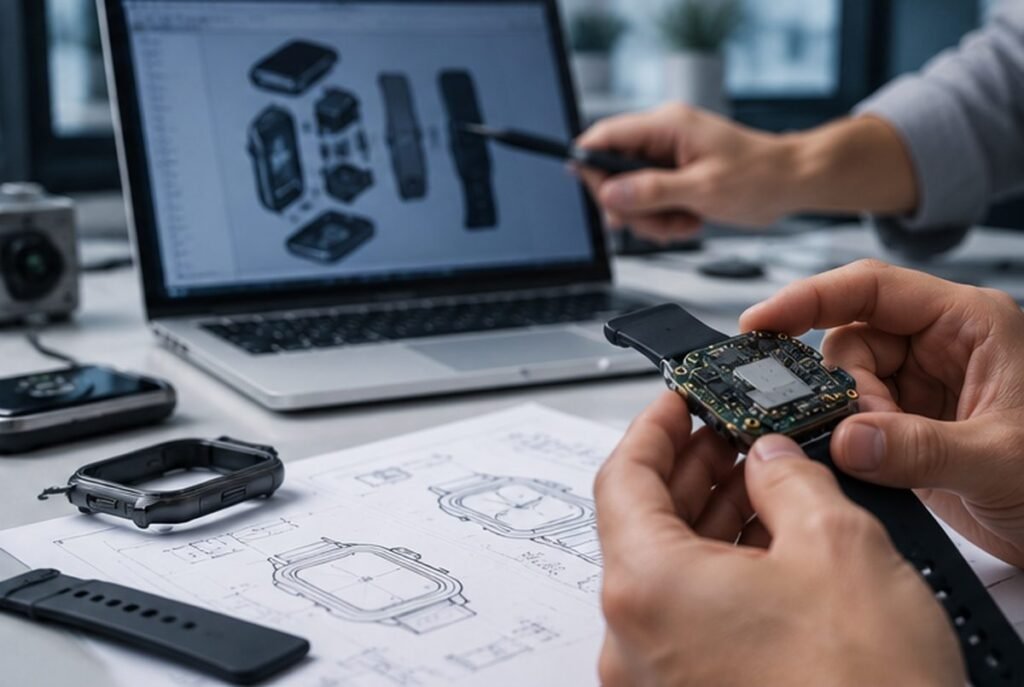
From Component Selection to Prototype Verification
Once the architecture and components are defined, the project typically progresses through:
Requirements → architecture → component selection → schematic → PCB → prototype → verification → revision
Prototype verification can evaluate:
- Electrical function
- Connectivity
- RF performance
- GNSS behavior
- Sensor operation
- Charging
- Power
- Display
- Mechanical integration
Datasheets describe individual components. They cannot prove that the complete smartwatch will behave correctly once everything is assembled.
This is why prototype verification remains necessary even when established components are selected.
Questions to Prepare Before Selecting Hardware
A useful hardware brief should answer:
- What must the smartwatch do independently?
- Is cellular required?
- Is voice required?
- Is location required?
- Which sensors are necessary?
- What display interaction is expected?
- What runtime target applies?
- What device dimensions are acceptable?
- How will the product charge?
- What application or cloud platform must it connect to?
- Which markets will the final product target?
The product team does not need to know the exact part number of every component before beginning engineering work.
It does need to define what the finished device is expected to achieve.
Choose the System Before Locking the Parts
There is no universally best processor, sensor, display or battery for a smartwatch.
The correct hardware depends on the relationship between functionality, connectivity, power, software, mechanical space and validation requirements.
Defining those relationships before individual components are locked can reduce avoidable redesign later in the project.
If you already have a product concept or preliminary specification, WearIntell can help translate those requirements into a practical smartwatch hardware architecture and prototype development path.