
A GPS fall detection watch should send more than a map pin after an alert. A responder needs the event time, location time, positioning source, and a clear current, last-known, pending, or unavailable state. Without that context, a precise-looking coordinate can be misleading. For personal safety providers, care programs, and monitoring platforms, location is an event-data problem as much as a positioning feature. The payload should preserve time, source, freshness, and uncertainty.
Separate the Fall Event Time From the Location Time
A fall alert can contain several legitimate timestamps. They describe different actions and should not be collapsed into one “alert time.”
| Timestamp | What it represents | Why it matters |
|---|---|---|
| Device event time | When the watch created or confirmed the automatic fall event | Establishes when the incident workflow began, even if transmission was delayed |
| Location time | When the reported position was acquired or estimated | Shows whether the map result relates closely to the event or reflects an older movement |
| Server receipt time | When the backend received the event or location update | Reveals communication delay and supports retry analysis |
| Display time | When the app or operator interface rendered the data | Helps diagnose UI or notification delay but should not replace the underlying event times |
Consider a watch that creates a fall event at 14:03. The last successful position was acquired at 13:56, the backend receives the alert at 14:04, and a fresh location arrives at 14:06. Showing only the 14:04 server time beside the old coordinate could make the location appear current. The interface should instead label the initial result as last-known, show its age, and then add the later update to the same event.
If the watch reconnects after an interruption, the server receipt time may be much later than the device event time. Preserving both prevents a delayed upload from appearing to be a new fall. Teams evaluating position performance can use the methodology to test GPS watch accuracy in real-world conditions; this workflow focuses on communicating the result.
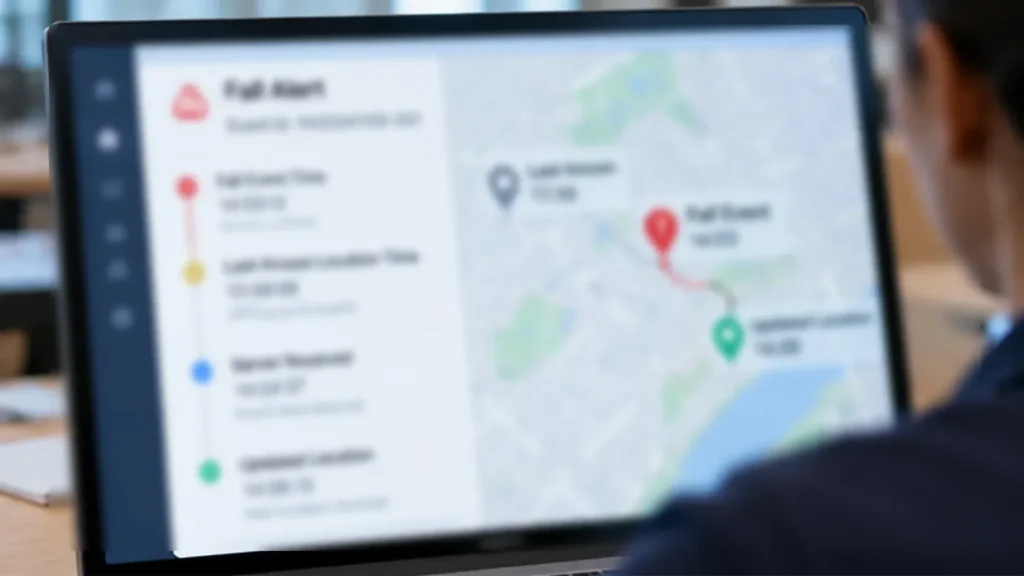
The location state should be explicit before a responder interprets the coordinates.
- Current: A position was acquired within the service’s defined freshness rule and is associated with the active incident. “Current” should be based on a documented threshold, not a visual assumption.
- Last-known: The system has an older valid position but no fresh result for the event. The interface should show the location time or age and avoid presenting it as the wearer’s confirmed present position.
- Pending: The event has been created and transmitted, while the device or platform is still trying to obtain or deliver a position. Pending is a temporary state, not a reason to hold the alert unless the service specifically requires it.
- Unavailable: No usable position is available under the current conditions or after the defined attempt. The alert can still continue through voice, caregiver, or monitoring routes.
- Delayed: A position exists but reaches the platform after the initial alert. It should be linked to the original event with its own acquisition and receipt times.
These states should not silently replace one another. If a last-known point is displayed while a fresh fix is pending, show both facts. When a fresh result arrives, add it to the event history. An older point may still identify a building or route, but the responder must be able to distinguish “last seen here before the event” from “current location confirmed here.”
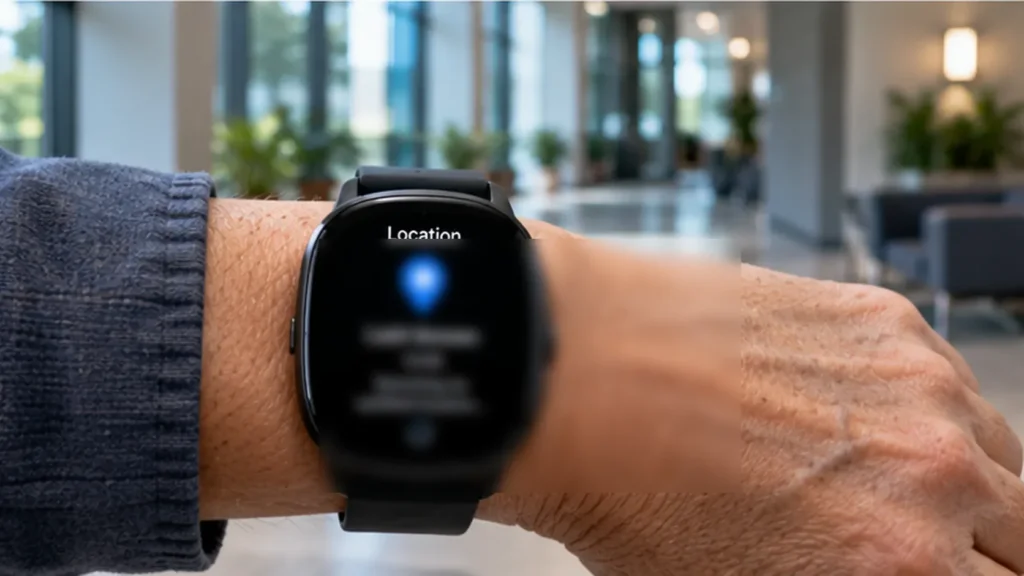
Record Which Positioning Source Produced the Result
Not every coordinate displayed by a watch or platform comes from GNSS. Depending on the hardware, firmware, environment, and service design, the position may use GNSS/GPS, Wi-Fi-assisted positioning, cellular or network-assisted methods, or another supported source. Calling every result “GPS” hides this distinction.
The source helps teams interpret uncertainty. Satellite positioning behaves differently near tall buildings or indoors, while Wi-Fi-assisted or network-derived positions may provide context where satellite signals are limited. No source has a universal accuracy figure.
Where exposed, record the source for each position and show any transition, such as a last-known GNSS point followed by a Wi-Fi-assisted indoor estimate. Source and freshness answer different questions: a recent assisted result may be more useful than an old satellite point, while a fresh GNSS result can still carry substantial uncertainty.
What Fields Should Be Included With a Fall Alert?
The minimum field set should support identification, interpretation, correlation, and response. The following is a design checklist, not a public WearIntell API schema.
| Field | Purpose | Required or conditional |
|---|---|---|
| Event ID | Correlates the initial alert, retries, channel notifications, and later location updates | Required |
| Event type and source | Distinguishes automatic fall detection from manual SOS or another trigger | Required |
| Device ID | Identifies the reporting watch within the authorized service | Required |
| User or account reference | Connects the event to the correct service record, subject to privacy design | Conditional |
| Device event time | Preserves when the watch created or confirmed the incident | Required |
| Location status | States current, last-known, pending, delayed, or unavailable | Required |
| Latitude and longitude | Supplies the position when available | Conditional |
| Location time | Shows when the coordinate was acquired or estimated | Required when coordinates are present |
| Positioning source | Identifies GNSS, Wi-Fi-assisted, cellular/network-assisted, or another supported method | Conditional on system support |
| Accuracy or uncertainty | Communicates the available confidence measure without overstating precision | Conditional on system support |
| Server receipt time | Shows when the backend received the record or update | Required at the backend |
| Battery and connectivity context | Helps explain operational limits when relevant to response | Conditional |
Coordinates without status and time are incomplete. An accuracy or uncertainty value should appear only when the source, meaning, and unit are defined. The payload should also minimize data: collecting health measurements does not make them necessary for a fall alert. Authorized roles should govern access to identity, precise location, history, and diagnostics.
How Should the Platform Update Location After the Initial Alert?
The initial alert should not normally wait indefinitely for a fresh position. If the event is ready but location is pending, the platform can notify the approved recipient with a pending state, then append the position when it arrives. This lets the response begin without turning location acquisition into a single point of failure.
Every later update should carry the same event ID, location time, source, status, and server receipt time. Preserve the original record so the system can show what the responder knew at each stage.
Networks may deliver messages out of order. The backend should compare acquisition times and event IDs rather than treating the last packet received as the freshest location, and retries should not create duplicate incidents.
The wider event contract—including authentication, retries, state transitions, and correlation with other alert data—belongs in the medical alert watch monitoring platform integration design. Within the fall alert, the location timeline should remain understandable to both operators and technical teams.
What Should the Responder See When Location Is Weak or Missing?
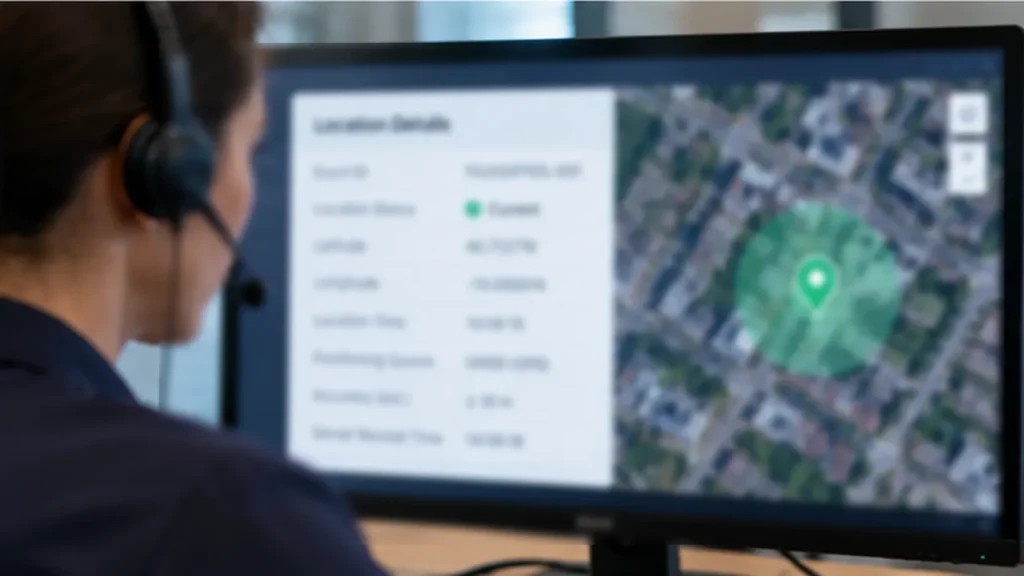
The interface should state what is known without hiding limitations. For a current position, show the acquisition time and source where useful. For a last-known point, show its age prominently. For pending location, tell the responder that the system is still waiting for an update. For unavailable location, keep the incident visible and present the other approved response routes.
Avoid a map pin that appears authoritative when the state is uncertain. Label an approximate area, and show unavailable rather than reusing an old point without context.
Weak or missing location should influence the response script. A caregiver may call the wearer, check an authorized address, or contact a care team, but the platform must not imply that an unconfirmed location is current.
The same principles apply across GPS tracking and personal safety wearables, but a fall alert specifically requires timing and event correlation. The responder must know whether a position describes the incident, an earlier moment, or a later update.
Validate the Alert-Location Contract Before Deployment
Validate the exact watch, firmware, SIM and operator, backend, platform, and target environment. A specified field is not proven until its value and state transitions appear correctly end to end.
Test at least these cases:
- a fall event with an immediate fresh position;
- an event sent first while location remains pending;
- a last-known point whose age is clearly displayed;
- a later position update linked to the original event;
- a source change between outdoor and indoor conditions;
- no fresh position while voice or another response route continues;
- network delay followed by queued event and location delivery; and
- out-of-order or duplicate location messages after reconnection.
For each case, retain the device event time, location time, source, status, server receipt time, event ID, and interface record. Compare what the operator saw with the underlying event logs. Confirm that the fall detection watch trigger remains separate from the location state and that unavailable location does not become a false “no incident” result.
Acceptance criteria should require a visible pending state, an age label for last-known data, event-ID continuity for updates, and protection against an older queued point silently overwriting a fresher position.
Conclusion
A usable GPS fall-alert record answers five questions: what event occurred, when it occurred, what location is available, when and how that location was produced, and how certain the system is. A map pin alone cannot answer them.
Share the required event fields, positioning sources, target environments, and platform behavior for your deployment. WearIntell can review the fall-alert location workflow and define pilot cases for current, last-known, pending, delayed, and unavailable states.
Frequently Asked Questions
Should a fall alert wait for GPS before being sent?
Not necessarily. A service can send the fall event while location is pending and add a correlated update later. The approved behavior depends on the deployment model, but the interface should not hide the pending state or block other response routes without a defined reason.
What is the difference between current and last-known location?
Current location meets the service’s defined freshness rule for the active incident. Last-known location is an older valid result retained because no fresh position is available. It should always include time or age context and must not be presented as confirmed current position.