
A telecare wearable pilot should not be the first time a project discovers whether SOS transmission, connectivity or platform integration works.
Those technical requirements should already have been validated.
The purpose of the pilot is different: to determine whether an approved wearable and service model can operate successfully with representative users, staff and support processes before deployment expands.
That makes the pilot an operational decision gate between technical acceptance and wider rollout.
A strong pilot produces evidence about user fit, staff readiness, support workload and unresolved risks. Its final output should be a clear decision to proceed, correct specific issues, extend the trial or stop expansion.
Set Entry Criteria Before Starting the Pilot
A project should not enter user pilot simply because sample watches have arrived.
Define the conditions that must already be complete.
Typical entry criteria include:
- The device model has been selected.
- The pilot firmware and configuration have been approved.
- Required connectivity and platform functions have passed technical acceptance.
- The intended alert and response workflow is documented.
- Devices can be assigned to the correct users.
- Training and support materials are available.
- Responsible teams know their roles.
- A process exists for reporting and managing issues.
If fundamental device or integration testing remains unresolved, complete that work before placing the burden on pilot participants.
For projects still defining standalone connectivity, event behavior or platform requirements, use the relevant standalone medical alert smartwatch specification before treating the activity as a user pilot.
Define the Decision the Pilot Must Make
“Test the watch” is too broad.
The pilot should answer a limited set of operational questions.
For example:
- Can intended users wear and operate the watch with the planned level of support?
- Can the charging routine be sustained in normal daily use?
- Do staff understand which conditions require action?
- Can support teams identify and resolve recurring operational problems?
- Are the training materials sufficient?
- Are remaining limitations acceptable for wider deployment?
- Can the organization support a larger user group without relying on temporary pilot-only resources?
Give each question an evidence source and a decision owner.
This makes the final review much easier because the pilot is gathering information against agreed questions rather than collecting unrelated comments.
Select Representative Participants

A pilot built only around confident technology users can produce a misleading result.
The participant group should reflect the variation expected after rollout.
Depending on the intended service, differences may include:
- Ability to see or hear device prompts.
- Hand dexterity.
- Familiarity with wearable technology.
- Mobility and daily routines.
- Ability to charge independently.
- Frequency of staff or family support.
- Likelihood of keeping the watch on.
- Different living or care environments.
The objective is not to make the pilot statistically universal.
It is to expose the operational differences most likely to matter when the service expands.
Participant selection should also identify cases that require additional support. A pilot should not hide these needs by providing every participant with intensive assistance that will disappear after rollout.
WearIntell’s elderly care wearable solution supports project paths from device configuration and integration through pilot evaluation and wider deployment.
Test the Intended Support Model, Not an Ideal One
Pilot conditions should resemble the planned operating model.
If users will normally receive limited assistance, do not provide continuous one-to-one supervision simply because the devices are part of a pilot.
If staff will manage many users after rollout, do not rely on one project engineer to manually resolve every routine issue.
Observe how the intended operating team handles:
- Initial device handover.
- User questions.
- Charging assistance.
- Device replacement.
- Assignment problems.
- Routine support requests.
- Escalation to technical teams where necessary.
A pilot is valuable partly because it shows whether the organization around the device is ready.
Excessive temporary support can make a weak service model appear successful.
Establish One Pilot Baseline
The pilot needs a controlled starting point.
Record:
- Device model and revision.
- Firmware version.
- Approved configuration.
- User-assignment method.
- Training material version.
- Support procedure.
- Response-policy version.
- Pilot participant or site group.
If a material change occurs during the pilot, record when it happened and who was affected.
For example, changing the charging instructions may be a reasonable corrective action. The results collected before and after that change should not be treated as though the same process was used throughout.
The same principle applies to configuration or firmware changes.
The pilot is not required to remain completely static, but it should remain traceable.
Observe User Fit Through Actions
User feedback matters, but satisfaction alone is not enough.
A participant may say the watch is easy to use while still needing repeated unplanned help.
Observe whether users can perform the actions relevant to the service.
These may include:
- Putting the watch on correctly.
- Keeping it on during the expected wearing period.
- Finding the SOS control.
- Understanding essential feedback.
- Responding to a voice interaction where required.
- Completing the normal charging routine.
- Putting the watch back on afterward.
- Knowing how to request support when something appears wrong.
Record the level of assistance required.
This distinction is important. Completing a task independently is different from completing it after repeated staff intervention.
The pilot should determine whether the required level of support matches what the service can provide after rollout.
Track Operational Exceptions
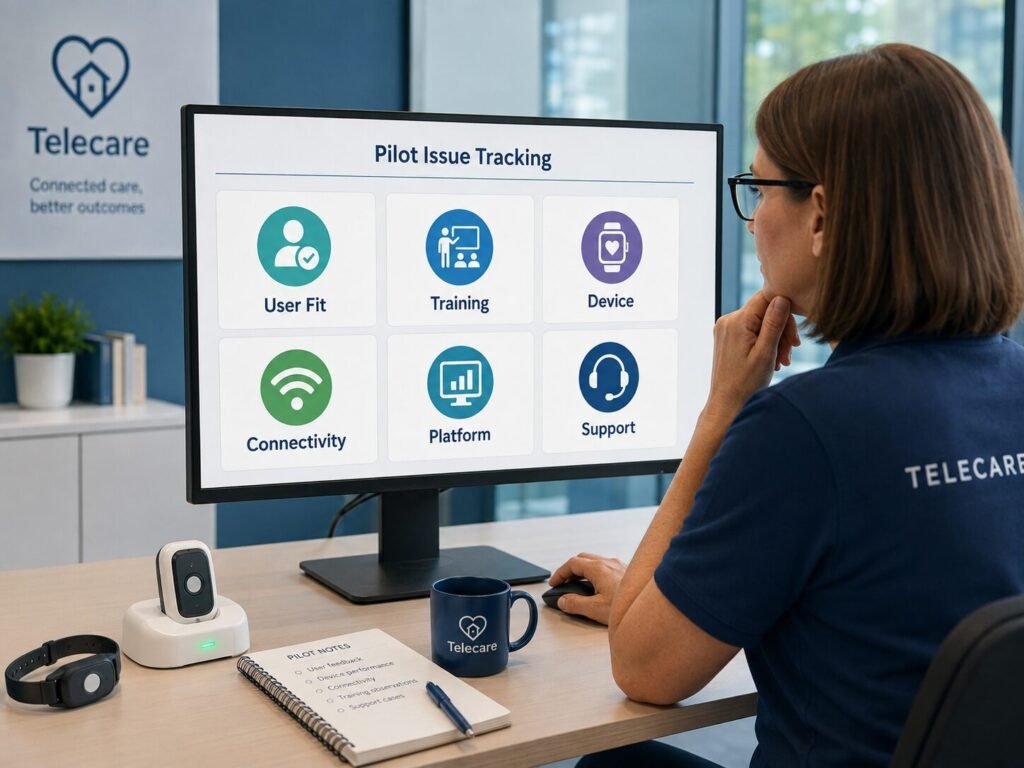
Not every pilot issue is a product defect.
An effective issue register should distinguish different causes.
Suggested categories include:
- User fit.
- Training.
- Support process.
- Device configuration.
- Hardware.
- Connectivity.
- Platform.
- Assignment or provisioning.
- Response procedure.
For each issue, record:
- What happened.
- User or device reference.
- Operational impact.
- Category.
- Owner.
- Corrective action.
- Whether retesting is required.
- Final status.
This prevents two common mistakes.
The first is classifying every problem as “user error.”
The second is treating every difficulty as evidence that the device itself has failed.
For example, repeated missed charging may be caused by the charger design, unclear instructions, an unsuitable routine or insufficient planned support. The corrective action depends on the actual cause.
Look for Patterns, Not Just Individual Incidents
A pilot becomes more useful when issues are reviewed across participants.
One user requiring additional help may be an individual support need.
The same issue appearing across many users may indicate a wider problem.
Look for patterns such as:
- Users repeatedly removing the watch.
- Users forgetting to put it back on after charging.
- The same instruction being misunderstood.
- Staff repeatedly escalating the same routine issue.
- Support teams lacking information needed to investigate.
- Device assignment mistakes occurring during handover.
- Different teams interpreting the same procedure differently.
Patterns are particularly important when deciding whether a problem can be solved before rollout.
A localized issue may require an individual adjustment. A systemic issue may require a change to training, workflow, support capacity or the product configuration itself.
Review Organizational Readiness
User acceptance is only half of the pilot.
The service also needs to prove that it can operate the wearable at a larger scale.
Review whether the organization can manage:
- Device assignment.
- User onboarding.
- Training.
- Routine support.
- Replacement devices and accessories.
- Escalation of technical issues.
- Staff handovers.
- Documentation updates.
- Open issue ownership.
Ask whether any pilot activity currently depends on a person or workaround that will not be available after rollout.
For example, a project manager manually checking every device may be workable for a small trial but impossible for a larger program.
The pilot should expose those dependencies before scale makes them expensive to correct.
Agree on Exit Criteria in Advance
Pilot success should not be defined after the results are known.
Agree on the categories used for the final decision before the pilot begins.
User Fit
Representative users can complete the essential interactions with the intended support.
Operational Readiness
Staff understand their responsibilities and can manage routine exceptions.
Support Readiness
Training, replacement and assistance processes are usable outside the pilot team.
Issue Control
Critical issues are resolved. Remaining issues have an owner and an acceptable treatment plan.
Baseline Control
The version of the device, configuration and operating procedure approved for expansion is known.
Scalability
The organization can support the next deployment stage without relying on unrealistic pilot-only resources.
The criteria do not all need to be numerical. They do need to be specific enough to support a defensible decision.
Make One of Four Rollout Decisions
At the end of the pilot, choose a clear outcome.
Proceed
The service is ready for controlled expansion.
Proceed after defined actions
Specific corrections must be completed before additional users are added.
Extend the pilot
More evidence is needed for particular users, environments or unresolved operational questions.
Stop or redesign
The current device or service model is not suitable for expansion without more substantial changes.
Avoid converting every pilot automatically into rollout.
Stopping or redesigning can be a successful outcome when the pilot identifies a problem before it affects a much larger population.
Move Into Controlled Rollout
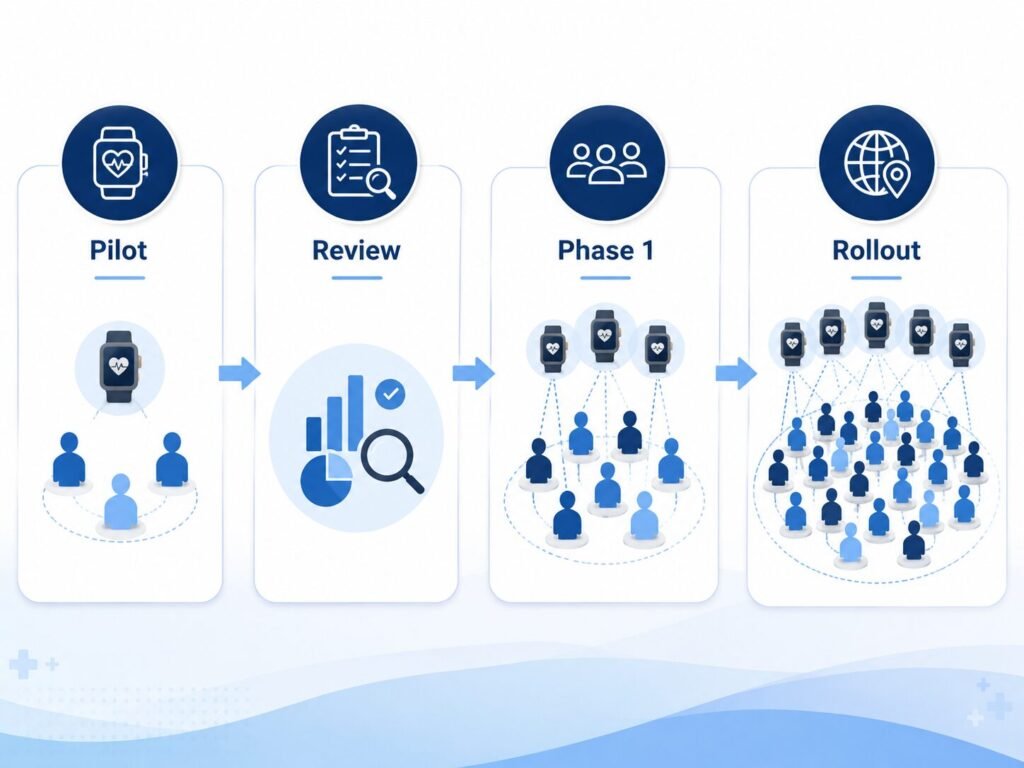
Even a successful pilot should not immediately become unrestricted deployment.
Expand in manageable stages.
Before each stage:
- Lock the approved baseline.
- Prepare the user and device list.
- Confirm training capacity.
- Confirm support ownership.
- Carry forward unresolved pilot actions.
- Define who reviews the first expanded group.
The issue register should move into normal operations rather than disappear when the pilot officially closes.
Resolved findings can be converted into training or procedures. Open findings should retain their owners.
This creates continuity between the project team and the team responsible for the live service.
WearIntell can support device configuration, integration coordination and project deployment according to the confirmed scope. The service provider remains responsible for participant selection, operating procedures and the final rollout decision.
Frequently Asked Questions
What is the main purpose of a telecare wearable pilot?
Its purpose is to determine whether an already validated device and service configuration work with representative users, staff and support processes before deployment expands.
How many people should be included in a wearable pilot?
There is no universal number. The group should contain enough variation in users, routines, environments and support conditions to expose the main operational risks of the planned service.
Should technical testing happen during the user pilot?
Core technical acceptance should be completed before the pilot. A pilot may reveal additional technical issues during real use, but it should not substitute for basic device, connectivity or integration verification.
What should prevent immediate rollout?
Unresolved critical issues, unsuitable user interaction, inadequate support capacity, unclear ownership or a service baseline that cannot be controlled should prevent immediate expansion.
Should rollout happen all at once after a successful pilot?
Usually, controlled expansion provides a better transition. It allows the organization to confirm that the processes proven with the pilot group remain workable as user numbers increase.
Share your intended users, support model and deployment structure with WearIntell to plan a controlled wearable pilot and rollout path.