
A smartwatch brand requests quotations from two manufacturers. One proposes an existing watch with branding changes and selected firmware adjustments. The other recommends a new hardware design with a higher initial development investment.
The first quotation appears cheaper. But does it include the functions the brand needs? Who will maintain the firmware? What happens if the company wants to change suppliers after launch?
These questions matter more than the manufacturing label alone.
Understanding OEM vs ODM smartwatch manufacturing helps buyers compare development responsibilities, customization costs, ownership rights, and long-term commercial risks before making a commitment.
OEM vs ODM: What Are You Actually Buying?
An Original Equipment Manufacturer (OEM) generally manufactures products according to agreed customer specifications. The design may originate with the buyer, or the manufacturer may contribute engineering under the development agreement.
An Original Design Manufacturer (ODM) generally offers an existing product design or platform that customers can adopt and customize.
In smartwatch manufacturing, these definitions are not always applied consistently.
Some suppliers use OEM to describe private-label products. Others reserve the term for projects involving customer-defined designs or extensive engineering work.
Similarly, an ODM platform may support anything from branding changes to significant hardware and firmware modifications.
For a buyer, the practical distinction is the starting point of the project.
An existing ODM platform uses an established product design as its foundation.
A modified platform retains parts of an existing design while introducing agreed engineering changes.
A custom development project requires more substantial design or architecture work to meet the buyer’s requirements.
A manufacturing proposal should explain which approach is being offered and what work is included.
The label OEM or ODM does not automatically establish design ownership, development cost, minimum order quantity, or delivery time.
Why Two Smartwatch Quotations May Not Be Comparable
Consider a telecare company preparing to launch a branded cellular safety watch.
It needs an SOS button, two-way voice, location reporting, and integration with its existing monitoring platform.
Supplier A proposes an established watch with the required basic hardware functions. Its quotation includes branding, standard production, and limited configuration work.
Supplier B proposes a modified platform with custom firmware behavior and additional integration development.
Both proposals may appear to satisfy the same product brief, but the commercial scope is different.
Supplier A may expect the customer to adapt its monitoring platform to the available interface.
Supplier B may include development work intended to change how the watch communicates with the customer’s system.
If the buyer compares only unit prices, it may overlook the cost of completing the missing work.
A lower initial quotation is not necessarily a lower total project investment.
Before evaluating the price, buyers must establish what each supplier is actually committing to deliver.
Companies approaching WearIntell or another smartwatch manufacturer should therefore provide a consistent product specification and request quotations based on clearly defined technical and commercial assumptions.
How Should You Compare OEM and ODM Smartwatch Quotes?
A useful comparison separates one-time development expenses, recurring product costs, contractual deliverables, and responsibilities after launch.
The following framework can be used to review an existing ODM proposal, a modified platform, and a more extensive custom development quotation.
| RFQ Comparison Item | What the Buyer Should Verify |
|---|---|
| Base product | Exact hardware configuration, firmware baseline, and included functions |
| Engineering / NRE | Non-recurring engineering work, deliverables, and payment milestones |
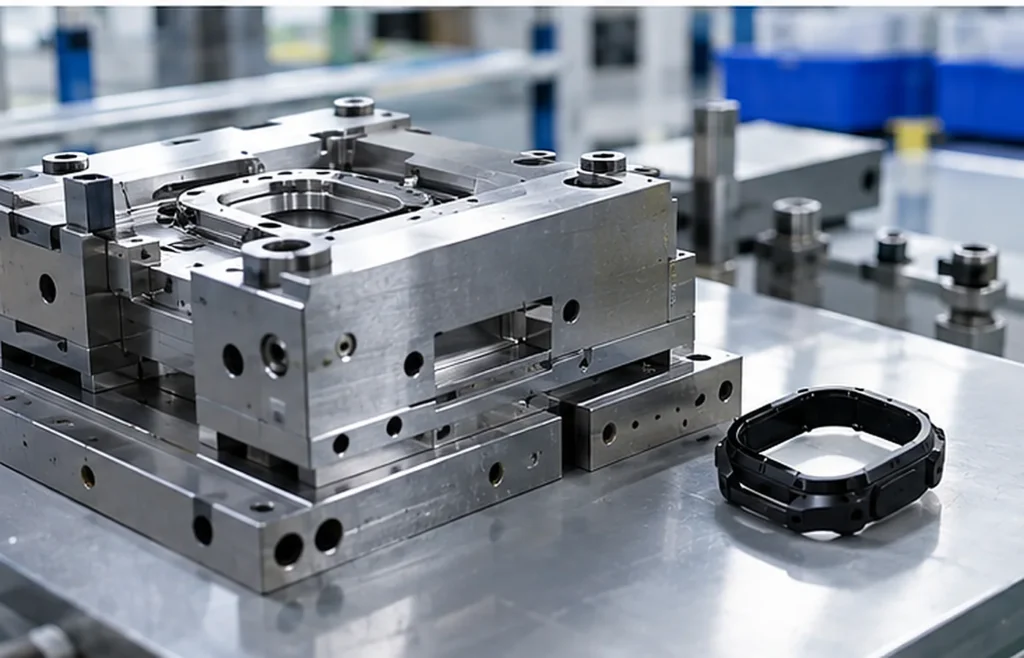
| Tooling | New or existing molds, modification costs, ownership, and maintenance |
| Unit pricing | Price at the same order quantities and agreed specifications |
| MOQ | Minimum Order Quantity for the exact customized configuration |
| Software integration | Included interfaces, custom development, access rights, and support |
| Testing and certification | Work included, responsible party, costs, and required approvals |
| Development schedule | Engineering milestones, sample approval, and production preparation |
| Ongoing support | Firmware updates, component changes, maintenance, and related charges |
| Product ownership | Design rights, software licenses, source-code access, and tooling arrangements |
The objective is to make the proposals comparable, not to assign every supplier the same development model.
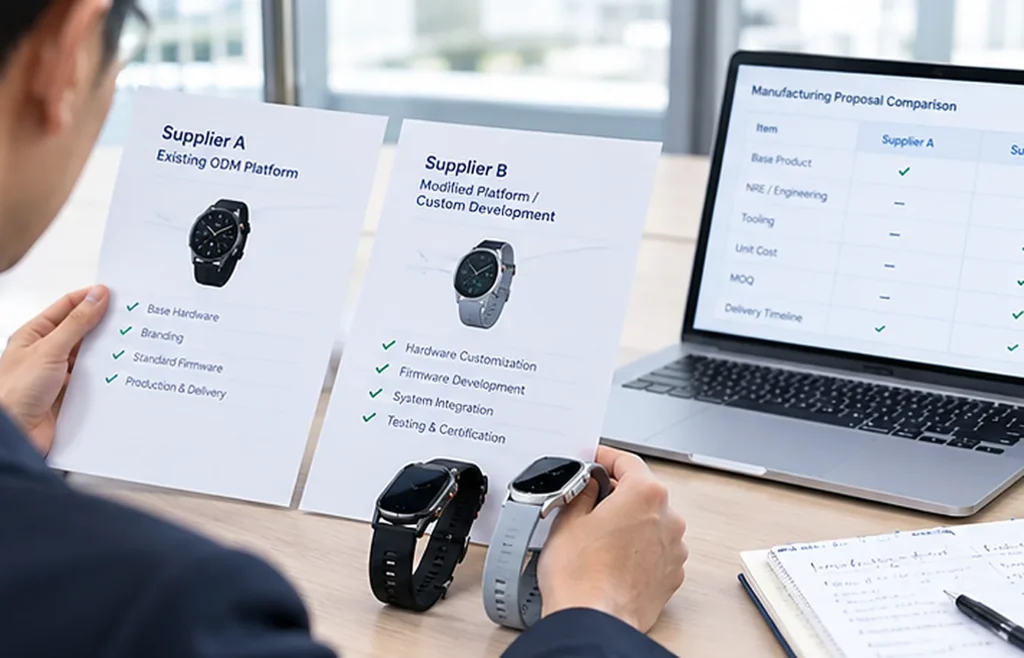
Separate One-Time Costs From Recurring Costs
Non-recurring engineering (NRE) charges may include custom electronics, firmware development, mechanical design, or other project-specific engineering work.
Tooling expenses should be identified separately where appropriate.
Recurring costs may include the manufactured units, agreed services, and other continuing obligations.
When comparing offers, use the same forecast quantities and product configuration.
For example, a supplier quoting standard hardware should not be compared directly with another quoting a redesigned enclosure and additional firmware development.
The buyer must first establish whether those changes are necessary.
Ask What the Unit Price Includes
A smartwatch unit price may exclude services that the buyer expects to receive.
Possible exclusions include custom packaging, software integration, certification-related activities, cloud access, or ongoing maintenance.
Not every project requires all of these items, but the quotation should identify what is included and what is excluded.
A meaningful comparison should also distinguish the estimated development schedule from the lead time for a repeat production order.
An existing platform may reach sample evaluation sooner, while extensive customization can introduce new engineering and testing dependencies.
Neither OEM nor ODM guarantees a particular delivery schedule.
When Does ODM Customization Become a Custom Development Project?
A company may initially choose an ODM platform because most required functions already exist.
During development, however, the project requirements change.
Imagine a buyer requesting an existing 4G safety watch with a branded watch face and a supported platform interface.
After sample evaluation, the buyer adds several requirements:
- A different battery configuration.
- New firmware-controlled alert behavior.
- Changes to the cellular communication module.
- A modified enclosure.
- Additional device-to-platform functions.
A different battery may change the case dimensions, charging design, and power-management requirements.
A communication-module change may affect antenna design, firmware, network compatibility, and testing.
Firmware modifications may require changes to the customer’s backend or new maintenance arrangements.
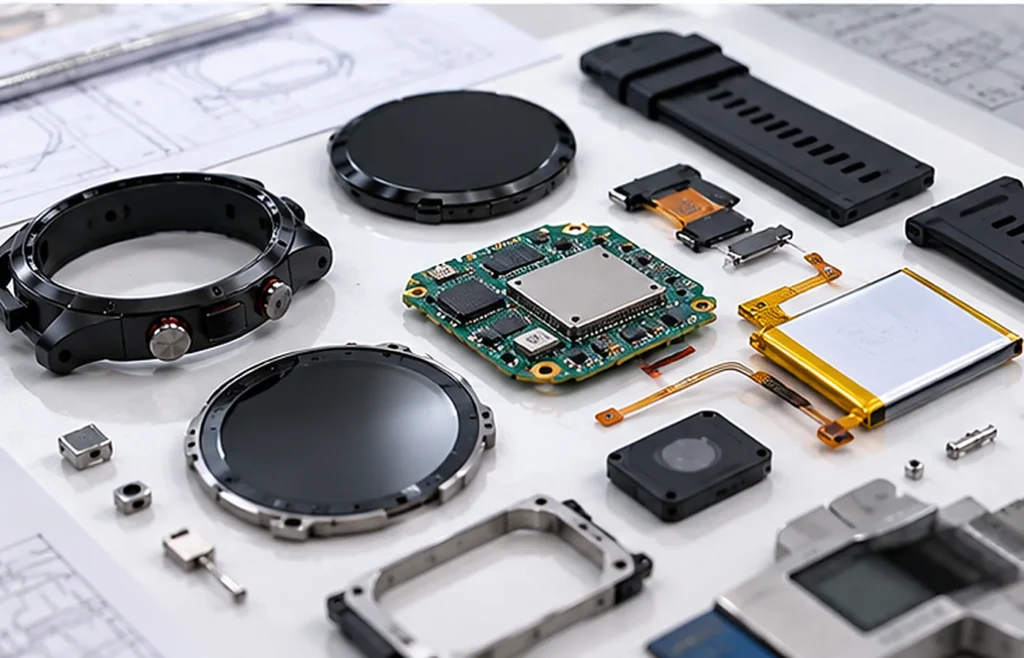
The manufacturer must therefore assess the combined technical impact rather than quote each request as an isolated adjustment.
The project may still use an ODM platform as its starting point, but its engineering cost and schedule can begin to resemble more extensive custom development.
For projects requiring substantial electronic or mechanical changes, custom smartwatch hardware development may be more appropriate than repeatedly modifying an unsuitable base product.
Control Changes Before They Affect the Budget
A useful development agreement should define:
- Which functions belong to the approved product baseline.
- Which modifications are included in the original quotation.
- How new requirements are evaluated and approved.
- Whether changes require additional engineering or testing.
- How costs, milestones, and delivery dates will be revised.
These controls help prevent disagreements when a project moves beyond its original assumptions.
What Should the Contract Say About Design and Software Ownership?
The manufacturing model does not automatically determine who owns the finished product’s underlying technology.
A customer may fund customized firmware but receive only the agreed executable software and usage rights.
A buyer may pay for mechanical tooling without having clearly established the conditions for transferring it to another factory.
These matters can become important when the product needs maintenance, redesign, or a manufacturing change.
Before substantial development begins, the buyer should confirm the contractual treatment of several assets.
Hardware design files: Who owns the schematics, PCB layouts, mechanical drawings, and project-specific design work? Which files will be delivered to the buyer?
Firmware and applications: What software rights are included? Is source-code access provided, restricted, or excluded? Who is responsible for updates and compatibility?
Tooling and production equipment: Who owns project-specific molds and fixtures? Where are they stored, and what conditions apply to their maintenance or transfer?
Cloud services and data: Who operates the required service infrastructure? What access, support, and continuity arrangements are available?
Testing and certification records: Which party commissions the work, manages product changes, and supplies the agreed documentation?
Ownership, licensing, access rights, and maintenance obligations are separate questions.
The answers depend on the specific commercial agreement, not simply whether the supplier calls the project OEM or ODM.
Buyers should also identify what happens if a critical component becomes unavailable or the product requires a future hardware revision.
A manufacturing agreement that supports the first production order but ignores these responsibilities may create substantial supplier dependence later.
Which Manufacturing Approach Fits Your Project?
The right decision follows the product requirements and the investment needed to satisfy them.
A Brand Launching a Private-Label Watch
If an available smartwatch already provides the required functions, an ODM platform may be a practical starting point.
The buyer should confirm that branding changes, target-market compatibility, quality expectations, and commercial terms fit the proposed product.
Commissioning new electronics may offer little benefit when the existing design already meets the essential specification.
A Telecare Provider With Specialized Integration Needs
A company may find that an existing safety watch provides the required hardware but needs additional firmware or platform integration work.
In this case, a modified ODM arrangement may be appropriate if the necessary changes are technically feasible and commercially justified.
The buyer should evaluate both the modification cost and the ongoing dependencies.
A Brand Requiring Distinct Hardware
A business developing a specialized wearable may need a different electronic architecture, sensor arrangement, mechanical design, or firmware foundation.
More extensive custom development may be appropriate when an existing platform cannot satisfy these requirements.
The decision must account for engineering investment, validation, manufacturing readiness, contractual rights, and expected order volumes.
What Should Buyers Confirm Before Signing?
Before selecting a manufacturer, review the proposed development scope alongside the quotation.
The buyer should know which product functions are included, which modifications require additional work, and how project changes will be approved.
The commercial agreement should also identify the expected engineering deliverables, sample acceptance process, production responsibilities, software maintenance arrangements, and relevant ownership rights.
For an existing platform, confirm which elements are standard and which depend on the exact model or configuration.
For extensive custom development, clarify responsibilities for design, testing, tooling, and production preparation.
A well-defined agreement makes it easier to evaluate whether the proposal meets the business requirements—not merely whether its price looks attractive.
Choose the Project Scope Before Choosing the Manufacturing Label
OEM and ODM smartwatch manufacturing are different ways to organize product development and production.
An established platform can reduce unnecessary engineering when it already meets the intended requirements. More extensive development may be justified when the product needs distinctive hardware, specialized functions, or greater control over future changes.
It is whether the proposed scope, investment, ownership terms, and long-term responsibilities support the intended product.
WearIntell provides smartwatch OEM/ODM manufacturing services for connected wearable projects. Sharing a clear product specification, target market, software requirements, and expected production volume gives the engineering and commercial teams a practical basis for evaluating the appropriate development approach.