
A wrist sensor sending periodic readings has different requirements from a safety watch that must place a voice call. In an LTE-M vs NB-IoT comparison, LTE-M is often the starting point for low-power mobile data; NB-IoT can suit small, infrequent reports from less mobile devices. LTE Cat 1 or Cat 1 bis deserves consideration when voice or a heavier data workload matters. None is a universal winner. The target country’s networks, module and firmware, service provisioning, and actual wearing routine can change the shortlist. Begin with what the wearer needs the device to do.
How Do LTE-M, NB-IoT and LTE Cat 1 Differ for Wearables?
| Technology | Typical traffic/workload | Mobility considerations | Voice suitability | Power considerations | Main deployment caveat |
|---|---|---|---|---|---|
| LTE-M | Small sensor reports, mobile tracking and interactive data | Supports connected-mode mobility; verify the operator’s implementation | VoLTE possible with a compatible device and supported service | Low-power modes can help when compatible with reporting and reachability needs | Local coverage and required features must be confirmed |
| NB-IoT | Small, periodic messages with limited need for immediate interaction | Better starting point for stationary or less mobile use; verify mobility behavior | Not a standard choice for conventional two-way voice | Sparse reporting can benefit from sleep modes; weak-signal retries still matter | Delay, mobility and service availability may rule it out |
| LTE Cat 1 / Cat 1 bis | More demanding data exchanges and voice-enabled applications | Uses LTE mobility capabilities, subject to device and network support | VoLTE possible with the appropriate module, firmware and operator | Evaluate the complete workload; category alone does not predict runtime | Band support and LTE registration do not establish voice compatibility |
LTE-M and NB-IoT are cellular technologies designed for connected devices with modest data needs. LTE-M refers to LTE for machine-type communications; NB-IoT means Narrowband Internet of Things. Both can support low-power operation, but their design choices differ.
LTE-M accommodates moving devices and more responsive exchanges, making it a useful candidate when a wearable must communicate while its wearer travels. NB-IoT prioritizes small data transfers and coverage extension. That can suit occasional telemetry, but it does not automatically fit a device needing an interactive connection.
LTE Cat 1 is another LTE device category with greater data capacity than these low-throughput options. As u-blox’s cellular IoT comparison explains, Cat 1 bis adapts Cat 1 for a single receive antenna, rather than the two-receive-antenna arrangement associated with conventional Cat 1 designs. It belongs to the same LTE family; it is not a newer network generation. The antenna simplification can help a compact design, but the finished watch still needs radio-performance evaluation.
The useful distinction is between reporting and interaction. A delayed sensor reading may remain useful. A conversation, or a location request while someone is moving, places different demands on responsiveness and connection continuity.
Can Each Technology Support SOS Voice Calls, Location Updates and Mobility?
An SOS data message and an SOS voice call are separate functions. A device might successfully send an event identifier and coordinates while being unable to establish a conversation. Demonstrating one does not validate the other.
As Telenor’s VoLTE testing guidance illustrates, LTE-M can support Voice over LTE, or VoLTE, in suitable deployments. The module and firmware must implement the required functions, and the operator must support and provision the voice service, including its IP Multimedia Subsystem, or IMS. Do not infer voice availability from an LTE-M coverage map. Calling emergency numbers can introduce additional requirements that need separate confirmation.
NB-IoT should not be the default shortlist choice for conventional two-way voice. A design requiring a speakerphone conversation needs an explicitly supported voice path. Cat 1 and Cat 1 bis are relevant candidates, but the label on the modem still does not prove that a particular operator will enable the proposed calling workflow.
Consider an outdoor SOS smartwatch that sends occasional position reports but must sometimes connect its wearer to a response service. Its routine data traffic is small. Selecting a radio only on that basis would miss the decisive requirement: establishing and maintaining the supported two-way call.
For location reporting, distinguish positioning from transmission. A Global Navigation Satellite System, or GNSS, receiver calculates location from satellite signals; the cellular connection transports the resulting report. Choosing a faster LTE category does not itself improve GNSS accuracy. Antenna placement, satellite visibility and the surrounding environment remain relevant.
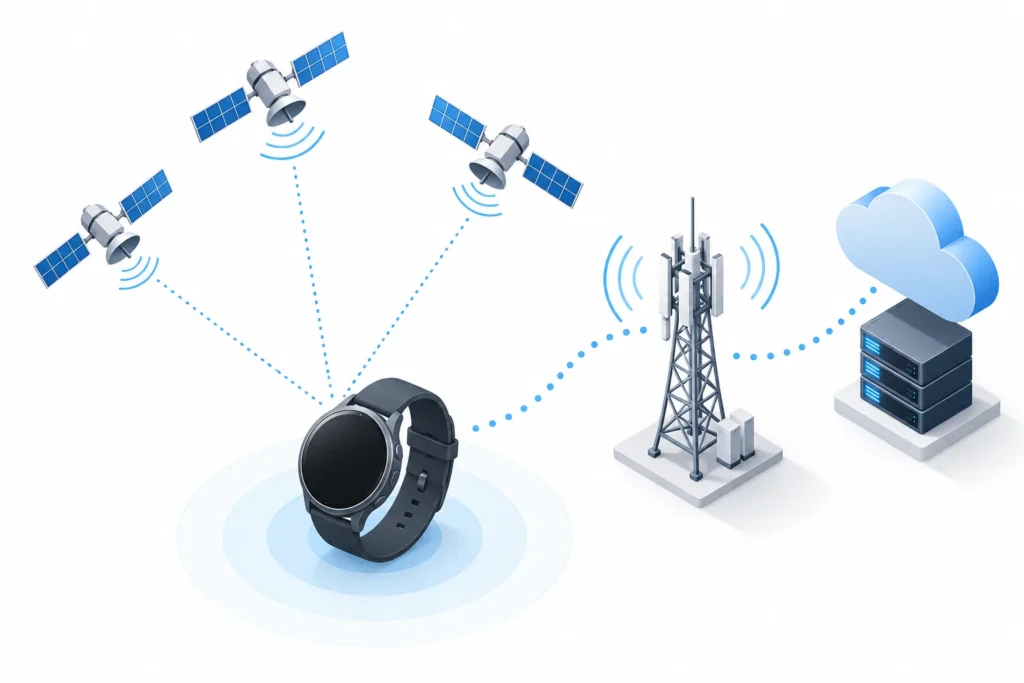
In GPS safety wearable projects, ask how location updates behave as the wearer moves between coverage areas. Evaluate handover, reconnection and report freshness on the intended networks. A stationary desk demonstration cannot establish performance along a walking route, in a vehicle or inside the buildings where the device will be used.
Also distinguish obtaining a new position from sending a stored one. A successful upload may contain an older location. Evaluate the required location age alongside connection behavior, rather than treating every received coordinate as current.
What Determines Power Use, Coverage and Carrier Compatibility in Practice?
Start with a day in the wearer’s life. How often does the watch report? How long does it search for a position? Must it receive an incoming call promptly? How much time does it spend in weak coverage? These questions matter more than an isolated modem power figure.
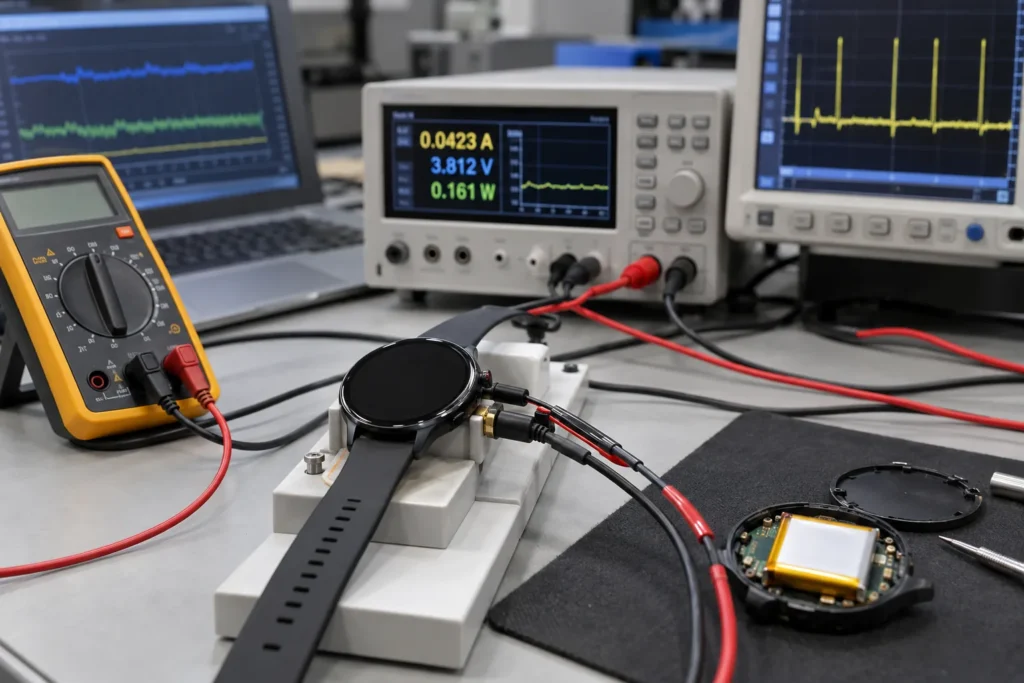
A meaningful energy budget includes cellular registration, payload size, reporting frequency, retries, GNSS activity, voice use and the rest of the watch. A radio transmitting little data may still consume substantial energy if it repeatedly searches for service. Frequent location fixes can also change the balance between radio consumption and total device consumption.
Power Saving Mode, or PSM, and extended Discontinuous Reception, or eDRX, can reduce consumption where the device and network support them. They also affect when a device can be reached. Evaluate sleep settings against the service’s incoming-message and call requirements; a setting suited to scheduled reports may not suit an interactive safety workflow.
Coverage needs similar care. A technology’s capacity for coverage extension is not a guarantee of usable service at every address. Radio bands, the enclosure and antenna, local deployment, roaming arrangements and the required service all matter. Data coverage and supported voice service should be verified separately.
Use a short validation sequence before committing the hardware:
- Name the countries and carriers. Identify the actual networks, including any roaming route, rather than specifying a continent.
- Confirm the proposed radio configuration. Match module, supported bands, firmware and antenna design to those networks.
- Verify the required services. Establish data availability, voice support where needed, and applicable roaming or access point name (APN) provisioning.
- Exercise the wearing scenarios. Test indoors, outdoors, in weak signal and while moving, including the required incoming and outgoing interactions.
- Measure energy under the defined routine. Include reporting, location acquisition, retries, voice and realistic time away from the charger.
Record which configuration produced each result. A useful comparison holds the reporting schedule and location workload consistent, then explains differences caused by network settings or supported features. Otherwise, a longer sleep interval can look like a better radio when it actually delivers a different service.
For broader procurement detail, the standalone 4G medical alert smartwatch requirements guide covers adjacent band, carrier and voice questions. Keep the technology comparison focused on which candidate can support the required workload.
Which Network Option Fits Your Wearable Project?
Use scenarios to narrow the field. The starting option is a hypothesis to test, not a purchase recommendation.
| Scenario | Starting option | Why | Must-verify condition |
|---|---|---|---|
| Periodic low-data sensor, mostly stationary | NB-IoT; compare LTE-M locally | Small, infrequent reports may suit its design priorities | Acceptable reporting delay, actual coverage and energy use |
| Mobile positioning wearable | LTE-M; compare Cat 1 / Cat 1 bis | Movement and responsive reporting influence the choice | Mobility behavior, location freshness and target-network support |
| Two-way-voice SOS safety watch | Cat 1 / Cat 1 bis; include LTE-M where voice is supported | A verified voice path takes priority over a small routine payload | Module/firmware voice support, provisioning and the complete call route |
| Cross-border deployment | Shortlist by country and service | No category label establishes consistent regional availability | Bands, roaming, data/voice availability and tested operation in each market |
A cross-border shortlist may require different regional configurations. Treat that as a product and support decision: can the team maintain the necessary hardware variants and test evidence? Do not assume a configuration validated on one network remains equivalent after changing a module, firmware build or service profile.
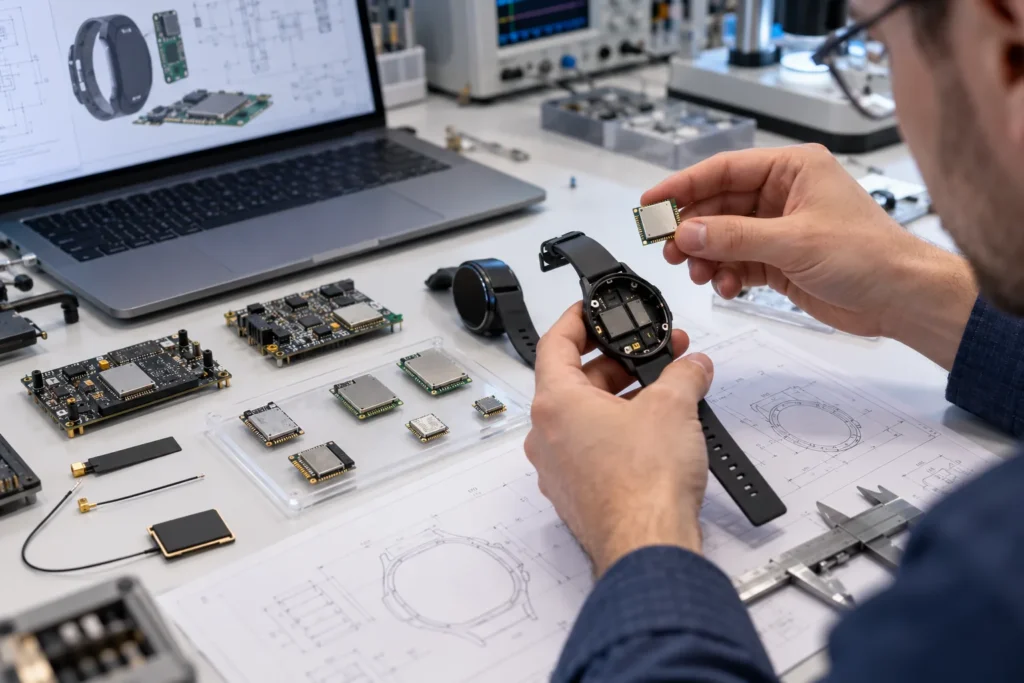
Ask suppliers to identify what remains unproven. “Supported by the chipset” and “demonstrated on the target carrier in this watch” describe different levels of evidence. A useful engineering discussion makes that gap visible early.
When discussing a project with WearIntell, provide the required wearing routine, communication functions and target networks before asking about a specific configuration. General LTE-M or NB-IoT capabilities do not establish availability in a particular WearIntell model.
Choose the workflow and networks first. Then test the complete device against them. The best option is the one that delivers the required reports, mobility and conversations within the project’s measured power budget.