
Choosing a smart watch OEM manufacturer for a healthcare project requires more than reviewing available models or requesting a unit price.
A suitable supplier may need to support industrial and mechanical design, hardware and PCBA development, firmware, mobile applications, cloud connectivity, system integration, testing, certification preparation and production. However, the required scope varies substantially from one project to another.
Some companies need an existing watch with branded packaging and a configured interface. Others need firmware changes, API integration or a modified enclosure. A more specialized healthcare wearable may require coordinated hardware and software development.
Before contacting manufacturers, the project team should define what the product must do, which work the supplier should complete and how proposals will be compared. A clear brief makes technical feasibility easier to assess and prevents suppliers from quoting different versions of the same project.
Define the Healthcare Project Before Comparing Manufacturers
Manufacturer selection should begin with the intended application rather than a feature list.
Start by defining who will wear the device, where it will be used and who will interact with the information it produces. A watch intended for an elderly safety program may have different interaction, communication and management requirements from a wearable connected to a healthcare technology platform.
The initial project definition should cover five areas.
Intended Users and Use Environment
Describe the expected users and the conditions in which they will wear, charge and operate the watch.
Relevant considerations may include:
- User age and ability to operate the interface
- Indoor, outdoor or mixed use
- Home, care facility, hospital or workplace deployment
- Expected wearing duration
- Charging and replacement procedures
- Staff, caregiver or service-provider involvement
These details help the manufacturer evaluate the interface, enclosure, controls, communication model and device-management requirements.
Required Device Behavior
List what the watch must do from the user’s perspective.
Avoid relying only on broad function names such as “SOS,” “location” or “health monitoring.” Describe the expected workflow instead. For example, specify what should happen after a button is pressed, which information should be reported and which person or system should receive it.
Separate functions into:
- Mandatory for the first version
- Optional for evaluation
- Planned for a later phase
- Not required
This prevents optional functions from being included in every proposal or presented as standard features.
Software and Platform Context
State whether the watch will use the manufacturer’s application and platform or connect to an existing system.
The supplier should know whether the project requires:
- Customized firmware
- A branded mobile application
- Cloud-platform support
- Device-management functions
- API or SDK integration
- Connection with an existing monitoring system
At this stage, the goal is not to define every technical field. It is to establish which software components are part of the manufacturer’s scope.
Target Markets
Identify the intended countries or regions as early as possible.
Target markets may affect radio configuration, network evaluation, labeling, documentation and certification planning. Requirements should be reviewed against the final device configuration, intended use and product claims rather than assumed from an existing model.
Deployment Model
Explain whether the project is an initial evaluation, a limited pilot or part of a planned larger deployment.
The expected scale can affect device activation, configuration, packaging, replacement procedures, software maintenance and production planning.
Decide What the Smart Watch OEM Manufacturer Must Deliver
Before requesting quotations, choose the most appropriate development starting point.
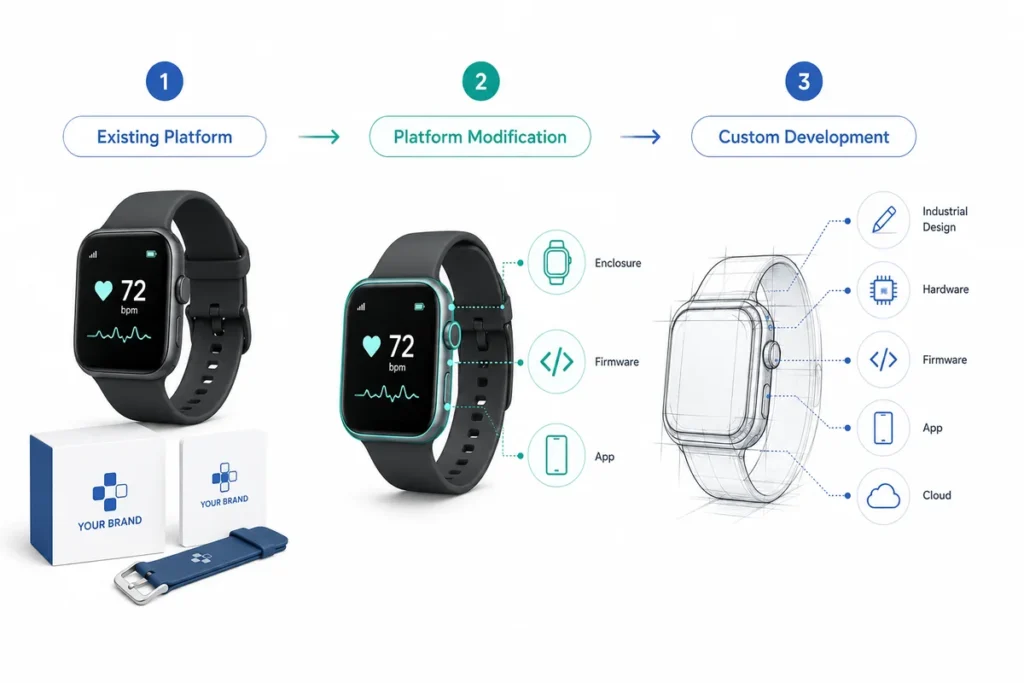
The terms OEM, ODM and private label are not always used consistently. Instead of relying on the label, describe the actual work required.
Existing Platform with Limited Customization
An existing platform may be appropriate when the core device already supports the intended workflow.
The supplier’s scope may include:
- Logo and watch-face changes
- Interface colors or selected menu changes
- Packaging and documentation
- App branding
- Configurable firmware settings
- Product labeling
Even when hardware development is not required, the project team should confirm that the existing device, firmware and platform support the intended users and operational process.
Existing Platform with Engineering Changes
This route starts with an available product but requires selected hardware, mechanical or software modifications.
Examples may include:
- Modified enclosure or button layout
- Different materials or external branding
- Firmware workflow changes
- Selected hardware-component changes
- App or platform adaptation
- API integration
The supplier should explain which requests can be handled within the existing architecture and which would require broader redesign or revalidation.
Full Custom Development
A full custom project may be needed when existing platforms cannot support the required form factor, hardware structure or connected workflow.
The scope may include ID and mechanical design, hardware and PCBA development, embedded firmware, applications, cloud connection, interface integration, branding and packaging.
The key selection question is not whether a manufacturer lists these capabilities on its website. It is whether the supplier can coordinate the agreed work and provide clear deliverables for each stage.
WearIntell supports connected wearable projects for healthcare, elderly safety and personal safety applications. The appropriate development route depends on the intended users, required functions, existing software environment and target market.
Set Responsibility Boundaries Before Requesting a Quote
Many project delays begin with an unclear division of responsibilities.
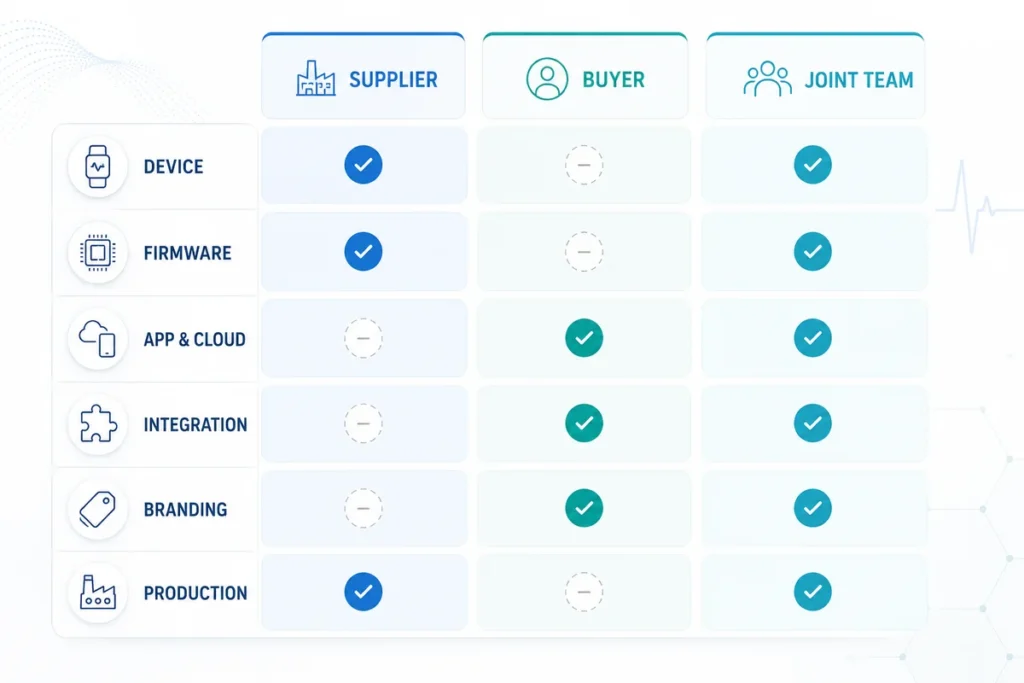
A supplier may assume that the customer will define the complete software workflow, while the customer assumes that the supplier will provide a finished application and backend. Similar misunderstandings can occur with certification, testing, data hosting and production approval.
Create a simple responsibility matrix before quotations are prepared.
| Project Area | Supplier Responsibility | Buyer Responsibility | Joint Confirmation |
| Device | Propose or develop the agreed hardware configuration | Define use requirements and constraints | Approve the final specification |
| Firmware | Deliver agreed device functions and settings | Define required behavior and workflows | Complete functional acceptance |
| App and cloud | Provide the agreed application or platform scope | Supply account, user and operational requirements | Confirm data and user workflows |
| Integration | Provide agreed documentation and technical support | Provide existing system information | Complete integration testing |
| Branding | Prepare approved device and packaging files | Supply brand assets and market requirements | Approve final artwork |
| Certification | Support technical documents and testing preparation | Confirm target market, intended use and claims | Agree the applicable scope |
| Production | Manufacture and inspect the approved configuration | Define approval and delivery requirements | Release the product for production |
This table does not need to define every contractual detail. Its purpose is to identify assumptions before they become quotation exclusions or development disputes.
Distinguish Standard, Configurable and Custom Work
Ask the manufacturer to classify every requested item as:
- Standard on the proposed platform
- Configurable without new development
- Optional
- Requiring firmware or software customization
- Requiring hardware development
- Subject to technical evaluation
This classification is more useful than a simple yes-or-no feature checklist.
A function may already exist but still require changes to fit the project workflow. Conversely, a requested outcome may be possible through configuration rather than new development.
Clarify Project Assets
The quotation or development agreement should also identify which project assets will be delivered or made available.
Depending on the scope, these may include:
- Product and mechanical files
- Tooling or molds
- Approved hardware specifications
- Firmware releases
- Application files
- API documentation
- Packaging artwork
- Test reports
- Production specifications
Not every project requires full ownership of every design file or source code. However, the buyer should understand what can be used, modified, transferred or retained if the cooperation changes later.
Send Every Manufacturer the Same Project Brief
Different quotations cannot be compared reliably when each manufacturer receives different information.
Prepare one supplier brief and send the same version to every shortlisted company. The document does not need to contain a final engineering specification, but it should define the commercial and technical boundaries of the project.
| Brief Section | Information to Include |
| Project summary | Intended product, users and service model |
| Use environment | Where and how the watch will be worn and managed |
| Development route | Existing platform, modified platform or custom development |
| Mandatory functions | Requirements for the first product version |
| Optional functions | Items to evaluate separately |
| Device workflow | How the user operates the watch |
| Alert or data workflow | Where information is sent and who receives it |
| Software scope | Firmware, app, cloud, device management and integration |
| Target markets | Intended countries, regions and network environments |
| Branding | Device, interface, packaging and documentation requirements |
| Project assets | Required documentation, access and ownership boundaries |
| Deployment plan | Evaluation, pilot and expected production path |
| Support expectations | Software maintenance, issue handling and product changes |
When a technical decision has not yet been made, describe the operating requirement instead of specifying an unverified component.
For example, the brief can explain the intended communication workflow, daily use pattern and charging environment without prescribing a battery capacity. The manufacturer can then assess the complete configuration rather than responding to an isolated component request.
A structured brief also helps determine whether the supplier’s smart wearable OEM/ODM manufacturer capabilities match the actual project rather than a generic product category.
Compare Manufacturer Proposals on an Equivalent Scope
The lowest quotation is not necessarily the least expensive project.
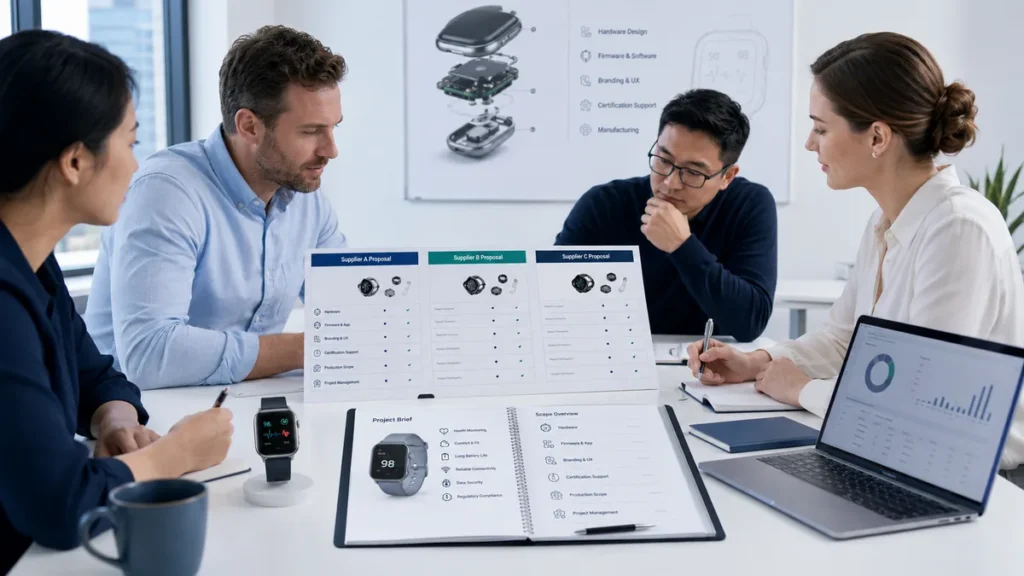
One proposal may cover an existing device with branding changes. Another may include firmware adaptation, application work, API support, customized packaging and additional testing. Comparing only the unit price would hide these differences.
Normalize each proposal before making a commercial comparison.
Development Starting Point
Confirm whether the quotation is based on:
- An existing device without engineering changes
- An existing platform with modifications
- A newly developed configuration
A proposal based on a substantially different starting point should not be compared directly.
Included Engineering Work
Identify which development work is included and which is quoted separately.
Review:
- Industrial or mechanical changes
- Hardware and PCBA work
- Firmware customization
- Mobile-application changes
- Cloud or device-management work
- API or SDK support
- Packaging and branding preparation
The proposal should state the expected deliverables rather than use broad wording such as “software customization included.”
Samples and Acceptance
Confirm which sample stages are included and what each stage is intended to prove.
The manufacturer should explain:
- What configuration the samples will use
- Which functions will be available
- How feedback will be handled
- What constitutes sample approval
- Which changes may affect the quotation
Detailed product-specific testing should be defined later against the final configuration. During supplier comparison, the immediate priority is confirming that both parties understand how the proposed product will be evaluated and approved.
Certification Support
Certification should be treated as a project-specific responsibility rather than a standard feature of every quotation.
Ask each supplier to clarify:
- Which technical documents are available
- Which testing or documentation work is included
- Which work depends on the final configuration
- Which responsibilities remain with the customer
- Whether design changes may require additional testing
Do not assume that reports for one model automatically apply to a modified product or a different intended use.
Production and Ongoing Support
The quotation should also explain what happens after sample approval.
Confirm the approach to:
- Approved product configuration
- Firmware and hardware version control
- Component changes
- Production inspection
- Packaging approval
- Defect handling
- Software maintenance
- Technical issue escalation
This does not require a complete factory audit during the first comparison. It does require enough information to determine whether the supplier can support the project after the initial order.
Exclusions and Recurring Costs
Request a written list of exclusions and ongoing charges.
Depending on the project, separate costs may apply to:
- Tooling
- Engineering changes
- Application publishing
- Cloud hosting
- Platform accounts
- Software maintenance
- Certification testing
- Packaging development
- Future firmware updates
These items should be visible before proposals are ranked.
Use a Feasibility Review to Select the Manufacturer
A written proposal is only one part of supplier selection. Shortlisted manufacturers should also participate in a technical feasibility review.
The meeting should focus on the actual project rather than a general company presentation.
Ask the manufacturer to explain:
- Which existing platform or architecture it recommends
- Which requirements are already supported
- Which requirements need configuration or development
- Which requirements remain uncertain
- Which information is still needed from the buyer
- Which dependencies could affect the project
- How the first sample configuration would be defined
A credible response should distinguish confirmed capabilities from items that still require engineering evaluation.
The manufacturer should also identify risks rather than accepting every request without qualification. For example, a mechanical change may affect antenna performance, water resistance or tooling. A software request may depend on the available device resources or the customer’s existing platform.
The feasibility review should end with a documented scope that both parties can use to revise the proposal. This document should identify:
- The proposed starting platform
- Included development work
- Customer-provided information
- Major deliverables
- Open technical questions
- Sample objectives
- Acceptance responsibilities
- Explicit exclusions
This creates a more reliable basis for selecting a smart watch OEM manufacturer than comparing feature lists or sales claims.
Choosing a Smart Watch OEM Manufacturer
The right smart watch OEM manufacturer is the supplier whose development scope and responsibilities match the healthcare project.
Begin by defining the intended users, device behavior, software environment, target markets and deployment model. Choose whether the project should start from an existing product, a modified platform or a custom development path.
Next, define responsibility boundaries and send every supplier the same brief. Compare quotations only after hardware, software, branding, certification support, samples, production and recurring services have been placed on an equivalent basis.
A clear feasibility review should then confirm what is supported, what requires development and which decisions remain open.
Healthcare technology brands, product managers, engineering teams and system integrators can submit project requirements to discuss the intended application, required functions, system integration and an appropriate OEM or ODM development route.
Frequently Asked Questions
What information should I send to a smart watch OEM manufacturer?
Provide the intended users, use environment, mandatory functions, device workflow, software requirements, target markets and expected deployment model. State whether the project needs an existing product, a modified platform or custom development. Separate confirmed requirements from optional functions so the manufacturer can prepare a clearer feasibility response and quotation.
How should I compare quotations from different smart watch manufacturers?
First place every proposal on the same scope. Compare the starting hardware platform, included engineering, firmware, app and cloud deliverables, integration support, branding, samples, certification responsibilities, production support and recurring costs. Ask each supplier to list assumptions, exclusions and work that will require an additional quotation.
Should the manufacturer provide the app and cloud platform?
It depends on the project. Some companies use a manufacturer-provided application and platform, while others connect the watch to an existing system. The supplier brief should identify which party provides, hosts, maintains and tests each software component. The responsibility boundary matters more than whether every component comes from one company.