
A prototype SOS smartwatch makes an emergency call and reports its location during an engineering demonstration. Does that mean the device is ready for mass production?
Not yet.
The antenna may behave differently inside the final enclosure. Battery performance may fall short of the specification. Even after the design passes testing, the factory may struggle to assemble every unit consistently.
EVT, DVT, and PVT address these different risks. They help a development team move from proving that a product can work to establishing that its design meets requirements and its manufacturing process is ready.
What Is the Difference Between EVT, DVT, and PVT?
The three terms describe distinct validation stages commonly used in hardware development.
| Stage | Full Name | Main Question | Typical Outcome |
|---|---|---|---|
| EVT | Engineering Validation Test | Does the core engineering design work? | Functional engineering samples and identified technical risks |
| DVT | Design Validation Test | Does the intended product meet its requirements? | Verified design performance and reliability evidence |
| PVT | Production Validation Test | Can the manufacturing process reproduce the approved design? | Pilot production results and evidence of manufacturing readiness |
A working EVT prototype is not proof of final product reliability. Similarly, passing DVT does not demonstrate that the production line can manufacture the device consistently.
The exact sequence, test scope, and terminology may vary by company and project. Some manufacturers use different names or combine activities. What matters is that engineering feasibility, product validation, and production readiness are each supported by appropriate evidence.
To see the differences, consider a hypothetical 4G SOS smartwatch throughout development.
EVT: Can the Proposed Smartwatch Design Work?
At EVT, engineers are evaluating the fundamental product architecture.
The watch may use an early printed circuit board assembly (PCBA), preliminary firmware, and mechanical parts that do not yet represent the final enclosure.
The team needs to establish whether the main systems can function together.
For a cellular safety watch, relevant activities include checking the processor, modem, charging system, battery-management circuit, SOS button, microphone, speaker, and location functions.
Firmware must support the essential device behavior, while early communication tests establish whether the watch can interact with the intended network and software environment.
Power consumption also needs attention. A smartwatch that performs well while idle may consume much more energy during voice calls, positioning, or cellular transmission.
The development team should investigate these conditions before committing to a finalized design.
Example: SOS Works, but the Cellular Signal Is Unstable
Suppose the prototype successfully makes SOS calls on a test bench.
When engineers test the watch with its antenna installed near other components, however, radio performance becomes inconsistent.
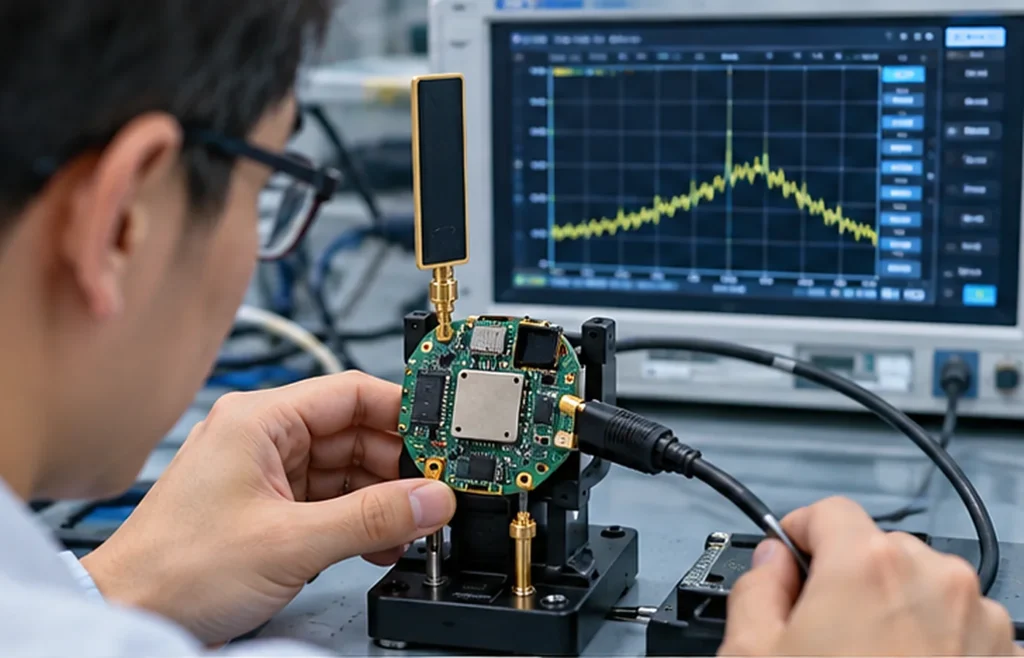
The team may need to investigate antenna placement, matching, grounding, component layout, or mechanical interference.
Resolving the problem could require a new circuit board revision or a change to the internal arrangement.
The important result is not that an engineer eventually completes a successful call. It is whether the proposed design can meet its essential technical objectives under defined conditions.
EVT outputs may therefore include functional test records, prototype configurations, identified defects, and agreed corrective actions.
These activities form part of the engineering work associated with wearable device research and development.
Passing EVT means the team has sufficient evidence to continue development under the agreed conditions. It does not mean every product requirement has been validated.
DVT: Does the Production-Intent Design Meet Its Requirements?
DVT evaluates the product in a configuration that more closely represents what customers will receive.
At this stage, engineers must consider the combined behavior of the electronics, firmware, enclosure, charging system, and mechanical components.
A smartwatch is particularly sensitive to the interaction between these elements.
Changing the case material can affect radio performance. A new seal may influence assembly and water resistance. Different component placement can alter thermal behavior or serviceability.
The development team must validate the intended product configuration rather than rely solely on results from earlier prototypes.
Example: The Final Enclosure Changes Performance
Imagine that the SOS smartwatch passes its early connectivity tests.
The engineering team then introduces the production-intent enclosure. During subsequent testing, antenna performance no longer meets the specified requirement.
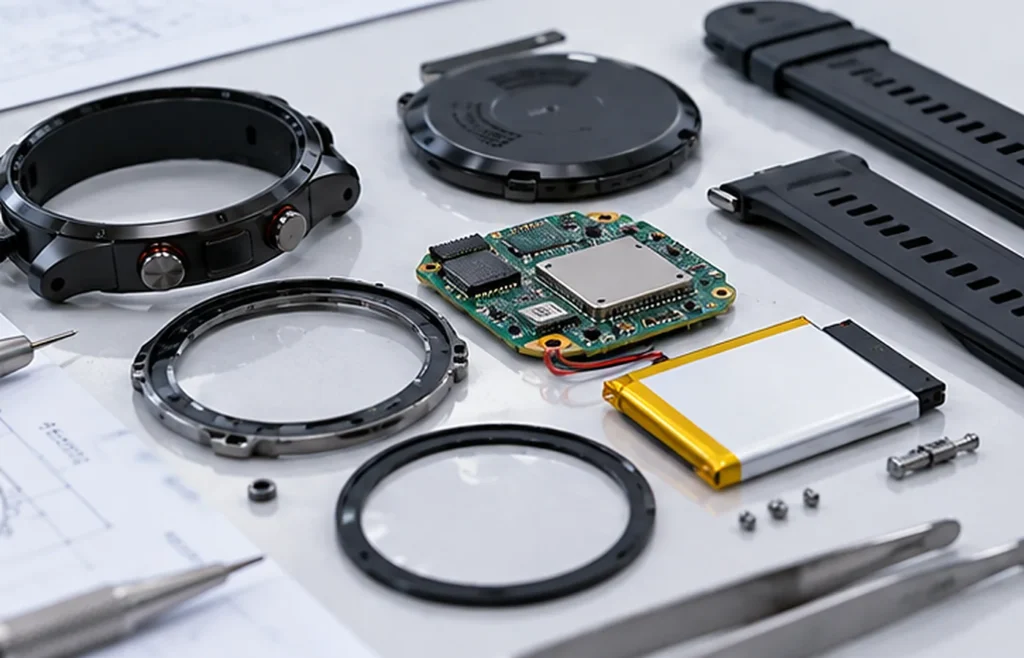
The device has not necessarily developed a new software fault. The physical design has changed the conditions under which the radio system operates.
Engineers must identify the cause, make the appropriate design correction, and repeat the affected tests.
DVT can also examine:
- Mechanical durability and button operation.
- Water-ingress protection against specified criteria.
- Charging and battery performance.
- Microphone and speaker behavior.
- Connectivity under defined conditions.
- Firmware stability and recovery.
- Relevant environmental and pre-compliance requirements.
Each test needs a defined acceptance criterion.
For example, “good battery life” is not sufficient. The requirement should identify the operating profile, test conditions, and acceptable result.
Similarly, a water-resistance test must relate to an agreed rating and procedure. Passing one test does not prove that the watch can withstand every exposure.
What Does DVT Approval Establish?
The team should be able to connect each important requirement to a test result and the exact hardware and firmware configuration tested.
When a design change is made, engineers must determine whether previous results remain valid or whether additional testing is required.
DVT approval supports the conclusion that the production-intent design meets its agreed requirements.
It does not automatically establish regulatory certification or authorization for sale. Those obligations depend on the product, its intended use, and the markets where it will be offered.
PVT: Can the Factory Build the Approved Design Consistently?
A design may perform well in engineering tests and still be difficult to manufacture reliably.
That is the problem PVT addresses.
The focus shifts toward production-intent materials, equipment, work instructions, assembly procedures, firmware programming, inspection methods, and process controls.
The team must establish whether the manufacturing process can produce conforming units repeatedly.
Consider the same SOS smartwatch.
Engineering technicians may have assembled several successful samples by carefully adjusting each device. A production line, however, must use a repeatable process rather than depend on individual adjustments.
Important checks may include correct component and bill of materials (BOM) revisions, firmware programming, assembly consistency, production test fixtures, defect tracking, and unit or batch identification.
Example: Waterproofing Fails During a Pilot Build
Suppose the smartwatch passed its required enclosure tests during DVT.
During a pilot production build, some devices fail the specified water-ingress test.
An investigation finds variation in seal placement or compression during assembly.
The team may need to adjust tooling, update work instructions, improve assembly controls, or revise inspection methods.
Simply repairing the failed samples is not sufficient. The factory needs evidence that the underlying cause has been addressed.
If the investigation identifies a design weakness rather than an assembly problem, the product may also require a design revision and additional validation.
This distinction matters: PVT can reveal manufacturing problems, but it can also expose design issues that were not evident in smaller test builds.
A successful PVT review supports a decision to begin the agreed production scope. It does not guarantee that future production will be defect-free.
What Evidence Should Support Each Stage Approval?
For an OEM/ODM buyer, a supplier’s statement that testing is complete is less useful than a clear record of what was tested and approved.
Each development stage should produce evidence appropriate to its objectives.
| Validation Stage | Evidence to Review | What It Helps Establish |
|---|---|---|
| EVT | Functional test reports, prototype revisions, engineering issue logs, corrective actions | The essential engineering concept is feasible |
| DVT | Requirement-linked validation reports, reliability results, controlled design changes | The production-intent design meets agreed criteria |
| PVT | Pilot-build records, production test results, process controls, defect and rework data | The intended manufacturing process is ready for the agreed release |
The documents and approval requirements should be determined by the project’s specifications and risks rather than copied from a universal checklist.
Three considerations deserve attention.
First, test results must identify the product revision. A report for an earlier circuit board or firmware build may not support approval of a changed configuration.
Second, unresolved issues must remain visible. An open technical problem should have a documented risk assessment, responsible owner, and agreed action.
Third, approval authority should be defined. Engineering, quality, manufacturing, and customer teams may have different responsibilities under the project agreement.
These records help buyers understand what a development milestone actually represents.
When reviewing a project with WearIntell or another wearable manufacturer, buyers should request validation deliverables relevant to their own product rather than assume every project follows an identical stage-gate system.
What Happens When a Device Fails a Validation Stage?
A failed test does not necessarily mean the entire project must restart.
The response depends on the problem and its effect on other requirements.
During EVT, a connectivity failure may require an engineering redesign or firmware correction.
During DVT, a failed enclosure test may require a mechanical change and further reliability testing.
During PVT, inconsistent assembly results may require process changes and another pilot verification activity.
However, changes can affect evidence from earlier stages.
If an antenna is redesigned after DVT, the team may need to repeat relevant radio and system tests. A change to the enclosure could also affect sealing, durability, or other previously validated requirements.
This is why configuration control and regression testing—repeating affected tests after a change—are important.
The purpose of validation is not to avoid discovering problems. It is to identify them early enough to investigate their causes, apply corrections, and verify the results.
A supplier’s handling of failures can therefore be as important as its initial test results.
For a broader assessment of engineering records and manufacturing controls, buyers can consult the guide to auditing a wearable device manufacturer.
From a Working Prototype to Production Readiness
The difference between EVT, DVT, and PVT comes down to the evidence each stage provides.
EVT establishes engineering feasibility. DVT verifies the intended product design. PVT evaluates manufacturing readiness.
These stages reduce different risks, and success in one cannot automatically substitute for another.
For smartwatch development projects, approval should depend on documented requirements, test results, controlled product revisions, and an agreed process for resolving failures.
A working prototype is an important beginning. A validated design and a controlled production process are what make the next manufacturing decision possible.