
A fall detection watch does not always need cellular service to recognize a possible fall. Motion sensing, on-device classification, and a wearer cancellation prompt may run locally, depending on the firmware and configuration. But a remote safety workflow needs an available communication path to send the event, place a voice call, upload location, or notify a caregiver platform. For teams evaluating fall detection watch cellular service, the important question is therefore not simply whether detection works offline. It is which stages remain available, which fail, and how the system reports that difference.
Which Parts of Fall Detection Can Work Locally?
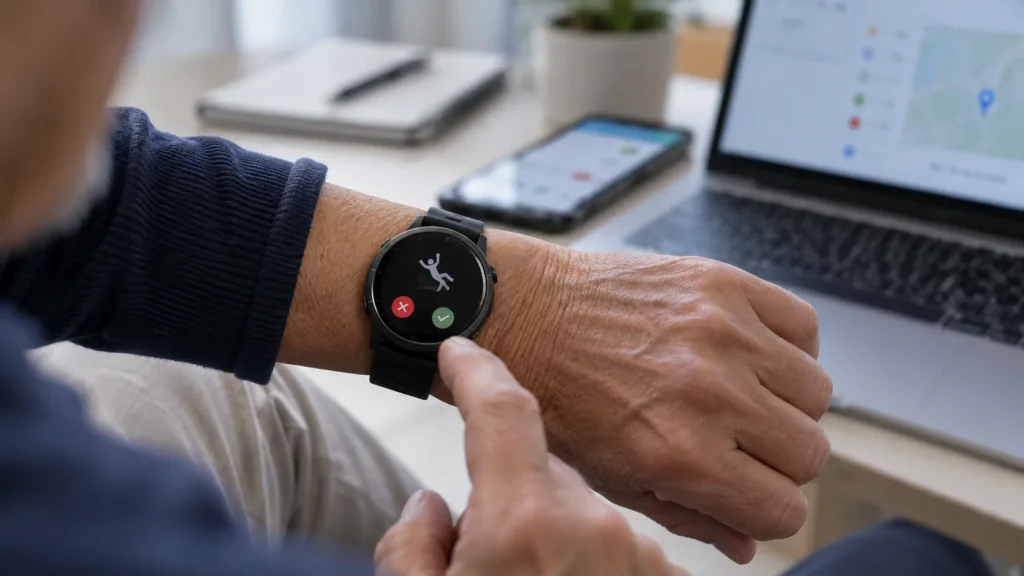
A watch can use its accelerometer, gyroscope, and embedded firmware to observe movement and identify a pattern that may represent a fall. Where the product design supports it, the same local workflow can create a suspected event, vibrate or sound an alert, display a prompt, and give the wearer time to cancel. None of those steps inherently requires a mobile data connection.
The exact boundary is product-specific. Some devices perform most classification on the watch. Others depend on a paired phone or backend for part of the workflow. Power-saving modes, sensor settings, wearer interaction, and firmware rules can also change what happens after a trigger. Buyers should confirm the implemented behavior instead of assuming that every watch handles an offline event in the same way.
This local sequence is only one part of the service. Teams that need more background on sensing and confirmation can review how fall detection works in a watch. For connectivity planning, the key distinction is that creating an event on the device is not the same as transmitting it or obtaining a response.
Which Functions Need a Connection?
Any action that must reach another person or system needs a communication route. Depending on the service design, that route may be cellular data, a cellular voice service, Wi-Fi, or a Bluetooth connection through a nearby phone. Remote functions can include:
- sending an alert to an app or monitoring platform;
- placing a call to a caregiver, contact center, or configured number;
- uploading an event record and device status;
- delivering a location result or later location update;
- receiving a remote acknowledgement or instruction; and
- synchronizing event history after the watch reconnects.
These functions should not be treated as one state. A watch may register for cellular data but still be unable to place the required voice call. A platform may receive an event while the caregiver app notification is delayed. A call attempt may start without being answered. A backend receipt may confirm delivery to a server but not human acknowledgement.
Location adds another separation. GNSS or GPS is a positioning method, not a transmission path. A watch may obtain coordinates locally but be unable to send them. The reverse can also occur: data service may be available while a fresh position is still pending or unavailable. A remote interface should show the position status and timestamp rather than presenting an old coordinate as current.
Compare Four Common Connectivity Architectures
The right architecture depends on where the watch will be used, whether the wearer normally carries a phone, and who must receive an alert. The table below summarizes the operational differences.
| Architecture | What may work locally | Remote dependency | Main deployment risk |
|---|---|---|---|
| Standalone cellular watch | Sensing, local classification, wearer prompt, and local event creation | LTE service, activated SIM or eSIM, data configuration, and voice service where required | Assuming network registration proves that calls, data, and location delivery all work |
| Bluetooth-to-phone | Local sensing and some wearer interaction | Paired phone, active Bluetooth link, phone permissions, app state, and the phone’s network connection | The watch appears functional while the phone is absent, disconnected, or restricted by the operating system |
| Wi-Fi-assisted watch | Local detection and defined Wi-Fi-based transmission functions | Known Wi-Fi coverage, credentials, network access, and backend reachability | Treating site Wi-Fi as continuous coverage outside the controlled environment |
| Hybrid design | Local detection plus one or more configured transmission routes | Clearly defined route selection, retry, fallback, and duplicate handling | Multiple routes create inconsistent states or duplicate incidents when fallback logic is unclear |
A standalone 4G design can remove dependence on a paired phone, but it does not remove service dependencies. The hardware must support the target network, the subscription must be provisioned correctly, and the firmware and backend must use the approved data and voice paths. The standalone 4G medical alert smartwatch requirements article covers those procurement details in greater depth.
What Happens When Cellular Service Is Lost?
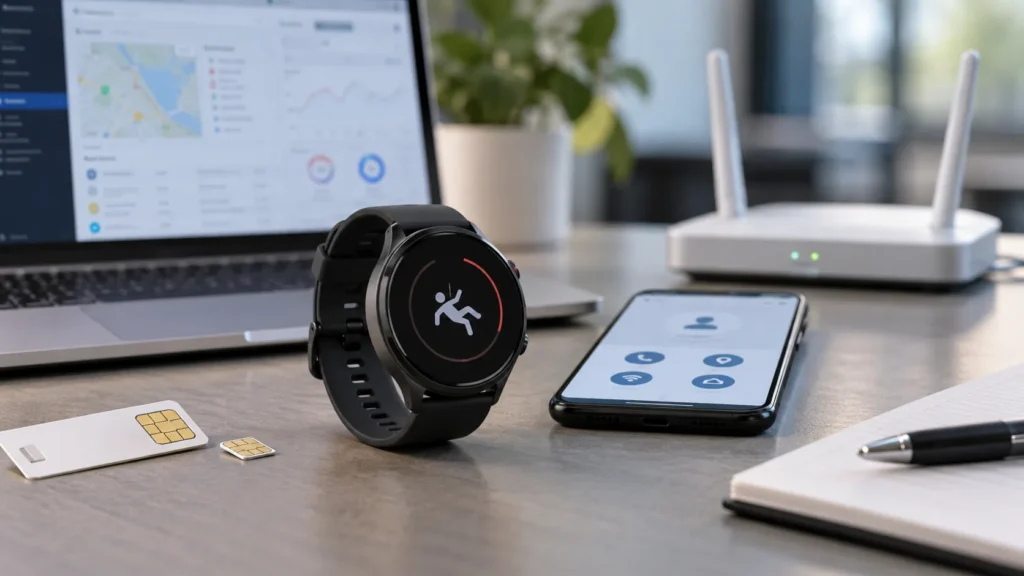
Loss of cellular service does not automatically stop local sensing. If detection and confirmation are implemented on the device, the watch may still recognize a suspected fall and create a local event. What it cannot do is complete functions that require the unavailable route.
The user experience and platform state should make this visible. A local trigger should not be labeled “delivered,” “caregiver notified,” or “help contacted” unless evidence exists for that later stage. Useful states may distinguish local creation, transmission pending, transmission failed, server received, contact attempted, and acknowledged. The exact state names are less important than preventing one technical milestone from being mistaken for another.
Offline behavior also needs a defined recovery path. A design may retain an event, retry it after reconnection, or discard certain data, but queue duration, retry timing, and duplicate handling are configuration-specific. When an event is sent later, the platform should preserve the original event time rather than making a delayed upload appear new. If location is last-known, delayed, or unavailable, that status should travel with the event.
Recovery can create additional risks. A watch may reconnect to data before voice service becomes usable. Several queued messages may arrive together. A retry through a second route may duplicate an event already accepted through the first. These are service-design questions that must be resolved before the workflow is used in a care or safety program.
What Should Buyers Verify Before Deployment?
Verification should use the exact combination intended for deployment: watch hardware, firmware, SIM or eSIM profile, operator, subscription, backend, app, and target country. A laboratory result from another configuration is not enough.
At minimum, the project team should check:
- target LTE bands and operator access in each market;
- SIM or eSIM activation, APN settings, data entitlement, and roaming policy;
- voice entitlement, IMS or VoLTE configuration, dialed-number rules, and call behavior where voice is part of the service;
- Bluetooth permissions, background app behavior, and phone absence for phone-dependent designs;
- Wi-Fi enrollment, authentication, coverage boundaries, and recovery after leaving the network;
- weak-signal behavior, network loss, reconnection time, and visible device status;
- whether current, last-known, pending, and unavailable location states are distinguishable; and
- how the backend reconciles delayed events, retries, and duplicate messages.
Cellular data registration should never be used as the sole acceptance test for voice. Teams can use the medical alert watch two-way voice testing workflow to separate call setup, audio, operator support, and firmware behavior from data connectivity.
Build a Loss-and-Recovery Test
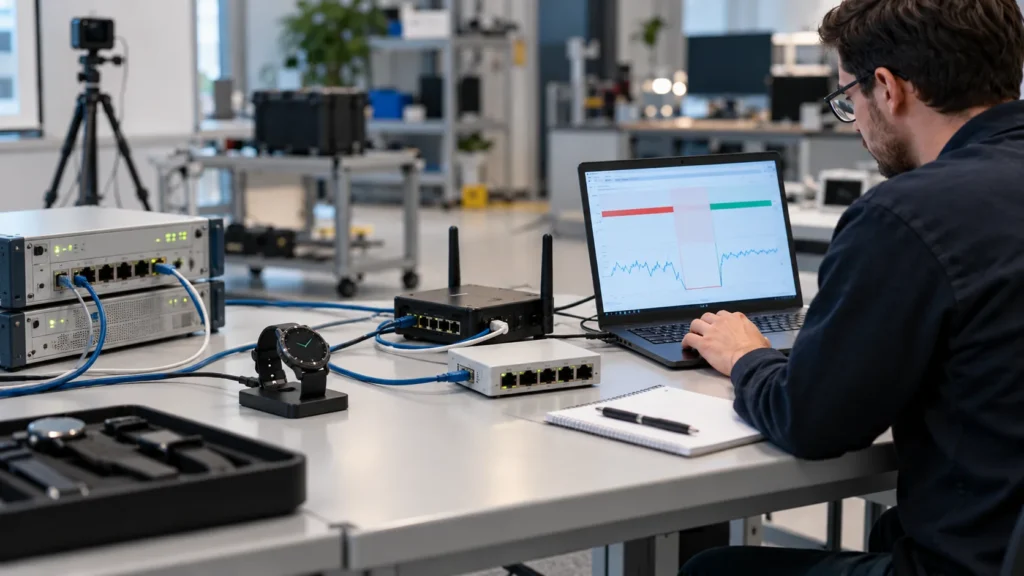
A controlled loss-and-recovery test provides better evidence than checking the signal icon. The test should produce an event trail that device, backend, QA, and service teams can compare.
- Establish the normal baseline. Confirm local detection, alert transmission, location behavior, platform receipt, and voice communication under normal service.
- Remove the intended route. Create a controlled cellular outage or disconnection without changing unrelated settings.
- Trigger the local event. Record whether sensing, the wearer prompt, cancellation, and local event creation still behave as specified.
- Observe remote attempts. Check call attempts, data transmission, platform state, location status, and the message shown to the wearer.
- Restore service. Record registration, reconnection, retry, queued-event delivery, and any voice-service delay.
- Reconcile the evidence. Verify the original event time, later transmission time, location time, event identifier, duplicate handling, and final disposition.
Acceptance criteria should report local trigger success and remote delivery success separately. A pass for detection cannot compensate for a failed notification route, and a server receipt cannot compensate for an untested human response. The goal is to know exactly where the workflow stops and what each participant can see.
Conclusion
Cellular service is not necessarily required for the sensor algorithm or local event creation, but remote fall-alert workflows need a tested communication path. A dependable design separates detection, confirmation, transmission, voice, location, acknowledgement, and response, then exposes failures instead of hiding them behind a single “alert” state.
For a fall detection watch project, share the target countries, operator and SIM assumptions, alert destinations, and whether the wearer must operate independently of a phone. WearIntell can then review the connectivity architecture and define configuration-specific pilot cases.
Frequently Asked Questions
Can a fall detection watch work without the internet?
It may continue local sensing, classification, prompting, and event creation if those functions run on the watch. Remote notification, platform updates, and calls still require the configured communication route. Offline behavior depends on the product firmware and service design.
Is GPS the same as cellular connectivity?
No. GPS or another GNSS can produce a position, while cellular or another network carries that position to a remote recipient. Either step can succeed while the other is unavailable, so location source, time, freshness, and transmission status should be reported separately.