
A telecare provider needs SOS alerts from cellular watches to reach its existing monitoring platform. Another company wants customers to pair compatible watches with its mobile app.
Both projects involve smartwatch integration, but they face different technical decisions.
The first may require a cloud API, while the second may use a mobile SDK. Some projects need both. Choosing correctly requires more than comparing interface features: the buyer must understand where the data travels, which services the device depends on, and who will maintain the connection after launch.
Smartwatch API vs SDK: What’s the Difference?
An API (Application Programming Interface) defines how software components exchange information or request actions. A smartwatch project might use an API to exchange supported device events, status information, or commands with another system.
An SDK (Software Development Kit) provides libraries, documentation, and other tools that help developers implement supported functions. A mobile SDK might simplify communication between a compatible watch and a smartphone application.
An SDK can contain APIs, so the two terms are not mutually exclusive.
For wearable buyers, the practical comparison is often between a cloud API used for backend integration and a mobile SDK used within an application.
| Question | Cloud API | Mobile SDK |
|---|---|---|
| Where is it commonly used? | Backend or cloud platform | Mobile application |
| What does it typically provide? | Access to supported data, events, and commands | Tools for implementing supported device functions |
| What does it depend on? | Available service interfaces and backend connectivity | Compatible devices, libraries, and mobile operating systems |
| Who normally maintains the customer-side work? | Backend development team | Application development team |
This distinction gives buyers a starting point. It does not establish which functions a particular watch supports or whether either interface is available for the proposed model.
Start With the Data Path, Not the Interface Name
Suppose a company wants to connect a standalone 4G SOS smartwatch to its existing monitoring system.
The watch must send an alert without relying on the wearer carrying a smartphone. A typical architecture may involve a cellular network, a device cloud, and an interface connecting that cloud to the customer’s backend.
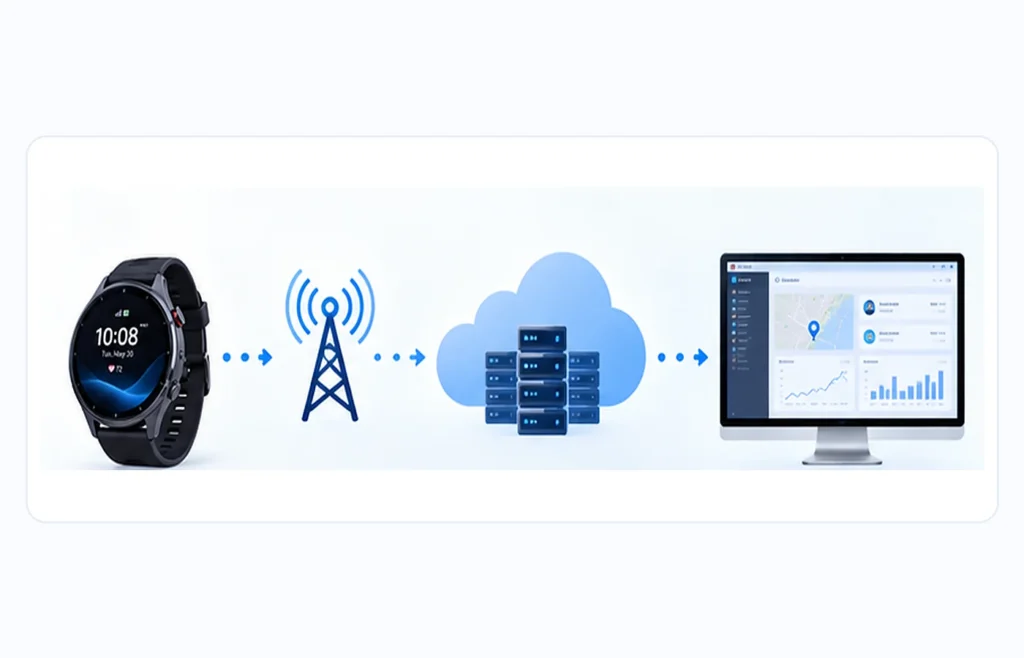
In this situation, asking only whether an SDK is available misses the main requirement. The buyer needs to establish how the watch communicates with the monitoring platform.
Now consider a different product: a wearable that exchanges information with a companion application through Bluetooth.
The smartphone may handle pairing, selected settings, and synchronization. A mobile SDK could be useful because the application is part of the intended operating model.
A third product may use both paths. Its app handles configuration while its backend supports user accounts, service management, and data exchange.
The important question is where each essential function belongs.
| Project Requirement | Likely Starting Point | Critical Question |
|---|---|---|
| Connect a watch to an existing app | Mobile SDK | Can the SDK access the required functions on supported devices? |
| Receive events from standalone cellular watches | Cloud API or agreed backend interface | Can the device deliver the required information without a smartphone? |
| Support app functions and backend services | SDK and API, where appropriate | Which system owns each function and data flow? |
These are architecture starting points, not guaranteed implementations. Actual device and service capabilities must be confirmed before development.
Who Controls the Cloud Between the Watch and Your Platform?
This question can have a greater long-term impact than the choice between API and SDK.
An advertised cloud API does not necessarily give the customer direct access to the smartwatch. The watch may communicate first with infrastructure operated by the manufacturer or another service provider.
The customer’s software then connects to that infrastructure through the agreed API.
That arrangement may work well, but it creates dependencies that should be understood before purchase.
For example, the buyer should determine:
- Who operates the device cloud and manages service availability?
- Does the customer receive access to the required information or only selected data?
- Are cloud hosting and interface access included in the commercial agreement?
- How are interface changes communicated and tested?
- What happens to the integration if the service agreement ends?
The answers can influence the choice of manufacturer, product platform, and integration architecture.
A company may own its monitoring software but still depend on the device supplier to maintain the connection between the watches and that software.
This is not necessarily a reason to reject a supplier-managed cloud. It is a reason to make the dependency visible and define the responsibilities.
For a project involving WearIntell, the proposed device, firmware, available interfaces, and cloud arrangement should be reviewed together rather than treated as separate purchases.
When Can a Mobile SDK Create an Unnecessary Dependency?
A mobile SDK can simplify development when the smartphone is an essential part of the product.
However, buyers should avoid adding a phone-dependent connection simply because an SDK is available.
Consider an elderly safety watch intended to initiate emergency communication when its wearer is outside the home.
If the required SOS function depends on a nearby smartphone, the service may become unavailable when the phone is absent, disconnected, or unable to perform the required operation.
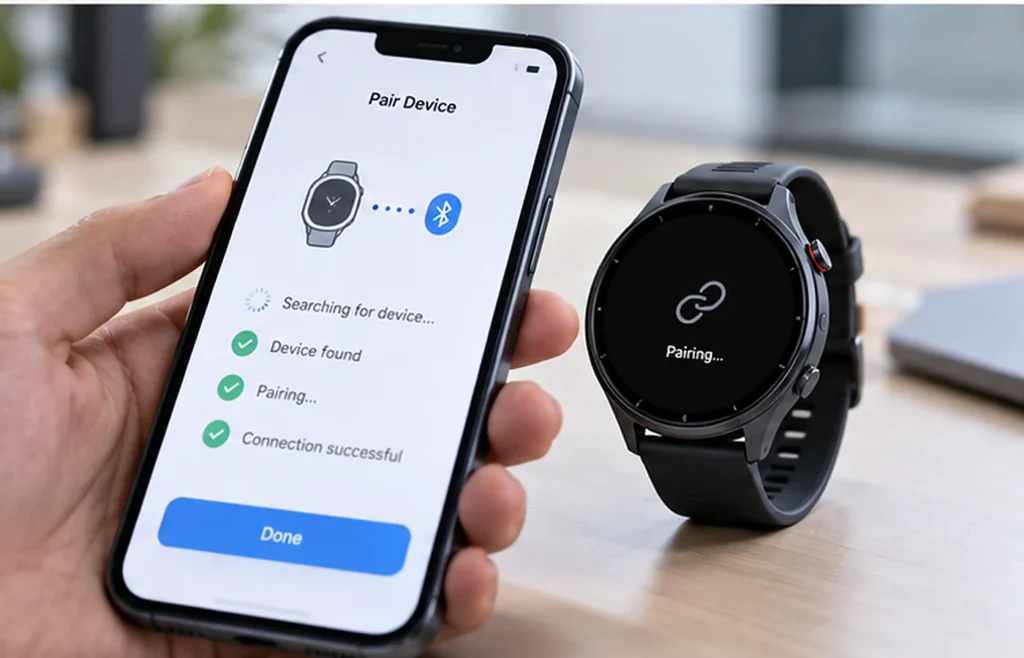
A standalone cellular watch may use a different communication path for emergency functions while still offering an app for setup or selected user features.
The buyer should therefore distinguish essential device functions from optional companion-app functions.
There are also maintenance considerations.
Mobile operating-system updates can affect permissions, background behavior, and communication with connected devices. SDK versions and device firmware may change over time.
An integration that works during initial development still needs a defined compatibility and support arrangement.
Before choosing an SDK-based architecture, establish whether the intended device functions genuinely require a smartphone and which team will maintain that application.
What Happens When Part of the Integration Fails?
Successful data exchange during a demonstration does not prove that the complete system will behave as intended after deployment.
Different architectures have different failure points.
A phone-dependent wearable may lose certain functions if the application is closed, the phone is unavailable, or the local device connection fails.
A cellular wearable may remain connected to the network while its supplier-managed cloud or customer API becomes temporarily unavailable.
A backend may receive an event successfully but fail to complete the customer’s intended workflow.
These outcomes are not equivalent.
For safety-related applications, the customer and manufacturer should determine which functions continue during interruptions and how failures become visible.
Consider the following example.
A watch generates an SOS event while the customer’s monitoring platform is unavailable. The project specification should define what the device and intermediate systems are expected to do, whether delivery can be retried, and how the service operator is informed of an unresolved event.
These behaviors must be established through supported functions and agreed technical requirements. They should not be assumed because the supplier advertises an API.
The integration should be tested using the actual device, firmware, network configuration, interfaces, and receiving platform intended for deployment.
Five Questions That Can Change Your Integration Decision
Before selecting an API, SDK, or combined approach, ask the supplier to address five issues.
| Buyer Question | What to Confirm | Why It Matters |
|---|---|---|
| Can the watch operate without a phone? | Which essential functions require an app or local connection | Determines the necessary system architecture |
| Who operates the device cloud? | Hosting, access, service responsibilities, and support terms | Reveals long-term supplier dependencies |
| Which functions are exposed? | Supported events, data, commands, models, and firmware versions | Establishes whether the interface meets actual requirements |
| What happens during interruptions? | Supported failure behavior and agreed recovery expectations | Identifies operational limitations before deployment |
| Who maintains compatibility? | SDK, firmware, API, and operating-system update responsibilities | Reduces uncertainty after launch |
A useful supplier response should refer to the proposed configuration, not a general capability list.
For example, confirmation that a manufacturer offers APIs does not establish whether an existing watch can provide a particular command or data field.
Likewise, availability of an Android SDK does not prove that the same functions are supported on iOS.
If a required function depends on additional development, that work should be identified separately from the standard integration scope.
What Should Be Agreed Before Development Starts?
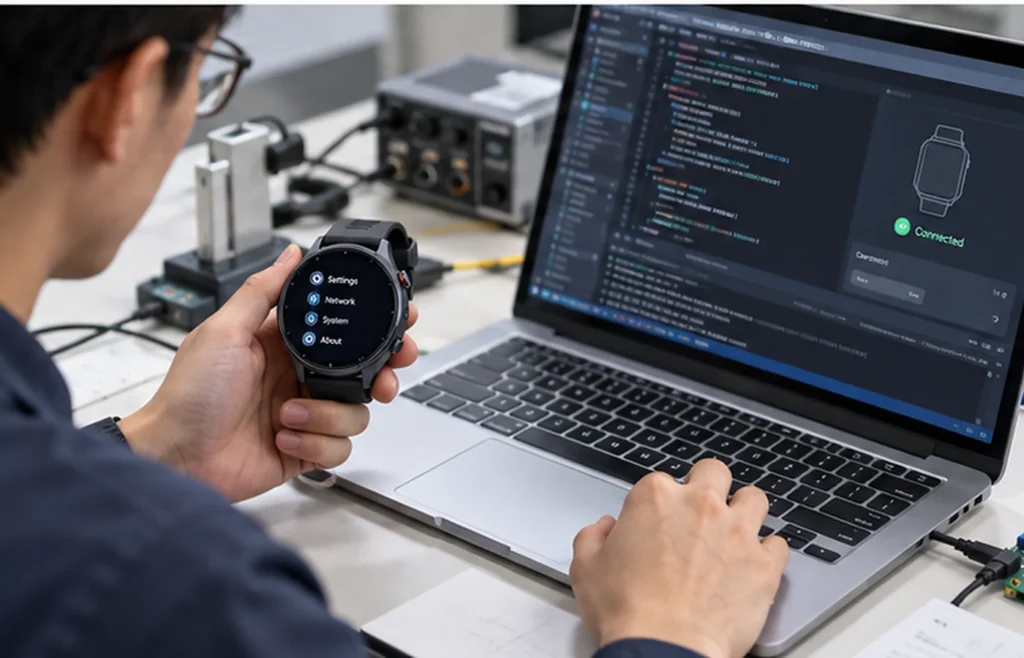
A technically sound integration project begins with a clear description of the existing system and required device behavior.
The buyer should provide its application or backend architecture, target device functions, preferred connectivity model, intended markets, and any important operational constraints.
The supplier should then confirm the relevant interfaces, supported device configurations, documentation, responsibilities, and acceptance criteria.
These points should be reflected in the integration scope before substantial development begins.
WearIntell’s smartwatch API and SDK integration services provide a starting point for discussing supported interfaces and project-specific engineering requirements.
The objective is not simply to connect two systems once. It is to establish an integration that the customer can operate, test, maintain, and support throughout the intended product lifecycle.
Choose the Architecture You Can Maintain
A cloud API may be appropriate when the customer needs wearable information in an existing backend. A mobile SDK may fit a product built around a companion application. Some projects require both, while others benefit from fewer software dependencies.
The deciding factors are the required functions, actual connection path, service ownership, failure behavior, and maintenance responsibilities.
Before requesting integration work, establish what the watch must do, where its information must go, and who will keep each part of the system operating.
That gives both the buyer and the engineering team a much stronger basis for selecting an integration approach.