
Presentations, quotations, and polished samples leave important questions unanswered. A sample can show that a device works once, but not whether the manufacturer can reproduce the approved configuration, control firmware versions, trace component changes, or investigate field failures.
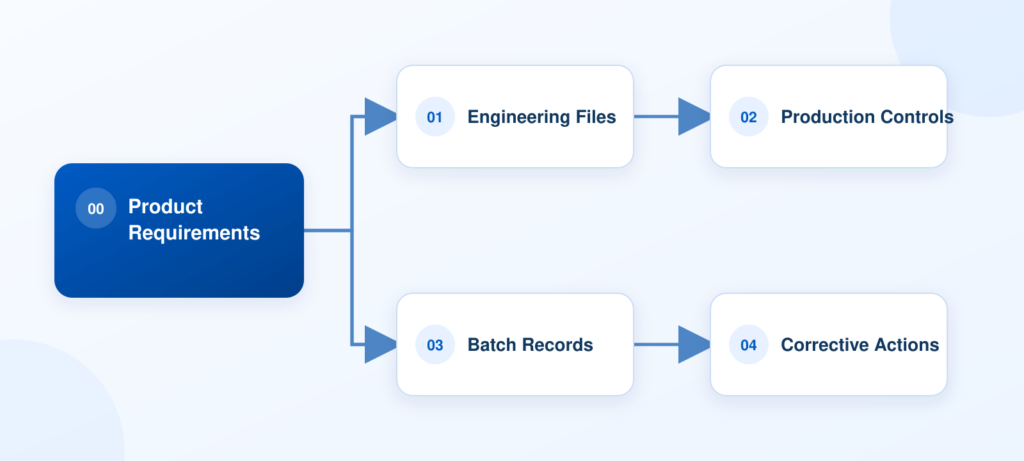
A wearable device manufacturer audit should test evidence, not confidence. Buyers need to see how requirements become drawings, bills of materials, firmware releases, inspection criteria, production records, and corrective actions. It should also separate manufacturer, buyer, laboratory, platform-provider, and component-supplier responsibilities.
This guide gives healthcare brands, safety-service providers, system integrators, and distributors a practical framework for auditing an OEM/ODM wearable manufacturer before production.
What a Wearable Device Manufacturer Audit Should Prove
An audit should determine whether the supplier’s processes can support the specific product and risk profile—not simply whether the factory looks organized.
A useful audit should answer five questions:
- Can the supplier build the agreed product? Engineering files, tooling, software ownership, and component availability should match the proposed scope.
- Can it build the same product repeatedly? Work instructions, controlled specifications, inspection methods, and production records should support consistency from batch to batch.
- Can it identify what changed? Hardware revisions, firmware builds, approved substitutions, and process changes should be recorded and linked to affected units.
- Can it detect and contain problems? Nonconforming material, failed units, customer complaints, and corrective actions should follow defined workflows.
- Can the buyer verify the result? Acceptance criteria, test reports, samples, and traceability data should be available in a form the buyer can review.
Audit depth should be risk-based. A private-label activity tracker does not require the same review as a connected safety watch that sends alerts, shares location, or integrates with a care platform. A regulated medical device may also face requirements that do not apply to a general wellness product.
For devices placed on the US market as medical devices, buyers should obtain qualified regulatory advice. The FDA’s Quality Management System Regulation became effective on February 2, 2026, and incorporates ISO 13485:2016 by reference. That does not make every wearable a medical device, and a supplier certificate alone does not establish project compliance.
Define the Product and Audit Scope First
Before requesting documents or visiting a facility, issue an audit brief covering the product, target market, intended users, customization level, software environment, and expected production volume.
The brief should distinguish among three development paths:
- Existing platform: The buyer selects a developed device and changes branding, packaging, interface elements, or configuration.
- Modified platform: The project uses an existing foundation but changes hardware, firmware, enclosure parts, sensors, communications, or integrations.
- Custom development: The manufacturer performs substantial product, mechanical, electronic, firmware, application, or platform work for the project.
For an existing platform, focus on configuration control, applicable validation, and production consistency. For a modified or custom product, review design inputs, verification, issue closure, and production transfer.
Prepare a responsibility matrix for specifications, design, source code, cloud services, applications, certification coordination, fixtures, tooling, production data, and updates. If a critical function comes from a third party, ask how that party is qualified and how changes are communicated.
A certificate list should never replace this scoping step. Certification needs depend on product classification, claims, radio technologies, battery configuration, materials, target countries, and sales channel. The audit should verify that any document presented applies to the correct legal entity, site, model, configuration, and validity period.
Review Engineering and Design Evidence
Wearables combine mechanics, electronics, sensors, firmware, connectivity, applications, and sometimes cloud services. An assembly-line review alone can miss failures that later appear in production or deployment.
Choose one representative project and trace it from requirements to an approved build. The supplier should show how requirements became technical specifications and acceptance criteria. Relevant evidence may include:
- product requirement and technical specification documents;
- mechanical drawings, material specifications, and approved color or finish standards;
- schematics, PCB files, and a controlled bill of materials;
- firmware and application version records;
- interface specifications for Bluetooth, cellular, Wi-Fi, APIs, or SDKs;
- engineering review records and unresolved-issue lists;
- verification plans, test results, and approval records;
- an approved sample or clearly defined golden-sample process.
Do not assess file names alone. Trace several requirements through the evidence. For a stated waterproofing level, examine the enclosure, seals, assembly process, test method, and production sampling. For an emergency event, examine the event fields, network behavior, retries, and software versions tested.
For connected products, version control is especially important. The auditor should be able to connect a shipped unit to its hardware revision, firmware version, configuration, and relevant application or platform release. Ask what prevents an unapproved build from reaching production and how the supplier handles urgent firmware fixes after release.
Development stages may be called EVT, DVT, PVT, pilot build, or something else. Each should have defined objectives, sample quantity, test scope, open issues, disposition, and approval authority. An acceptable demo sample is not production-readiness evidence.
Verify Manufacturing and Quality Controls
Follow the actual product flow—from incoming materials through assembly, programming, testing, packing, and release—and compare procedures with actual practice.
Use the following wearable manufacturer audit checklist as a starting point:
| Audit area | Evidence to request | Questions to test |
| Incoming control | Approved supplier list, material specifications, inspection records, nonconformance history | Are critical components verified against the approved part and revision? |
| Production setup | Work instructions, line-clearance records, first-article approval | How does the line confirm the correct model, tooling, firmware, and configuration? |
| Process control | Defined parameters, operator training, in-process checks | Which steps are controlled, and what happens when a result is outside limits? |
| Test equipment | Equipment list, maintenance and calibration records, fixture validation | Can the supplier show that a passing result is produced by a suitable, controlled method? |
| Final inspection | Functional test criteria, visual standards, sampling plan, release record | Do tests cover the buyer’s critical functions and agreed acceptance criteria? |
| Nonconforming product | Segregation, labeling, review, rework, scrap, and concession records | Can failed material accidentally return to normal production? |
| Corrective action | Root-cause analysis, containment, action verification, recurrence monitoring | Does the supplier close causes or only repair affected units? |
Pay attention to hidden sources of variation such as adhesive curing, waterproof assembly, sensor placement, antenna assembly, battery installation, firmware programming, and test-fixture setup. Critical processes vary by design.
Sampling plans also need context. Ask who approved the sampling level, what defect categories are used, and whether critical characteristics receive different controls. A generic inspection report is weak evidence if it cannot be connected to the purchase specification, production lot, inspection equipment, inspector, and disposition.
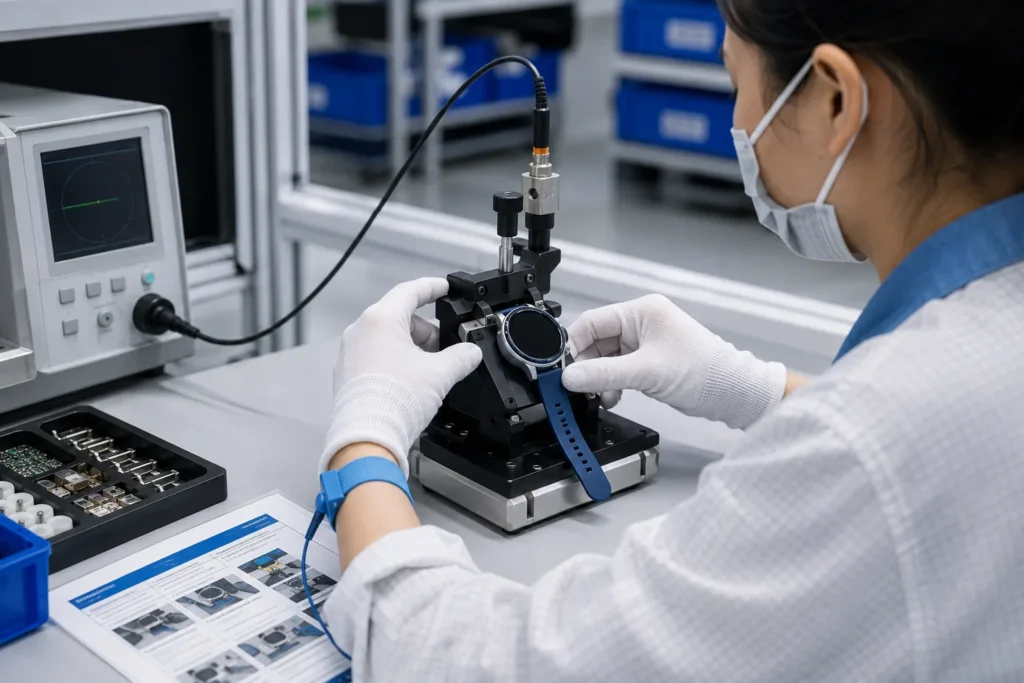
During a smartwatch manufacturer audit, select a recent batch and reconcile quantities at several points: units started, units failed, units reworked, units scrapped, and units released. Unexplained gaps can reveal weaknesses in recordkeeping or product control.
Check Traceability, Changes, and Post-Launch Support
Wearable programs change after launch as components, firmware, network requirements, and field issues evolve. Audit lifecycle controls as well as initial production.
Ask the manufacturer to demonstrate traceability for a finished unit or batch. Records may connect its serial number or lot to the production date, line, key components, firmware, tests, rework, and release status. Define the required traceability before ordering.
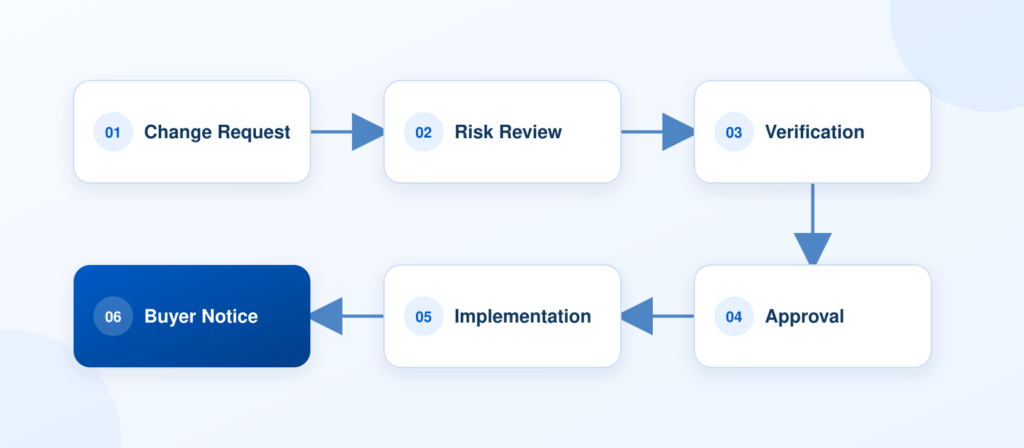
Next, review the change-control process. A credible process should define:
- which hardware, software, material, supplier, tooling, or process changes require review;
- how the affected products and customers are identified;
- what verification or regression testing is required;
- who can approve the change;
- how old and new configurations are separated;
- when and how the buyer is notified;
- how effective dates and first affected batches are recorded.
Trace one completed change from proposal to production. The record should show its reason, risk assessment, testing, approval, implementation date, and affected configuration. An “equivalent” substitution still needs documented evaluation.
Ask how complaints are logged, investigated, and linked to production or software records. Confirm the path for field containment, replacements, firmware updates, and corrective actions. For integrated products, define how device and platform teams share logs and own incident investigation.
Make an Evidence-Based Supplier Decision
An audit report should separate observations by risk and required action. A practical decision model includes:
- Approved: Evidence supports the defined scope, and any minor observations have acceptable actions.
- Conditionally approved: The supplier may proceed only after specified evidence, corrections, or pilot results are accepted.
- Not approved: Major gaps prevent the buyer from establishing product control or production readiness.
Avoid turning the result into a simple total score that allows many low-risk strengths to cancel one critical weakness. Missing configuration control, unverified safety-related requirements, unauthorized substitutions, or ineffective containment may justify a stop regardless of the overall percentage.
Every finding should state the requirement, evidence, risk, owner, due date, and closure method. Important gaps may require a new sample build, process demonstration, repeat test, or follow-up audit.
Supplier approval is also not permanent. Ongoing monitoring can include incoming defect rates, production yield, on-time delivery, field returns, complaint response, change notifications, audit findings, and corrective-action effectiveness. The frequency and depth should reflect product and supplier risk.
For buyers evaluating a new OEM/ODM wearable project, WearIntell can discuss the product scope, engineering handoffs, production controls, and documentation available for review. Its quality inspection capabilities provide a useful starting point for defining a project-specific audit and acceptance plan.
A strong wearable device manufacturer audit does not attempt to eliminate every commercial or technical risk. It makes those risks visible, assigns responsibility, and establishes the evidence required before the project advances from sample approval to production.
Frequently Asked Questions
When should a wearable device manufacturer audit take place?
Conduct the initial audit after the project scope and risk profile are clear but before a major production commitment. For modified or custom devices, an additional review before pilot or mass production may be appropriate because the process and configuration may have changed since supplier selection.
Is a quality-system certificate enough to approve a wearable manufacturer?
No. A certificate may be relevant evidence, but buyers should verify its issuer, scope, legal entity, site, standard, and validity. They should also audit whether the processes and records for the selected product actually support the agreed requirements. Product classification and target-market obligations require separate review.
What records should buyers request after the audit?
At minimum, retain the audit scope, agenda, attendees, reviewed evidence, findings, supplier responses, corrective-action approvals, and final decision. Project records may also include agreed specifications, version lists, approved samples, test reports, change-notification terms, quality agreements, pilot results, and production acceptance records.