
A medical alert watch with no monthly fee may appear to offer emergency alerts, location reporting and communication without any continuing expense. In practice, the phrase usually describes one part of the service arrangement rather than the full cost of operating a connected medical alert program.
The device may be purchased without a professional monitoring subscription, but cellular connectivity, cloud hosting, app maintenance or platform operation may still create ongoing costs. Those costs may be paid by the user, distributor, telecare provider, care organization or another service partner.
For organizations planning a medical alert watch program, the more useful question is not simply whether a monthly fee exists. It is which services are included, which services are managed separately and who remains responsible for each part of the alert workflow.
What Does “Medical Alert Watch with No Monthly Fee” Mean?
The phrase is used differently across products and service models. It should not be treated as a complete description of what the watch requires after deployment.
Depending on the offer, “no monthly fee” may mean:
- No subscription to a professional monitoring center
- No recurring device-management charge from the hardware supplier
- No bundled cellular plan
- No paid consumer app subscription
- A one-time hardware purchase with other services arranged separately
These arrangements are not equivalent.
For example, a watch may contact designated family members rather than a monitoring center. This can remove the professional monitoring fee, but the watch may still need an active cellular connection to place calls or transmit alerts.
Another watch may connect to a platform operated by a telecare provider. The hardware supplier may not charge a recurring subscription, while the provider continues to pay for hosting, connectivity, technical support and alert handling.
A smart watch with medical alert functions can therefore be sold without a bundled monthly service while still depending on continuing infrastructure.
Before describing a product as having no monthly fee, the provider should state exactly which recurring service is not included and which operating costs remain.
The Costs Behind a Medical Alert Watch Service
A medical alert watch is one component of a wider communication and response system. Separating the main cost layers makes it easier to compare different offers and service structures.
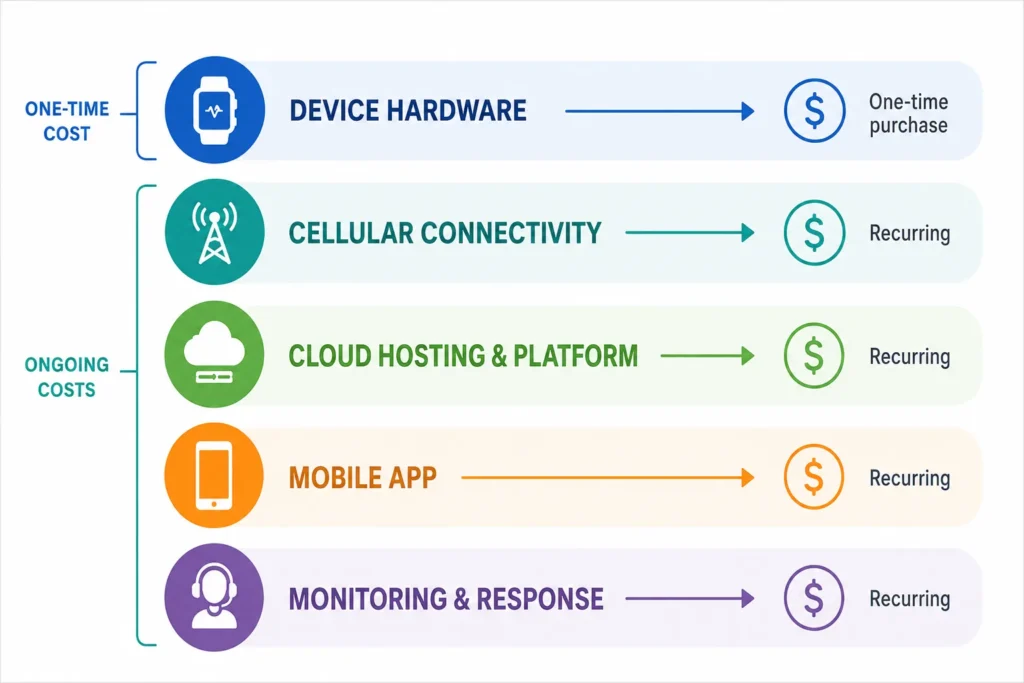
Device hardware
The initial device price covers the physical watch and the functions included in its approved configuration. These may include a manual SOS control, speaker, microphone, positioning components, communication hardware and other selected features.
Costs can vary according to the hardware platform, enclosure, charging design, branding requirements and customization scope. Firmware changes, structural development, private-label packaging or project-specific testing may also be quoted separately.
Paying for the device does not automatically provide network access, server operation or monitoring personnel.
Cellular connectivity
A medical alert watch may use GPS to determine its location, while cellular connectivity can be required to transmit that location, send an alert or support two-way voice outside Wi-Fi coverage.
Depending on the project, connectivity may be managed by:
- The medical alert or telecare provider
- A distributor in the target market
- A third-party connectivity partner
- The organization deploying the devices
The commercial arrangement should specify whether a SIM or other connectivity service is included, who activates it and who pays the continuing network charges.
A medical alert watch with GPS should not be assumed to include permanent cellular service simply because the device supports location reporting.
Cloud hosting and backend operation
Connected alerts may pass through a server or backend before reaching a caregiver app, monitoring dashboard or existing telecare platform.
Depending on the system design, the backend may receive events, route alerts, manage device records or exchange selected information with another platform. The exact functions depend on the approved project configuration.
Relevant costs may include hosting, platform maintenance, technical support, security updates and system administration.
Even when the device manufacturer does not charge a subscription, another party may still need to operate and fund this infrastructure.
Mobile application development and maintenance
Some medical alert watches connect to an app used by caregivers, service teams or family members.
An app may be free for the end user to download, but it still requires development and maintenance. Potential costs include:
- Initial app development or adaptation
- Private-label branding
- App store account management
- Compatibility updates
- Backend communication
- Technical support
- Ongoing maintenance
For organizations deploying a medical alert smart watch under their own brand, app ownership and maintenance responsibilities should be agreed before production.
Monitoring and response services
Professional monitoring is an operational service rather than a standard hardware function.
A monitoring organization may receive an alert, review the available information, attempt voice contact and follow a defined escalation process. Providing that service requires trained personnel, operating procedures and supporting systems.
A watch can also use a direct-notification model in which alerts go to selected caregivers, family members or an internal care team. This may avoid a professional monitoring subscription, but it does not guarantee that the recipient will be available or that emergency assistance will be dispatched.
The response model must therefore be defined separately from the watch purchase.
Four Ways a No-Monthly-Fee Model May Be Structured
The same wearable can be used within different commercial and operational models. Understanding these structures helps providers decide which responsibilities they are prepared to manage.
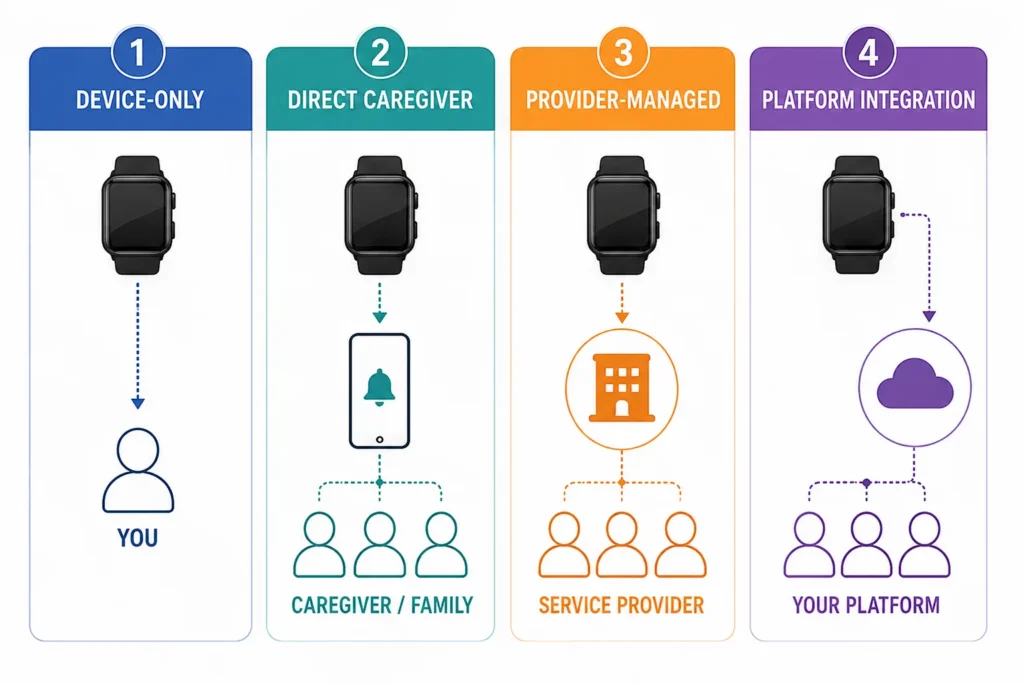
Device-only model
In a device-only arrangement, the buyer purchases the hardware and manages the supporting services independently.
The buyer may be responsible for arranging:
- Cellular connectivity
- Platform or server access
- Alert routing
- App operation
- Device activation
- Customer support
This approach can give an experienced provider greater control over its service. It can also create more integration and operational work.
A device-only quote should identify what technical resources or documentation are included and what the buyer must build or source separately.
Direct caregiver notification model
In this model, the watch sends an alert to designated caregivers, family members or an organization’s own care team rather than to an external monitoring center.
Depending on the configuration, pressing the SOS button may initiate a call, send a notification or generate an event in an app or platform. Two-way voice may allow the wearer and recipient to communicate after the alert.
This structure may remove the cost of professional monitoring, but it does not necessarily remove cellular, cloud or app costs.
Providers should also explain that a direct alert does not guarantee that a contact will answer or respond.
Provider-managed service model
A medical alert provider, senior care organization or distributor may purchase the watch and include it within its own paid service.
The provider can decide how to package hardware, connectivity, platform access, support and monitoring for its customers. The end user may pay the provider a recurring fee even when the device manufacturer does not operate a subscription program.
In this arrangement, a wearable development partner such as WearIntell can support the device side of the project while the provider retains control over pricing, account management and response operations.
This distinction is important: a watch can be supplied for use in a subscription-based service without the manufacturer acting as the subscription provider.
Existing-platform integration model
Some organizations already operate a monitoring dashboard, care platform, call center system or device-management environment.
Instead of adopting a separate consumer service, they may need a watch that can connect with the existing workflow.
This model requires early discussion of:
- How alerts are generated and transmitted
- Which system receives each event
- What information is exchanged
- Who manages device accounts and settings
- How the integration will be tested
- Who maintains the connection after deployment
The device price may be a one-time cost, but the organization must still account for its own platform operation and integration support.
Questions to Answer Before Advertising “No Monthly Fee”
The phrase can be useful in customer communication, but only when the excluded and remaining costs are clearly explained.
Providers should answer the following questions before using it in a product page, sales document or service agreement.
Is cellular service required?
Determine whether the intended alert, voice and location functions require an active cellular connection.
The commercial documentation should explain whether connectivity is supplied with the device, arranged by the provider or sourced by the customer.
Who operates the backend?
Identify whether the watch connects to a supplier-hosted environment, the provider’s own platform or another approved system.
Hosting, maintenance and technical-support responsibilities should be documented rather than assumed.
Is an app required?
Confirm whether caregivers or service personnel need an app to receive alerts or view available device information.
The project should also define who owns, publishes, updates and supports the application.
Who receives an SOS alert?
The recipient may be a caregiver, relative, internal care team, monitoring center or provider-operated platform.
The answer affects the required connectivity, software and response process.
What happens after the alert?
A manual SOS event begins a workflow; it does not by itself define the response.
Providers should establish whether the watch places a call, sends an app notification, reports an event to a platform or performs a configured combination of actions.
No device should be promoted as guaranteeing caregiver availability or emergency response.
Is professional monitoring included?
If there is no monitoring subscription, explain who is expected to receive and handle the alert.
If professional monitoring is included through another provider, describe it as a separate service rather than implying that it is part of the one-time watch price.
Who supports the deployed devices?
Users may need assistance with charging, connectivity, contact settings or basic device operation.
For larger programs, responsibility for activation, replacement, support and account management should be assigned before deployment.
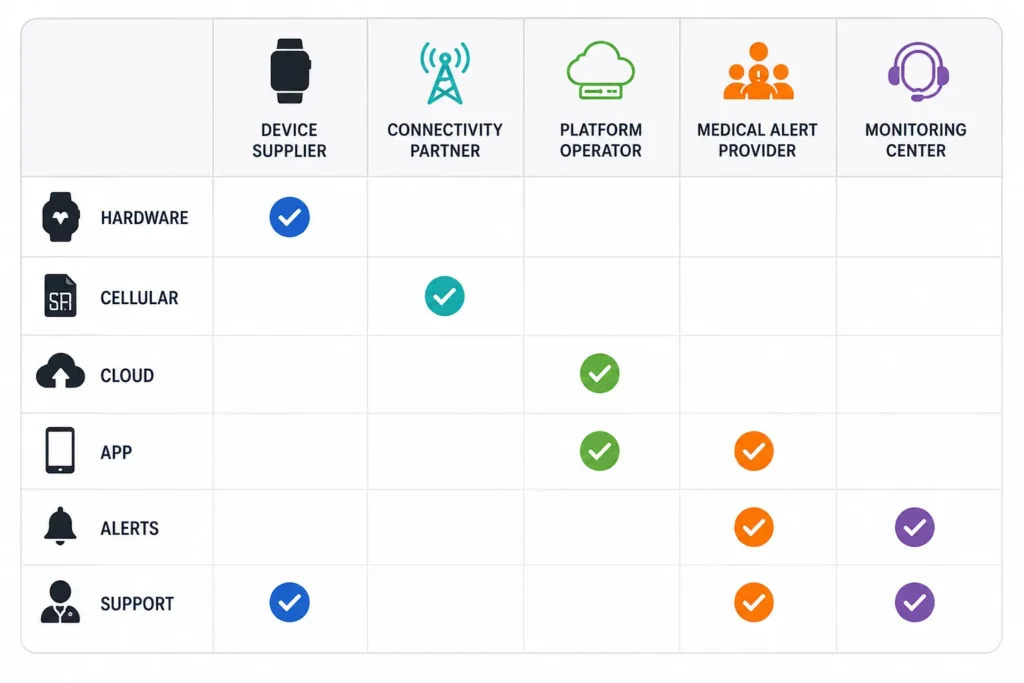
Define Service Responsibilities Before Choosing the Watch
A provider should define the operating model before finalizing the hardware configuration.
The project team should first decide:
- Who purchases and manages connectivity
- Who hosts the platform
- Who maintains the app
- Who receives alerts
- Who provides customer support
- Whether professional monitoring is part of the service
- Which costs are one-time and which are recurring
Once these responsibilities are clear, the organization can evaluate a suitable medical alert watch for the intended workflow.
The selected configuration may support manual SOS, optional fall detection, two-way voice, location reporting and connection to a caregiver or monitoring platform, depending on the project requirements.
Fall detection should be evaluated as an optional alert-support function rather than a guaranteed emergency safeguard. Its performance may be affected by movement type, wearing position, sensor configuration, detection logic and alert settings.
WearIntell can discuss device configuration, OEM/ODM customization and platform-integration requirements without operating the provider’s customer subscription or monitoring service. A useful initial discussion should cover the intended users, target market, alert recipients, connectivity arrangement and existing software environment.
Conclusion
A medical alert watch with no monthly fee does not necessarily operate without continuing costs.
The phrase may mean that there is no professional monitoring subscription, no hardware-supplier platform fee or no bundled service contract. Cellular access, cloud hosting, app maintenance, technical support and response operations may still need to be paid for and managed by another party.
Providers should therefore evaluate the complete service model rather than comparing devices only by their initial purchase price.
Before deployment, define who is responsible for the device, connectivity, platform, app and response workflow. This makes pricing clearer, reduces integration surprises and helps the selected watch fit the intended medical alert or telecare service.
Frequently Asked Questions
Can a medical alert watch work without a monthly subscription?
It may work without a professional monitoring subscription, depending on its configuration. Alerts might be sent directly to caregivers, family members or a provider-operated platform. However, cellular connectivity, hosting, app maintenance or internal support may still create continuing costs. The complete service structure should be confirmed before the watch is described as subscription-free.
Does a no-monthly-fee watch still need cellular service?
It may. GPS can determine the watch’s location, but the device may need cellular connectivity to transmit that location, send alerts or support voice calls when Wi-Fi is unavailable. The cellular plan may be managed by the provider, distributor or another connectivity partner rather than included in the hardware price.
Can WearIntell supply the device without operating the monitoring service?
Yes. WearIntell can support medical alert watch development, manufacturing, customization and platform-integration discussions without operating the provider’s customer subscription or professional monitoring service. The buyer can define its own connectivity, billing, alert-handling and response model according to the project structure.