
Smartwatch fall detection uses sensors and algorithms to identify falls. If the wearer doesn’t respond, the device sends an alert to emergency contacts.

Core Logic of Smartwatch Fall Detection
Below, we’ll break down the principles in detail, focusing on WellCare’s technical solutions.
How does the fall detection feature in a smartwatch work?
What sensors are used in a fall detection smartwatch?
Accelerometers measure changes in speed and direction, gyroscopes measure orientation, and barometers can detect sudden changes in altitude (which may mean falling from a height, although this is relatively rare).

Schematic Diagram of Core Sensor Collaboration for Smartwatch Fall Detection
How does a smartwatch with fall detection for seniors distinguish between falls and other movements?
Smartwatches analyze sensor data through algorithms, considering the intensity of the impact, the direction of movement, and sudden deceleration, combined with threshold settings to determine whether a fall is suspected.
The specific workflow is as follows:
- Pattern recognition: The algorithm is trained to recognize movement patterns related to falls.
- Threshold settings: Preset thresholds for triggering changes in impact force, speed, and orientation.
- Data analysis: The device compares the collected data with thresholds. Some algorithms also combine the wearer’s age, gender, and activity level to further distinguish falls from other movements.
WellCare uses advanced artificial intelligence technology to customize exclusive algorithms for different user groups, maximizing detection accuracy.
How do fall detection watches for seniors utilize posture and angle changes to assist in fall detection?
Smartwatches monitor posture and angle through gyroscopes. If there is a sudden change from an upright position to a horizontal position, accompanied by impact force, it is very likely that a fall has occurred; if the horizontal position is maintained for a long time after a suspected fall, an alarm may be triggered.
Define the angular range of normal and abnormal postures
- Monitor the angle of the watch in three-dimensional space (with the ground as a reference, the angle with the vertical direction), and delimit the safe range.
- Normal posture: When standing/walking, the angle is mostly between 60°-90° (such as 90° when raising a hand to look at the time, and 70° when naturally drooping), which is marked as the “safe benchmark”.
- Transitional posture: When bending/squatting, the angle temporarily drops to 30°-60°, but the change is slow (≤50°/second) and the duration is short (1-3 seconds to recover), which can be distinguished from falls.
- Abnormal posture: After falling prone/supine, the angle drops sharply to 0°-10°, and remains stable for a long time, becoming the core signal of “suspected fall”.
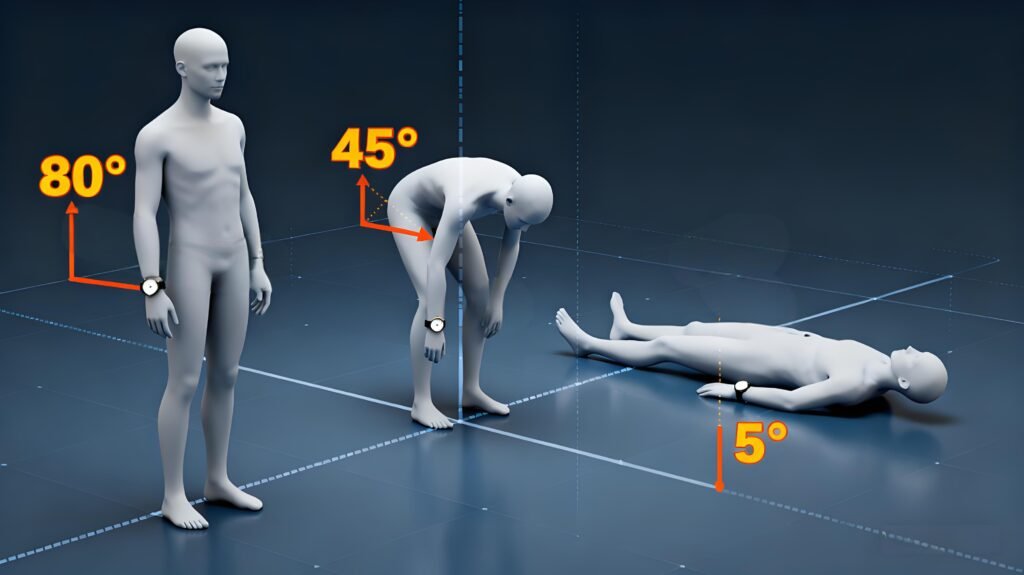
Smartwatch Wearing Angle Comparison
Verify falls with “dynamic rotation + impact force”
- Capture the “high-speed rotation” during a fall: Tilting the body will cause an explosive rotation of the wrist, and the angular velocity reaches 300-500°/second (far exceeding the daily turn of 50-100°/second and the wave of 100-200°/second), triggering an early warning.
- “Time synchronization” with accelerometer: Determine whether there is a ground impact (>1.5g) detected by the accelerometer within 1-2 seconds after judging “high-speed rotation”. Synchronization of the two will strengthen the “fall” judgment; exclusion of false alarms if there is only rotation and no impact.
Posture lock and no action verification
- Set a 10-30 second “waiting period”: If the angle continues to be 0°-10° and there is no “angle rise” (such as getting up) or “active operation” (such as pressing a button), it is determined that “cannot move after a fall” and an alarm is triggered.
- Eliminate interference: When deliberately lying flat, although the angle also reaches 0°-10°, the change is slow (≤20°/second), and there is no pre-rotation and impact, which can be distinguished by combining the previous data.
How does the Fall Alert Watch for Seniors address false alarms (such as during vigorous exercise) and missed alarms (such as slow falls)?
Smartwatches use complex algorithms and user-defined settings to reduce errors. Some devices learn user activity patterns to reduce false alarm rates, but slow falls are still difficult to detect.
Specific strategies for handling errors are as follows:
- Activity recognition: Through learning, the algorithm can distinguish different types of activities.
- User-defined: Users can adjust the sensitivity settings to change the trigger threshold.
- Delayed response: The device waits for user confirmation before sending an alarm.
- Data analysis: The device compares the collected data with thresholds. Some algorithms also combine the wearer’s age, gender, and activity level to further distinguish falls from other movements.
WellCare uses machine learning to continuously optimize algorithms, while reducing false alarm rates and missed alarm rates.
How does a smartwatch for the elderly with fall detection achieve real-time data processing and analysis?
Most smartwatches process fall detection data locally on the device to ensure a fast response, which is critical in emergencies. Some devices may use cloud processing for algorithm updates.
The two data processing methods are as follows:
- Local processing: Data is directly analyzed on the smartwatch for immediate response.
- Cloud processing: Used for algorithm updates and data analysis to optimize detection accuracy in the long term.
WellCare gives priority to local processing to ensure response speed and reliability even without a network connection.
What is the response process after the fall detection feature on a smartwatch is triggered?
What happens after a fall is detected? Who will be notified? How will they be notified?
The smartwatch will vibrate and display an alarm. The user can confirm or cancel the alarm; if the user does not respond, the device will notify emergency contacts, and in some cases will automatically call emergency rescue services.
The specific response process is as follows:
- Fall detected: The sensor triggers the fall detection algorithm.
- Alarm issued: The watch vibrates and displays an alarm message.
- User response: The user can confirm the alarm (indicating safety) or ignore the alarm.
- Notify emergency contacts: If the user does not respond, the device will send a notification containing location information to emergency contacts.
- Call emergency rescue services (optional): Some devices automatically call emergency rescue services.
WellCare’s SOS feature adds an extra layer of security, allowing users to manually trigger an alarm with a double-click.
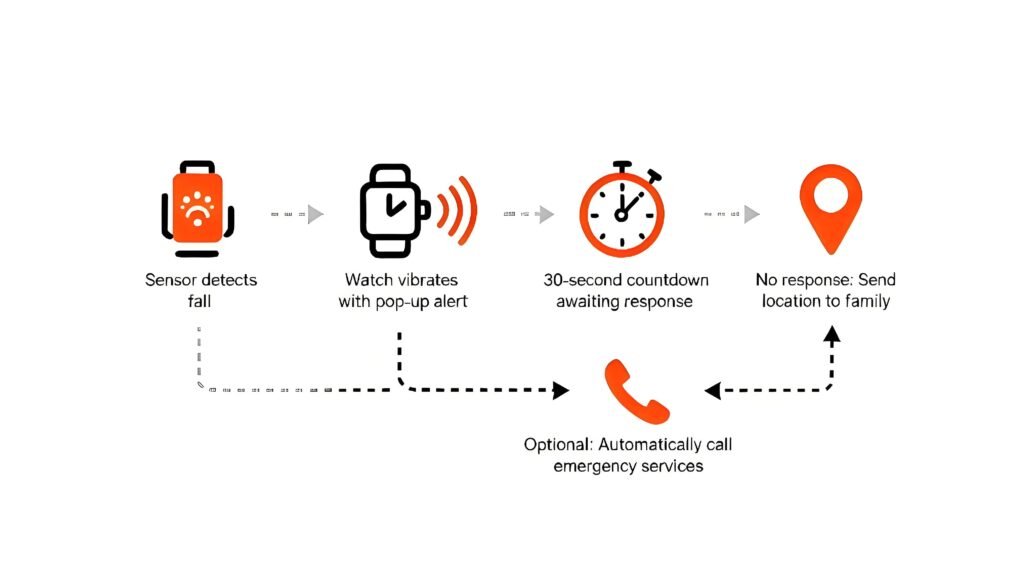
Smartwatch Fall Detection Response Workflow
How accurate is smartwatch fall detection in real-world scenarios?
Accuracy varies depending on the device. Some studies show that it has high sensitivity (can detect most falls), but false alarms may also occur. It is crucial to evaluate performance through actual scenario testing.
The factors affecting accuracy are as follows:
- Algorithm complexity: Basic threshold algorithms only judge based on single acceleration or angle data, which is easily interfered with; while advanced algorithms equipped with AI machine learning can dynamically adjust the judgment logic by analyzing the complete data chain of “impact-rotation-posture change” combined with the user’s daily activity habits, which can The false alarm rate is reduced by more than 30%, and the detection accuracy is significantly higher.
- Sensor quality: Low-precision MEMS sensors are prone to signal drift in severe exercise or low-temperature environments, resulting in data deviations; while devices using high-precision accelerometers (error within ±2%) and high-stability gyroscopes (angle drift rate <1°/hour) can capture more subtle movement characteristics and provide a reliable data basis for accurate judgment.
- User activity: The elderly move slowly and have a small impact force when falling, which may cause a missed alarm because the device’s trigger threshold is not reached; rapid movements and vibrations during high-intensity exercise by young people may trigger false alarms, and these differences in user behavior further exacerbate the fluctuation in accuracy.
As a brand focused on health monitoring, WellCare deeply understands the importance of accuracy in actual scenarios to users, and has carried out special optimization for the above-mentioned pain points: tens of thousands of tests have been completed in real scenarios such as elderly care institutions, community homes, and outdoor trails. Collect fall data under different age groups and activity states for algorithm iteration; at the same time, select industrial-grade high-precision sensor groups, and use dynamic calibration technology to correct environmental interference in real time, so that the fall detection sensitivity of its devices is stable in core B2B scenarios such as home care and elderly health monitoring. Above 88%, the false alarm rate is controlled within 8%, and the reliability is far better than the industry average, which has also become one of its core competitiveness in B2B cooperation such as elderly care institutions and telemedicine platforms.
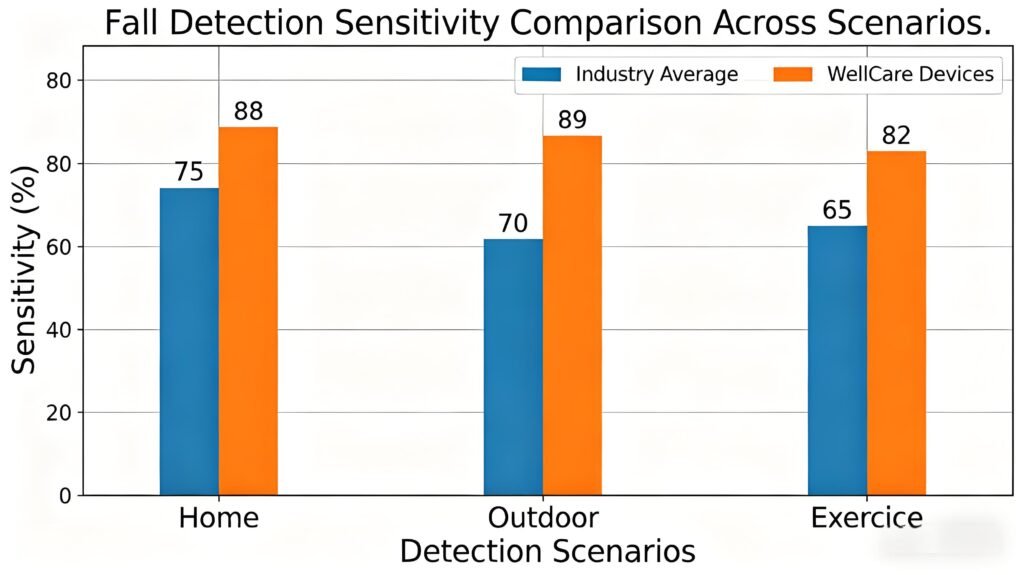
WellCare vs. Industry Average Fall Detection Sensitivity Comparison
How can the fall detection function of smartwatches be integrated with other safety monitoring systems?
Home automation: Link with smart homes to create “timely environmental response after a fall”
Use the device interconnection capabilities of smart homes to transform the fall detection signal of the watch into automatic adjustment instructions for the home environment, reducing secondary risks after a fall and helping users to rescue themselves.
- After a fall is triggered, automatically turn on the lights in the corresponding area of the home (such as the living room and corridor lights) to prevent the user from bumping into things while struggling in the dark; if it is detected that the user has not moved for a long time, link the smart curtains to turn on, increase indoor lighting, and facilitate external observation.
- Link with smart speakers/voice assistants to play voice prompts (such as “A fall has been detected, do you need to call emergency contacts?”), and provide voice-interactive rescue guidance for the elderly with poor hearing or limited mobility.
- If the user has bound a smart door lock, he/she can remotely authorize the family member to temporarily unlock the door after a fall, allowing the family member to quickly come to the door to assist without waiting for the key to be delivered.
Telemedicine: Connect to a medical monitoring platform to provide medical staff with “complete health data after a fall”
Link the watch’s fall data (such as fall time, location, and heart rate/blood oxygen changes before the fall) with the user’s health records on the telemedicine platform to help medical staff more accurately assess the impact of the fall and develop follow-up care plans.
- After a fall occurs, the watch automatically synchronizes “fall events + real-time physiological data” to the hospital’s remote monitoring system or family doctor APP. Medical staff can check for abnormalities such as a sudden increase in heart rate or a drop in blood oxygen as soon as possible to preliminarily determine whether there is a risk of internal injury and prevent the user from aggravating the condition due to delayed medical treatment.
- For patients with chronic diseases (such as elderly people with high blood pressure and osteoporosis), the platform can generate a “fall risk assessment report” based on historical fall records and medication conditions, and medical staff can adjust medication plans or increase the frequency of home visits based on this.
- In the elderly care institution scenario, the watch fall data can be connected to the institution’s centralized monitoring platform. When an elderly person falls in the room, the platform will immediately pop up a reminder to the nursing staff and display the elderly person’s room number and fall location. The nursing staff’s response time can be shortened by more than 50%.
Emergency rescue: Connect with professional rescue system to build “fast rescue channel after fall”
Break through the limitations of the watch “only notifying family members”, directly link with urban emergency rescue services, shorten rescue response time, especially for high-risk scenarios such as elderly people living alone and outdoor falls.
- When falling outdoors, the watch uses GPS positioning to determine the user’s location, and automatically sends “fall location + user basic information (age, medical history)” to the local emergency command center, and synchronizes it to the family’s mobile phone. The emergency center can prepare rescue equipment in advance based on the medical history (such as carrying a defibrillator for patients with heart disease).
- Connect with community rescue stations and property emergency teams. If the user does not trigger an emergency call after a fall, but has not taken action for a long time, the watch can send a help signal to the community rescue terminal, and community staff can come to the door to check within 5-10 minutes to fill the rescue gap of “non-critical but need assistance”.
- For elderly users, integrate “fall rescue + follow-up care” services. After the rescuers arrive, they can retrieve the user’s allergy history and medication list through the medical platform associated with the watch to avoid medical risks due to missing information during the rescue process.

WellCare Fall Detection Multi-System Integration Diagram
How does continuous fall monitoring affect battery life?
How much power does the fall detection function “consume”?
Continuous fall monitoring does affect battery life, but advances in sensor technology and power management technology have greatly reduced power consumption.
The factors affecting battery consumption are as follows:
- Sensor use: Continuous monitoring requires sensors to remain active.
- Processing performance: Real-time data analysis consumes power.
- Alarm frequency: False alarms increase battery consumption.
WellCare uses optimized algorithms and energy-saving components to ensure long battery life even with continuous fall monitoring enabled.
What are the future development trends for smartwatch fall detection technology?
Future trends include algorithms driven by artificial intelligence, more accurate sensors, and personalized fall detection. The core goals are to improve accuracy and reduce false alarm rates.
The main emerging trends are as follows:
- Artificial intelligence and machine learning: Future algorithms will not only be able to identify fall actions, but also learn the user’s daily behavioral characteristics over the long term (such as the slow gait of the elderly and the exercise habits of young people) to generate exclusive detection models and reduce false alarm rates from the root cause.
- Advanced sensors: In addition to existing accelerometers and gyroscopes, future watches may add more sophisticated sensors: such as miniature pressure sensors, which determine whether it is a real fall (rather than accidental touch) by the contact pressure between the wrist and the ground; or inertial measurement units (IMU), which more accurately capture subtle movement trajectories when the body falls, and can even distinguish different types of falls such as “falling forward” and “falling backward”, providing more specific injury references for subsequent rescue. At the same time, the anti-interference ability of sensors will also be improved, and stable data collection can still be maintained in harsh environments such as low temperature and humidity.
- Scene perception: Future fall detection will not only focus on the movements of “people”, but also combine environmental data to assist judgment: for example, by connecting to weather APPs, knowing that the outdoor rain makes the road slippery, automatically increase the sensitivity of fall detection, further judge the risk level after a fall, and provide more comprehensive information support for rescue.
WellCare is also continuing to make efforts along these trends. It has now added an initial user behavior learning module to the algorithm and is testing the application of new composite sensors. In the future, it will gradually achieve “personalized + scenario-based” precise detection to create more reliable safety protection plans for different groups of people.
Conclusion
The fall detection function of smartwatches is a valuable safety guarantee tool. It uses sensors and algorithms to identify fall behaviors and send alarms to emergency contacts. WellCare’s related technologies focus on accuracy, reliability and ease of use, making it a trusted choice for both B2B partners and end users.