
How Do the Core Hardware Sensors of a fall detection watch Work for You?
1.3-Axis Accelerometer
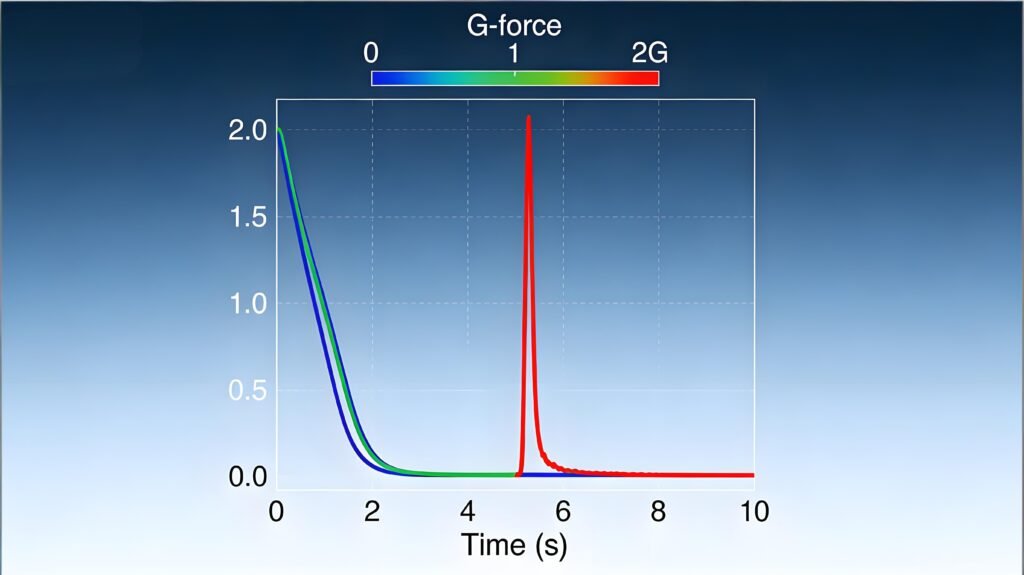
As the core sensing element for fall detection in a fall detection smart watch, the 3-axis accelerometer’s primary function is to measure velocity changes (i.e., G-force) across three perpendicular axes: X, Y, and Z. During daily activities such as walking or lifting the arm, the resulting acceleration is relatively smooth. In contrast, a fall—with its characteristic drop and impact—generates a unique acceleration curve.
2.3-Axis Gyroscope
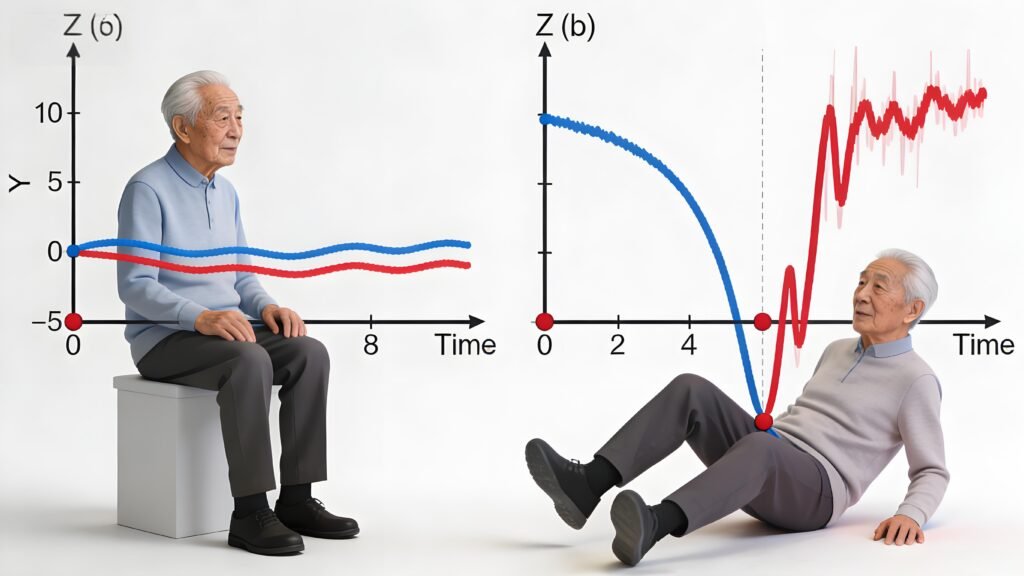
A fall alert watch can precisely record the angular displacement and rotation speed of the wearer’s arm. Its core value lies in identifying the spatial transition of the human body from a vertical state (standing or walking) to a horizontal state (lying on the ground)—a key criterion for determining whether a fall has occurred.
best smart watch for seniors with fall detection
3.Altimeter / Barometer
As an auxiliary detection component in medical alert watches with fall detection, the altimeter judges the wearer’s altitude fluctuations by sensing changes in air pressure. In a fall scenario, the human body experiences a noticeable drop in height in a short period (e.g., from approximately 1.5 meters when standing to ground level). The sudden altitude change data captured by the altimeter further confirms the occurrence of a fall, effectively eliminating false positives caused by sudden in-place movements (such as jumping) and improving overall detection accuracy.
How Does WellCare’s smart watch fall alert Algorithm Identify and Define the Four Physical Stages of a Fall?
1.Free Fall Stage
When the human body loses balance and starts to drop, the wearer of a fall detection band enters a state of weightlessness for a short time. At this point, the 3-axis accelerometer detects that the gravitational acceleration (G-value) approaches zero instantaneously—a typical feature of the free fall stage. The algorithm immediately flags this abnormal signal and enters a risk alert state.
2.The Impact Stage
After the fall, the body (or the arm wearing the watch) collides with a surface such as the ground or a wall, generating a strong impact force. The accelerometer in a wrist worn fall detector captures an extremely high acceleration peak (usually far exceeding the G-value range of daily movements). This signal is the core basis for determining whether a substantial impact has occurred. The algorithm filters out interference from minor bumps by analyzing parameters such as impact intensity and duration.
3.Orientation Change Stage
Following the impact, the human body rapidly transitions from a vertical posture (standing or walking) to a horizontal posture (lying on the ground). The 3-axis gyroscope in a fall detection devices watch real-time records this drastic rotation of spatial coordinates. By analyzing the angle and speed of the posture change, it confirms whether the human body is in a recumbent state where self-rising is impossible, further verifying the authenticity of the fall.
4.Post-fall Immobility Stage — The Most Critical Step
This is the core highlight that sets WellCare’s algorithm apart from conventional solutions. After an impact is detected, the algorithm of a fall monitor watch does not trigger an alert immediately. Instead, it activates a 15–60 second post-impact immobility monitoring period. If the wearer of a watch with fall alert shows no effective movement at all after the impact (e.g., lifting an arm or turning over), the algorithm determines that the wearer may be unable to move due to injury or unconsciousness, and then officially triggers the fall alert. If regular slight movements are detected (e.g., getting up or adjusting posture), it is judged as a minor fall with no danger, and no alert is triggered to avoid unnecessary panic.
How Does a fall detection watch Precisely Filter Out Daily False Alerts Through Intelligent Algorithms?
- Quick sitting / lying down: Although these actions also cause posture changes and slight acceleration variations, their acceleration curves are much smoother than those of a fall (without a sharp impact peak) and are followed by regular minor movements (e.g., adjusting sitting posture or turning over). By analyzing signal intensity and subsequent movement continuity, the algorithm can quickly classify these as normal daily actions.
- Forceful table slamming / high-fiving: These actions generate short-lived high acceleration peaks (similar to impact signals) but lack the weightlessness signal of the free fall stage and the spatial change of posture rotation. Additionally, the altimeter does not detect a significant altitude drop. Through multi-sensor signal cross-verification, the algorithm of a fall protection watch eliminates false positives caused by such single-impact actions.
- Device dropping: When a fall sensor watch accidentally falls from the hand or a table, it generates signals similar to a fall, including free fall, impact, and immobility. However, it lacks human muscle tremors and vital sign-related data (such as heart rate changes). WellCare’s algorithm combines device wearing status detection (e.g., skin contact) and auxiliary data from the heart rate sensor to determine whether the signal originates from device dropping or human falling, effectively filtering out these non-personal risk scenarios.
How Does a fall detection watch Rapidly Initiate a Closed-Loop Rescue Response After Confirming a Danger?
Tactile Alert: Granting the user manual cancellation authority
medical alert watch for seniors with fall detection
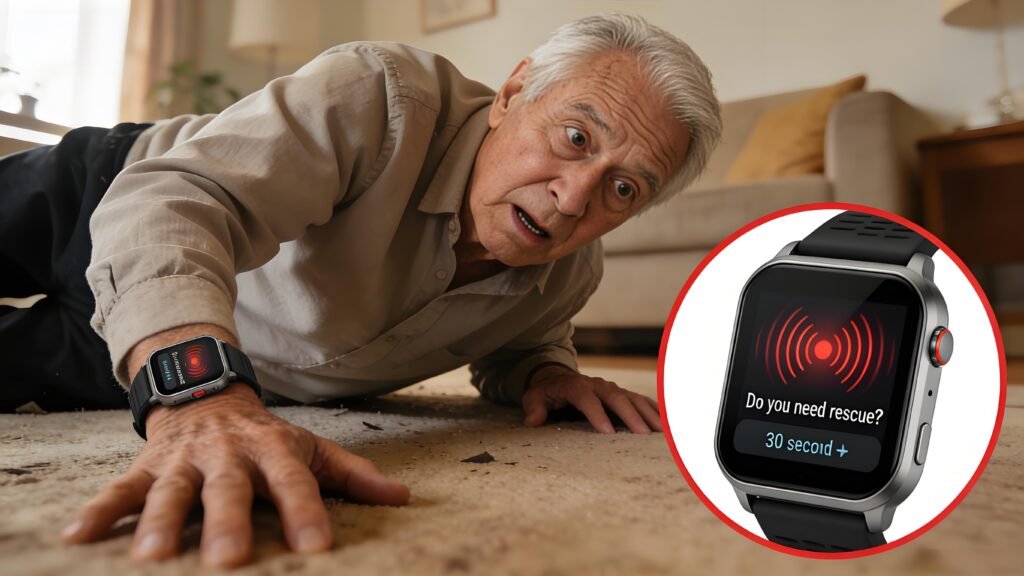
First, the system sends alerts via strong vibrations and high-decibel ringtones from the medical alert watch with fall detection, while displaying an “Do you need rescue?” option on the screen, giving the user approximately 30 seconds to cancel the alert manually. This design primarily targets scenarios of minor falls with no danger (e.g., falling slowly and being able to get up independently), avoiding unnecessary emergency notifications.
Automatic Emergency Call: Synchronous alert via multiple channels
If the user does not manually cancel the alert within the specified time, the system of the smart watch with medical alert automatically initiates the emergency call process: the built-in 4G module prioritizes calling preset emergency contacts (e.g., family members, caregivers) and simultaneously sends SMS/APP push notifications containing the fall time and precise location. For customized solutions integrated with elderly care institutions or rescue platforms, the system of the watch with fall detection and gps also synchronously sends alert information to the corresponding platforms, initiating a professional rescue process.
Location Synchronization: Precisely locking the position
Relying on multi-mode positioning technology combining GPS + BDS + base station, the system real-time acquires the wearer’s precise location information and sends it to the recipient along with the alert. Whether the wearer is indoors, outdoors, or in remote areas, it ensures that rescuers can quickly locate them—making it particularly suitable for elderly people who go out frequently or those with cognitive impairments.
Why Choose WellCare as Your Preferred Partner for fall detection watch Solution Customization and OEM/ODM Services?
- Algorithm Transplantation: Breaking the limitations of device form factors
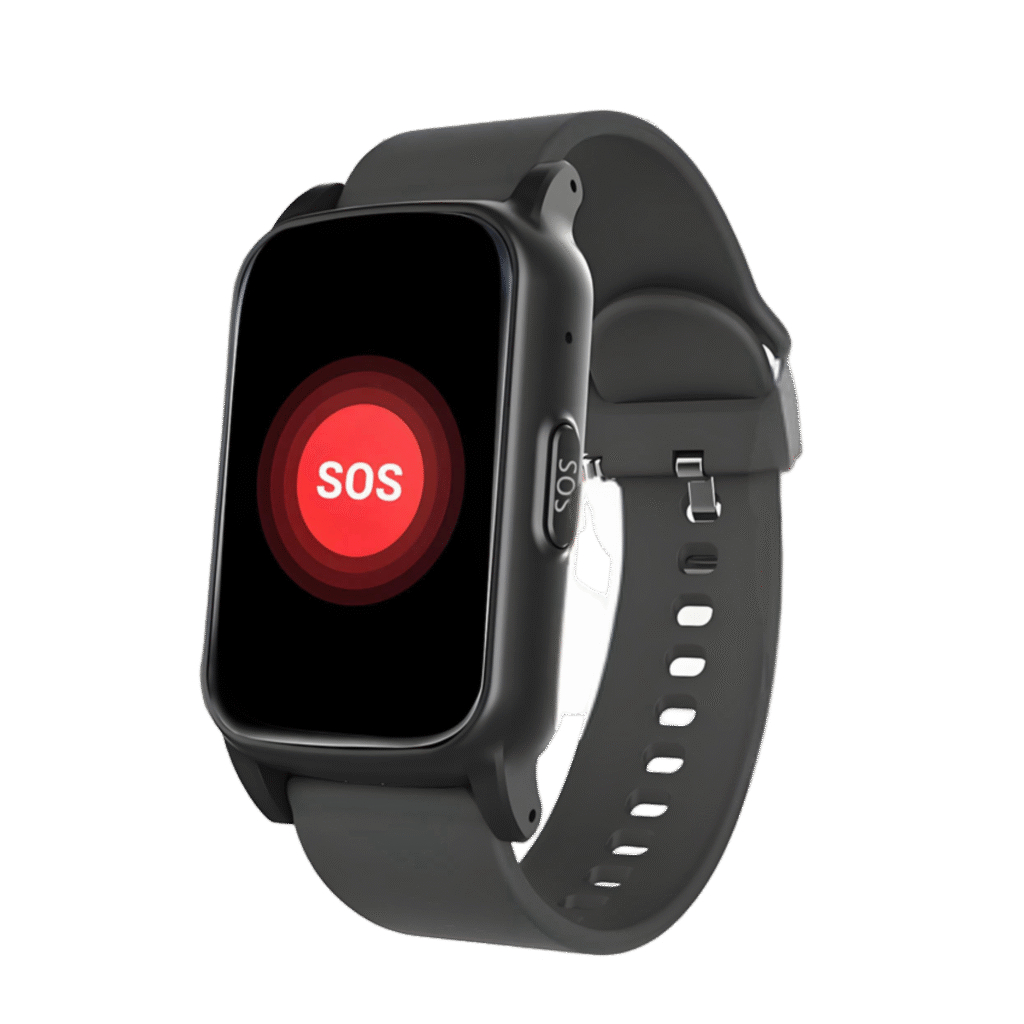
Although our current flagship products are smart watches, this mature fall detection algorithm can be easily transplanted to various lightweight hardware forms such as pendants, ID badges, bracelets, and waist belts. Whether you need to develop a minimalist fall alarm (retaining only core detection and alert functions) or a multi-functional safety device (integrating health monitoring and communication features), our algorithm can be quickly adapted.
- OEM/ODM Customization: Full-chain technical support
As a professional OEM/ODM manufacturer in the smart wearable industry, WellCare provides end-to-end customization services from technology licensing to finished product delivery:
- Algorithm Licensing: Providing a mature fall detection algorithm SDK to support partners in integrating it into their own hardware products;
- Hardware Solution Design: Offering hardware solutions such as sensor selection, PCB circuit design, and low-power optimization based on your product positioning and cost budget;
- Finished Product Customization: Providing customized development throughout the entire process—from appearance design and function selection (e.g., whether to retain health monitoring and communication functions) to APP/cloud system construction—helping you quickly launch differentiated products.
Conclusion