In the increasingly competitive consumer electronics market, wearable technology is experiencing explosive growth. Among these, the GPS smartwatch has become a favorite among fitness enthusiasts, outdoor adventurers, and everyday consumers, thanks to its deep integration of outdoor positioning, fitness tracking, and health management features. Whether you want to understand its technical principles, choose a suitable product, or explore market opportunities, this guide will help you fully understand the GPS smartwatch and find a solution that better fits your needs.
What is a GPS Smartwatch?
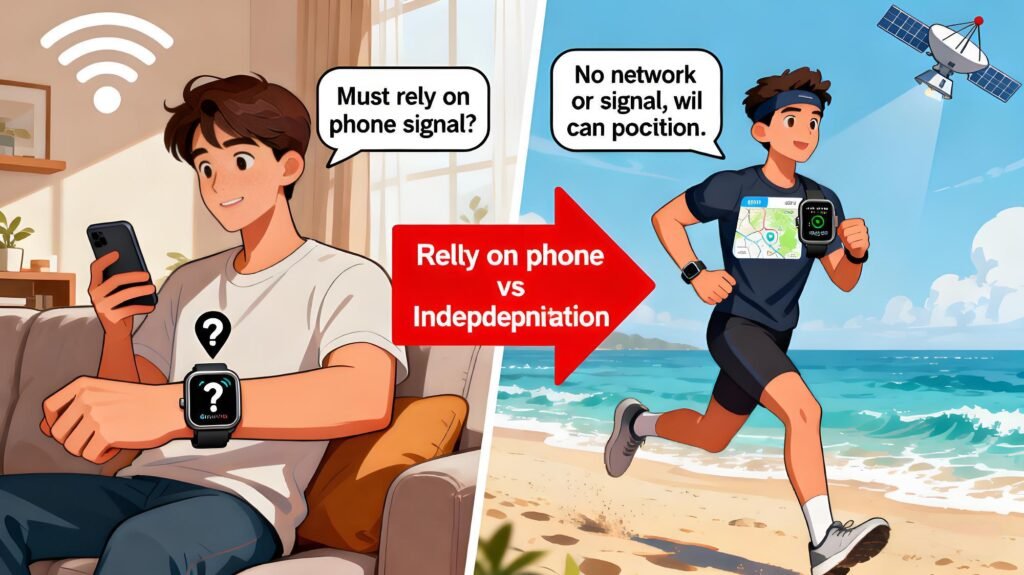
A GPS watch is not just a simple combination of “watch + GPS”. Instead, it is a multi-functional device that integrates the features of a traditional smartwatch (such as notifications and apps) with Global Positioning System (GPS) technology. Its core difference lies in “independent positioning capability” — it can accurately track location and record movement trajectories via satellite signals without connecting to a smartphone. It also provides exclusive functions like fitness data monitoring and outdoor navigation, which ordinary smartwatches (relying on phone positioning) cannot achieve.
Differences in Location Tracking Between GPS Smartwatches and Regular Watches
In terms of technical essence, a GPS watch has a built-in miniature GPS receiver. It can receive signals from satellites orbiting the Earth, determine its own latitude, longitude, and altitude by calculating the distance to the satellites, and further derive practical functions such as distance statistics, speed measurement, and route mapping.
How do GPS Watches Work?
To understand the positioning capability of a GPS tracker watch, you first need to grasp its technical principles and satellite system options — these directly determine positioning accuracy and applicable scenarios.
Working Logic of GPS Smartwatch
Satellite signal reception: The GPS chip built into a GPS tracking device watch needs to receive signals from at least 3 satellites (4 satellites are required for 3D positioning). Each satellite sends real-time information about its own position and precise time.
Position calculation: Top GPS watches determine their exact position using the triangulation principle. They calculate the time difference between the satellite signal reaching the device and combine data from multiple satellites.
Dynamic update and function expansion: When the user moves, the smart watch GPS tracker continuously receives new satellite signals and updates position data in real time. At the same time, most devices also integrate sensors such as accelerometers, barometers, and compasses to optimize movement data (e.g., altitude changes, cadence) and navigation experience (e.g., direction calibration).
Beyond GPS: Choices for Global Navigation Satellite System (GNSS)
GPS is a satellite system led by the United States, but modern GPS smartwatches usually support multiple GNSS systems to improve positioning accuracy and reliability. Differences between systems directly affect the performance of smartwatch GPS trackers in different scenarios, as detailed in the table below:
Satellite System
Operator
Coverage
Civilian Accuracy
Core Advantages
GPS (Global Positioning System)
United States
Global
5-10 meters
High reliability, strong compatibility with consumer devices (phones, watches), and stable number of satellites (about 31).
GLONASS
Russia
Global
5-10 meters
When used in combination with GPS, it provides more stable positioning in “urban canyons” (areas with dense high-rises) and high-latitude regions (e.g., near the Arctic Circle).
Galileo
European Union
Global
≤1 meter
Highest civilian accuracy, suitable for positioning in dense urban areas, and supports emergency response functions (quick positioning in distress).
BDS (Beidou Navigation Satellite System)
China
Global (after 2020)
5-10 meters globally, ≤1 meter in the Asia-Pacific region
Optimal accuracy in the Asia-Pacific region, supports two-way communication (positioning + communication in remote areas), and has unique regional service advantages.
In practical use, watches supporting multiple GNSS systems (e.g., compatible with GPS + BDS + Galileo simultaneously) can receive more satellite signals in high-rise dense cities or dense forests. This reduces obstruction interference and improves positioning accuracy by more than 30% compared to a single GPS system.
What Can a GPS Smartwatch Do?
The value of smartwatches with GPS lies in “scenario-based function implementation”. Its functions cover multi-dimensional needs, from daily fitness to outdoor adventures and safety protection, which can be specifically divided into five categories:
This is the most basic and core function. Through the collaboration of smartwatch GPS tracker and sensors, it provides professional sports data:
Real-time data monitoring: During running or cycling, it displays distance, pace, and speed in real time to help users control their exercise rhythm.
Trajectory recording and analysis: It records the exercise route, allowing users to review the trajectory on a map later and analyze speed changes and altitude fluctuations in each section of the journey.
Specialized sports modes: Optimized for scenarios such as swimming (waterproof + pool/open water mode), skiing (ski slope counting, slope measurement), and hiking (cadence, stride length statistics), ensuring data is more in line with the characteristics of the sport.
2. Outdoor Adventure and Navigation: Safe Travel Even Without Network
For outdoor enthusiasts, smartwatches with GPS are “safety protection tools”:
Route navigation and backtracking: It supports uploading routes in advance (e.g., hiking trail trajectories), and the smartwatch with built-in GPS guides directions according to the route. If you deviate from the route, you can backtrack to the starting point through “breadcrumb navigation” (recording the trajectory you have traveled) to avoid getting lost.
Environmental data monitoring: Combined with a barometer, it displays altitude and barometric changes, and predicts weather trends (e.g., a sudden drop in air pressure may indicate rain) to help users cope with sudden outdoor weather.
Positioning in remote areas: In mountainous areas or deserts without mobile phone signals, it can still determine the location via satellite positioning and provide accurate coordinates to rescuers if necessary.
Some high-end models enhance safety functions to meet family and personal protection needs:
Emergency SOS and location sharing: In case of accidents (e.g., falls, injuries), one-click activation of the SOS function allows the smartwatch with GPS navigation to automatically send a distress message with location to preset contacts.
Geofence alerts: Parents can set a “safe area” (e.g., school, community) for the kids GPS watch. When the child leaves or enters the area, the parent’s mobile phone will receive an alert.
Fall detection and assistance: The smart watch with GPS navigation combines an accelerometer and a gyroscope. After detecting a fall, it automatically pops up a window for confirmation. If the user does not respond, it automatically contacts emergency contacts and sends the location.
4. Daily Health Management: More Than Positioning, It Understands Your Body
Modern smart watch with GPS tracking have integrated health monitoring functions, becoming daily health assistants:
Basic health data: It monitors heart rate (resting heart rate, exercise heart rate), sleep quality (deep sleep/light sleep/REM cycles), and calorie consumption, and generates health reports.
Health reminders: It issues alerts when the heart rate is abnormal and reminds users to get up and move when sitting for a long time, helping users develop healthy habits.
Data linkage: It synchronizes data with the mobile health APP, tracks health trends over the long term, and provides data support for goals such as fat loss and muscle gain.
5. Smart Life Assistance: Balancing Convenience and Practicality
It retains the convenient functions of traditional GPS navigation watch to achieve “one device for multiple uses”:
Mobile phone notification synchronization: It receives notifications such as WeChat messages, text messages, and calls, allowing users to check them without taking out their mobile phones.
Music control and storage: Some models support storing local music. You can play it by connecting to Bluetooth headsets, eliminating the need to carry a mobile phone during exercise.
Battery life optimization: It provides multiple modes (e.g., “sports mode” enables GPS, “daily mode” disables GPS to save power) to balance functions and battery life.
What Types of GPS Smartwatches are There?
Different users have significant differences in needs, so GPS enabled smart watches have been subdivided into three product categories, each with a clear positioning. You need to match your own scenario first when purchasing:
Product Type
Core Features
Target Users
Representative Functions
GPS-Enabled Fitness Tracker
Compact and lightweight, long battery life, affordable price. Its core function is fitness data monitoring, and GPS is only used for sports positioning.
Durable body (shockproof, dustproof, high waterproof), strong GPS performance (multiple GNSS systems), professional functions. Focus on outdoor scenarios.
Multi-GNSS positioning, altitude/barometric monitoring, professional sports data analysis, long battery life (up to several days in outdoor mode).
For example: For daily jogging + commuting, a “smartwatch with GPS” is sufficient; if you plan to hike through uninhabited areas, a “GPS sports watch” is needed, as its durability and stable positioning can cope with complex environments.
What Key Factors Should You Consider When Choosing a GPS Smartwatch?
Faced with numerous products, blind purchasing is likely to lead to mistakes. You need to focus on 6 core dimensions and screen based on your own needs:
Prioritize models that support “multiple GNSS systems” (e.g., GPS + BDS + Galileo), especially if you often use the watch in cities or complex outdoor environments.
If you focus on accuracy, pay attention to GPS wearable devices marked with “support for Galileo system” or “BDS high precision support in the Asia-Pacific region”, which can achieve an accuracy of less than 1 meter in civilian scenarios.
2. Battery Life: Balancing Functions and Usage Time
Daily use (GPS disabled, only receiving notifications and monitoring heart rate): Battery life should be at least 7 days to avoid frequent charging.
Sports/outdoor use (GPS enabled): Choose based on exercise duration — for 1-2 hours of running, it needs to support more than 10 hours of GPS battery life; for 1-2 days of outdoor hiking, it needs to support more than 24 hours of continuous GPS positioning.
3. Screen and Durability: Adapting to Usage Scenarios
Screen: For outdoor use, choose a “sunlight-readable” screen (e.g., MIP reflective screen) to avoid being unable to see data under strong light; for daily use, an AMOLED screen is optional for brighter colors.
Durability: Refer to the waterproof rating and material (e.g., sapphire glass screen for scratch resistance, titanium case for light weight and corrosion resistance). Prioritize models with high protection levels for outdoor scenarios.
4. Function Matching: Avoid “Paying for Unneeded Functions”
Fitness users: Focus on whether the “sports modes of the wearable GPS cover your own sports” (e.g., swimming requires support for pool/open water modes) and whether it has “training plan formulation” and “data comparison and analysis” functions.
Outdoor users: Confirm whether it has “altitude/barometric monitoring”, “breadcrumb navigation”, and “emergency SOS”, and whether it supports offline map download.
Daily users: Pay attention to “whether notification synchronization is smooth”, “whether it supports fast charging”, and “whether the weight is lightweight” (a weight of less than 50g is recommended for daily wear).
5. Device Compatibility: Ensuring Linkage with Existing Devices
If you use an iPhone, confirm that the GPS inbuilt smartwatch supports the iOS system and can synchronize data with Apple Health.
If you use an Android phone, prioritize models that support mainstream health APPs such as “Huawei Health” and “Mi Fitness” to avoid data synchronization obstacles.
How to Improve GPS Smartwatch Positioning Accuracy and Extend Battery Life?
After purchasing a suitable inbuilt GPS smartwatch, proper use can improve performance and experience. Here are 4 key tips:
Regular synchronization and calibration:
Before each outdoor use, synchronize the in-built GPS smart watch with your mobile phone to update GPS satellite data (shortening positioning time).
Calibrate the compass every 1-2 months (use the “calibration function” built into the GPS navigation smartwatch and rotate the watch as prompted) to avoid direction deviation.
Choose the right usage environment:
When positioning, try to stay in an open area. Avoid activating GPS in areas with dense high-rises or dense forests (signals are easily blocked, leading to slow positioning and large errors).
Avoid using metal watch case accessories, as metal can block satellite signals and affect positioning accuracy.
Switch modes reasonably:
Disable GPS during daily commuting and only enable “daily health mode” (monitoring heart rate and sleep) to extend battery life.
Use “standard GPS mode” for short-term sports and “power-saving GPS mode” for long-term outdoor activities.
Update software in a timely manner:
Regularly update the system and supporting APP of the GPS enabled smart watch. Manufacturers will optimize GPS algorithms and fix battery life vulnerabilities through updates to improve overall performance.
Why Is GPS Smartwatch a “Business Worth Entering”?
For enterprises or entrepreneurs, the smartwatch with inbuilt GPS market contains huge potential, with core advantages reflected in 4 aspects:
Sustained growth in demand:
The increasing awareness of fitness (e.g., the number of marathon and hiking participants increases year by year) and the rising trend of outdoor adventures drive the demand for professional GPS smartwatches.
Family safety needs (e.g., positioning for children and the elderly) drive sales of entry-level GPS smartwatches, expanding the market size year by year.
High profitability and diversified income:
High-end models (e.g., professional outdoor watches) have high pricing, with profit margins reaching 30%-50%.
The “hardware + service” model can be used to expand income (e.g., subscribing to fitness courses, outdoor rescue services), forming a continuous profit stream.
Large space for differentiated competition:
Most brands focus on general scenarios, so you can innovate for segmented fields (e.g., “ladies GPS watch”, “kids GPS watch”, “GPS watch for hiking”).
It supports OEM/ODM customization to meet the personalized needs of corporate customers.
The integration of health monitoring and medical scenarios (e.g., GPS + chronic disease management) expands new market spaces.
WearCare — A Reliable Choice Focused on GPS Smartwatch
Among many brands, WearCare has become a trustworthy brand in the GPS smartwatch field, relying on its in-depth understanding of user needs and technical accumulation. The core advantages of its products are reflected in three aspects:
Technical strength: It supports multiple GNSS systems (GPS + BDS + Galileo), with a positioning accuracy of less than 1 meter. Relying on the BDS system, it achieves “seamless positioning” in the Asia-Pacific region. It integrates a high-sensitivity barometer and accelerometer for more accurate outdoor altitude and sports data monitoring.
Scenario-based design: It covers a full range of products — entry-level fitness trackers (lightweight with long battery life), mid-range smart watches (balancing daily use and sports), and high-end outdoor watches (10ATM waterproof, titanium case, suitable for complex outdoor environments) — to meet the needs of different users.
User experience optimization: The supporting APP supports in-depth analysis of sports data (e.g., training effect scoring, recovery suggestions) and outdoor route sharing (users can upload/download popular hiking routes). The watch supports fast charging (charging to 80% in 30 minutes) to solve battery life anxiety.
In addition, Wearcare also provides OEM/ODM customization services for corporate customers. From appearance design (strap color, dial style) to function development (exclusive sports modes, brand co-branded functions), a professional team provides full-process support to help brands quickly enter the GPS smartwatch market.
Future Trends: Which Directions Will GPS Smartwatch Develop Towards?
With technological iteration, the experience of GPS smartwatch will continue to upgrade, and three trends are worth paying attention to:
Further upgrading of positioning accuracy and scenario adaptation:
Optimization of satellite technology (e.g., increase in the number of low-orbit satellites) will make positioning faster (reducing from “1 minute of positioning after startup” to “10 seconds of positioning”).
Development of “auxiliary positioning technology” (combining Bluetooth and Wi-Fi for signal supplementation) for special scenarios (e.g., underground parking lots, tunnels) to reduce signal blind spots.
Deeper function integration:
Health monitoring will be more closely integrated with GPS (e.g., adjusting heart rate warning thresholds according to altitude changes during outdoor hiking).
Augmented reality (AR) navigation will be implemented (displaying real-time routes overlaid on real scenes through the watch screen, making outdoor navigation more intuitive).
Innovation in form and interaction:
The miniaturization of chips will make watches thinner and lighter (weight can be reduced to less than 30g), making them more comfortable to wear.
New “voice interaction + gesture control” functions will be added (e.g., waving to switch navigation modes when wearing gloves outdoors), making operation more convenient.
Conclusion
From technical principles to purchasing skills, from user scenarios to market value, the GPS smartwatch is no longer a “niche device” but a “multi-functional tool” covering daily life, fitness, outdoor activities, and safety. Whether ordinary users want to choose a suitable GPS enabled smart watch, or enterprises want to deploy in this track, they need to focus on the core based on needs — and as a brand focusing on this field, Wearcare will provide you with a more suitable solution with its technical strength and scenario-based products.