
Wearable devices have two development directions: on one hand, they meet the daily health and fitness needs of the general public; on the other hand, they are also more deeply applied in fields such as logistics, healthcare, and security. Among them, three types of devices have become core segmented categories.
The boundaries between them may be blurred, but each type has its unique advantages. GPS watches excel at tracking outdoor activities, smart watches are versatile mini-computers, and fitness trackers focus on monitoring basic health metrics.
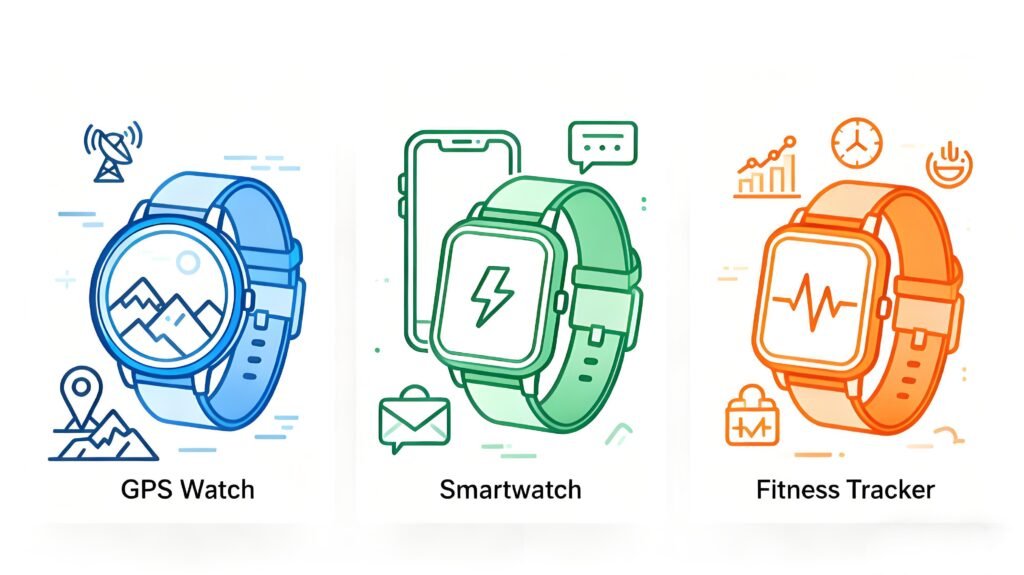
GPS Watches VS.Smartwatches VS. Fitness Trackers
What is a GPS Smartwatch?
Built for accurate tracking of outdoor activities, it relies on GPS for positioning. It also includes advanced data indicators for specific sports, heart rate monitoring, and an altimeter/barometer for obtaining altitude data. Its smart functions vary, and its battery life is considerable, especially when in GPS mode.
What is a Smart Watch?
This device is feature-rich. In addition to fitness tracking, it also covers message notifications, app support, music playback, mobile payments, and voice assistants. Most smart watches have built-in GPS, but their battery life is usually relatively short.
What is a Fitness Tracker?
Activity tracker fitness band is mainly used to record health and fitness data. Some models have built-in GPS, while others need to connect to a smartphone’s GPS function to obtain positioning. Their smart functions are usually relatively limited, but their battery life generally performs well.
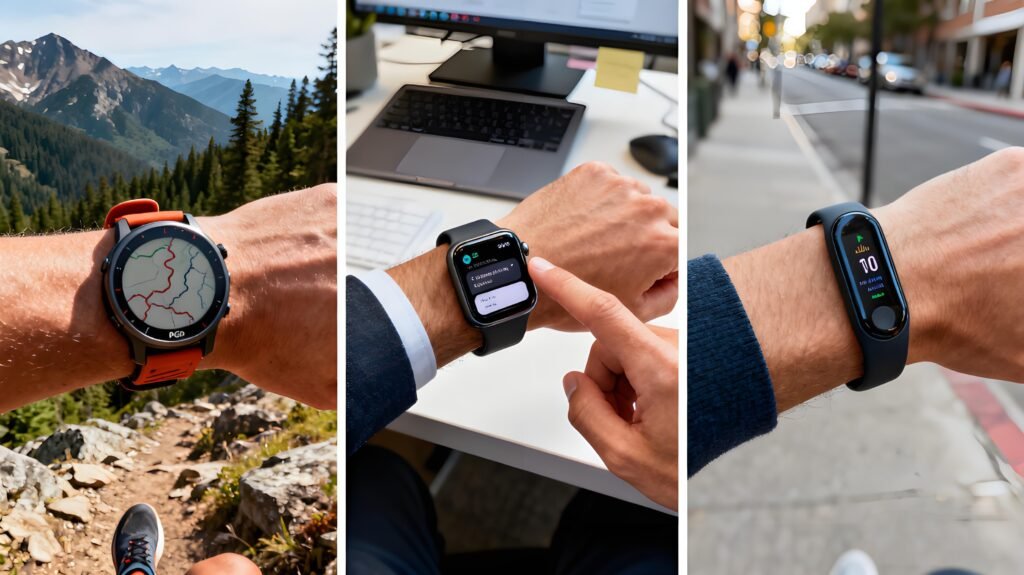
The definitions of GPS Watches, Smartwatches, and Fitness Trackers
Comparison of Core Functions: Detailed Analysis of GPS, Activity Tracking, and Smart Functions
| Function Dimension | GPS Watch | Smart Watch | Fitness Tracker |
|---|---|---|---|
| GPS Positioning | Independent offline positioning with high accuracy (1–5m); supports track recording and route planning | Some support independent GPS with medium accuracy (3–10m); mostly used for short-distance recording (e.g., urban running) | Most have no independent GPS; rely on phone connection for positioning with low accuracy (5–15m) |
| Activity Tracking | Focuses on professional sports data (distance, pace, altitude, slope) | Covers multi-scenario sports (running, swimming, cycling, strength training) with detailed analysis reports | Only basic data (step count, exercise duration, calories, sleep stages) |
| Smart Features | Only basic reminders (SMS, calls); no independent communication | Independent calling/SMS, social message replies, app installation (e.g., navigation, payments), voice assistants | Only basic message reminders (no reply function); no additional app support |
| Health Monitoring | Basic heart rate monitoring; some include blood oxygen (for sports scenarios) | Comprehensive monitoring (heart rate, blood pressure, blood oxygen, sleep quality, stress levels, women’s health) | Basic heart rate and sleep duration; no in-depth health analysis |
GPS Accuracy and Performance: How Do Different Devices Perform in Actual Scenarios?
1. Complex Outdoor Environments (Mountains, Forests, Deserts)
2. Dense Urban Environments (Many High-Rises, Complex Signals)
3. Industrial Application Value (Logistics, Surveying and Mapping, Outdoor Operations)
Operating Systems and Application Ecosystem: Understanding the Development Fields of Various Devices
1. Types and Characteristics of Operating Systems (OS)
2. Comparison of B2B Development Friendliness
Data Integration and API Access: Connecting Wearable Device Data to Enterprise Systems
1. Data Format and Compatibility
2. B2B Application Scenario Cases
Customization Options: Brand Customization, Hardware Modification, and Software Development
Can these devices be customized for specific brands? Customization is key for B2B applications.
Smart watches offer the most software customization options. GPS watches support a certain degree of hardware and brand customization, while fitness trackers usually have limited customization space.
Brand Customization
- GPS smartwatch: Supports dial LOGO printing and startup screen customization, with no space for in-depth brand integration.
- Smart watch: Allows customization of dial UI, system startup page, exclusive APP icons, and even pre-installation of enterprise-exclusive APPs for more complete brand exposure.
- Fitness tracker watches: Only supports strap LOGO customization, with no software-level brand adjustments.
Hardware Modification
- GPS watches: Support battery life optimization (e.g., larger batteries) and protection level upgrades (e.g., higher water resistance). However, core hardware (positioning modules) cannot be replaced.
- Smart watches: Support hardware module expansion (e.g., adding NFC access control, temperature sensors). Configurations can be adjusted based on industry needs.
- Fitness trackers: Fixed hardware. Only support strap material replacement (e.g., medical-grade silicone). No other modification options.
Software Development
- GPS watches: Only support simple data field adjustments (e.g., adding a “work checkpoint marking” function). No new module development is possible.
- Smart watches: Allow development of exclusive software functions (e.g., “cargo scan registration” for logistics, “medication reminders” for healthcare). Support system-level integration.
- Fitness trackers: No software customization possible. Only factory-installed functions can be used.
Now, let’s discuss power consumption and battery life optimization for different scenarios.
Power Consumption and Battery Life: Optimization Directions for Different Scenarios
What are the impacts of core functions on battery life? And how can battery life be optimized?
Impact of Core Functions on Battery Life
- GPS function: GPS watches with built-in GPS see battery life drop from 15 days to 10–30 hours when independent positioning is enabled. Smart watches’ battery life drops from 3 days to 8–12 hours when GPS is on. Fitness trackers have no independent GPS, so their battery life is not affected by positioning.
- Smart interaction: Frequent calls and screen activation can reduce smart watches’ battery life to less than 1 day. GPS watches/trackers have no complex interaction, so their battery life is less affected.
- Sensor usage: Enabling comprehensive health monitoring on smart watches (e.g., heart rate measurement every 5 minutes) reduces battery life by 30%. Fitness trackers only use basic sensors, resulting in low power consumption.
B2B Scenario Optimization Recommendations
- Outdoor operations (e.g., power inspection): Choose GPS watches. Disable unnecessary reminders and enable “power-saving positioning mode” (positioning every 30 seconds) to extend battery life to over 24 hours.
- Medical monitoring (e.g., hospitalized patients): Choose smart watches. Disable independent calling and only retain heart rate/blood oxygen monitoring. Battery life can last about 3 days.
- Employee daily attendance: Choose fitness trackers. Only enable step count and basic positioning. Battery life can reach 14 days, reducing charging frequency.
Next, let’s explore target markets and industry applications with scenario-based matching recommendations.
Target Markets and Industry Applications: Scenario-Based Matching Recommendations
Which devices are best suited for which industries and applications?
Industry/Scenario Recommendations
| Industry/Scenario | Recommended Device Type | Specific Application Cases | Core Value |
|---|---|---|---|
| Logistics/Delivery | GPS Watch / Smart Watch | Courier track tracking, delivery confirmation, emergency alarm | Ensures route compliance; improves delivery efficiency |
| Healthcare | Smart Watch | Real-time patient heart rate/blood oxygen monitoring, post-op recovery data recording, medication reminders | Reduces manual monitoring costs; detects health abnormalities promptly |
| Outdoor Adventure/Tourism | GPS Watch | Hiking route planning, team location sharing, outdoor emergency positioning | Ensures travel safety; prevents getting lost |
| Enterprise Employee Health | Smart Watch / Fitness Tracker | Employee step competitions, sleep quality analysis, sedentary reminders | Enhances employees’ health awareness; reduces sub-health risks |
| Security/Patrol | Smart Watch | Patrol checkpoint check-in, real-time communication, emergency calls | Ensures full patrol coverage; enables quick response to emergencies |
| Fitness Centers | Smart Watch / Fitness Tracker | Member sports data recording, training effect analysis, class check-in | Quantifies training results; increases member retention |
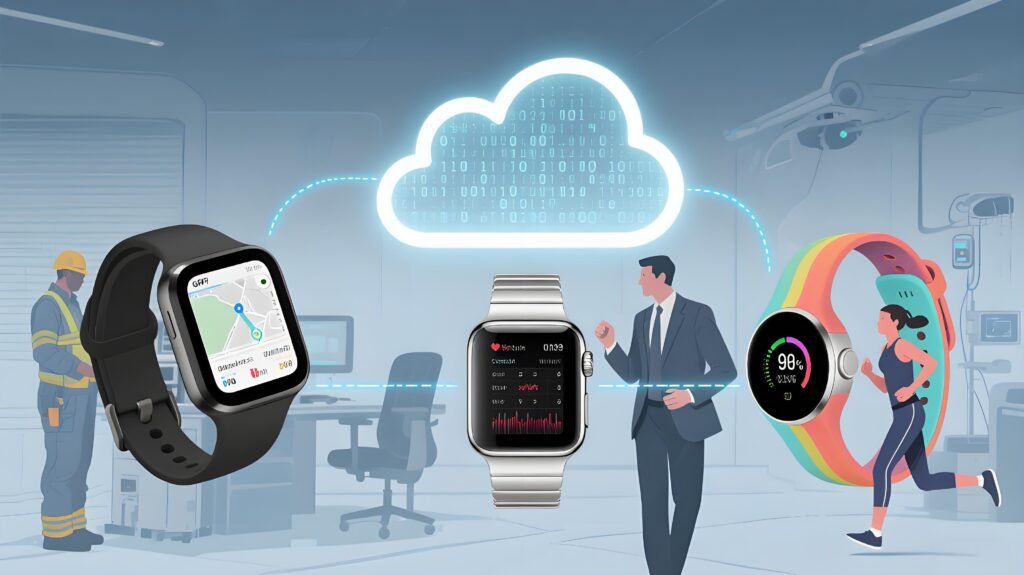
The Future Trends of GPS Watches, Smartwatches, and Fitness Trackers
Industry Applications
Conclusion
The three types of wearable devices (GPS watches, smart watches, and fitness trackers) have no superiority or inferiority, only differences in scenario adaptation—GPS watches are for accurate positioning, smart watches for multi-functional interaction, and fitness trackers for simplicity and practicality; the core B2B selection criteria involve evaluating four dimensions (function matching degree, cost controllability, development adaptability, and safety compliance) to avoid paying for unnecessary functions or affecting efficiency due to insufficient functions; and their future core trends will be moving toward AI integration, ecosystem development, and industry customization, with data interconnection and scenario integration becoming key value points for B2B applications.