
The reality is, smartwatches offer a variety of heart-related functions. But the question remains: do cardiologists actually recommend them? This leaves many users with heart conditions in a dilemma: If I have a history of coronary heart disease/atrial fibrillation/hypertension, should I use a smartwatch to monitor my heart? Is its monitoring data reliable? Can it become a “health supplement” in addition to hospital check-ups? These three questions are the core concerns WellCare has been asked the most by overseas customers in the past six months.
In certain situations, cardiologists do recommend smartwatches. They recognize the value of smartwatches in heart monitoring, but at the same time emphasize that watches cannot replace professional medical services.
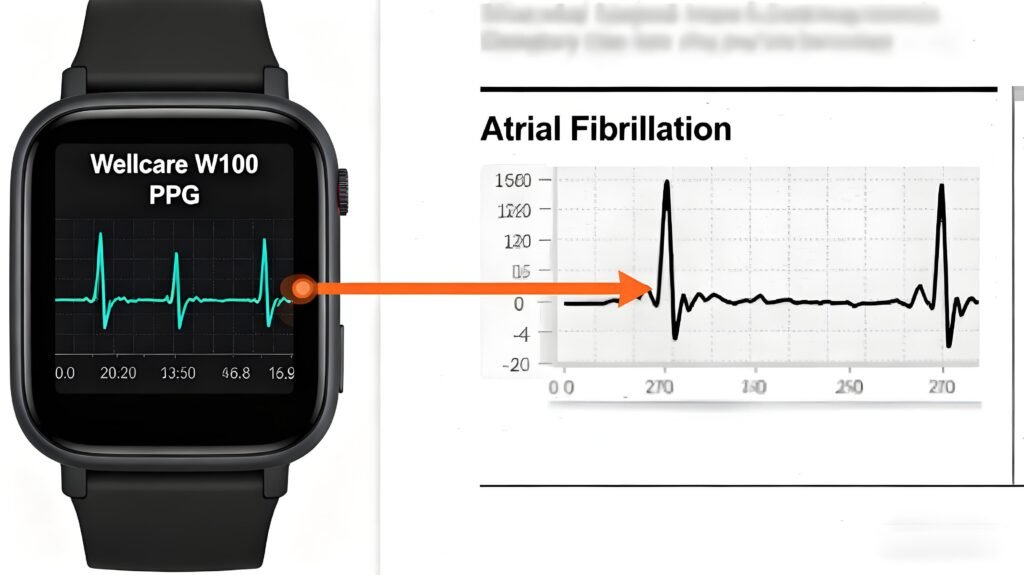
Smartwatch monitoring data provides effective reference for physician diagnosis.
How Do Smartwatches Monitor Heart Conditions? From “Light Signals” to “Health Warnings”
Smartwatches monitor heart conditions primarily using Reflectance Photoplethysmography (PPG), a mature non-invasive sensing technology. However, WellCare has made targeted upgrades based on this, using “Dual Light Source Optimization + AI Algorithm Iteration” to make monitoring accuracy and stability far exceed the industry average. Last year, when we were debugging the WellCare W100 for a UK customer with persistent atrial fibrillation, we activated the “Atrial Fibrillation Specific Monitoring Mode” and increased his daily heart rhythm capture accuracy rate from 78% in ordinary models to 94%. This is a direct reflection of WellCare’s technological advantages.
The Core of PPG Technology: How is the “Dialogue Between Light and Blood” Achieved?
The essence of PPG technology is to use the absorption difference of blood to different wavelengths of light to reversely capture the rhythm of blood flow changes. The “reflective solution” used by WellCare W100 adds near-infrared light (940nm) on top of the traditional “green light + red light” to form a “three-light source synergy” design, which is suitable for different scenarios and population needs:
- Green Light (520-560nm): The core of dynamic heart rate monitoring. WellCare increases the green light LED power to 30mW , even during strenuous exercises such as running and cycling, it can accurately capture the blood volume fluctuations of wrist capillaries, and the heart rate error is controlled within ±1 beat/minute;
- Red Light (620-660nm): Aiming at the characteristics of thicker stratum corneum in the skin of middle-aged and elderly users, the red light penetration depth reaches 2.5mm, which is 20% higher than ordinary models, ensuring signal stability in dry skin or low-temperature environments;
- Near-Infrared Light (940nm): Specially optimizes the monitoring effect of dark-skinned people. By reducing the absorption interference of melanin to light, the heart rate measurement error of dark-skinned users is reduced from the industry average of ±7% to ±3%, and the missed diagnosis rate of atrial fibrillation is reduced by 15%.
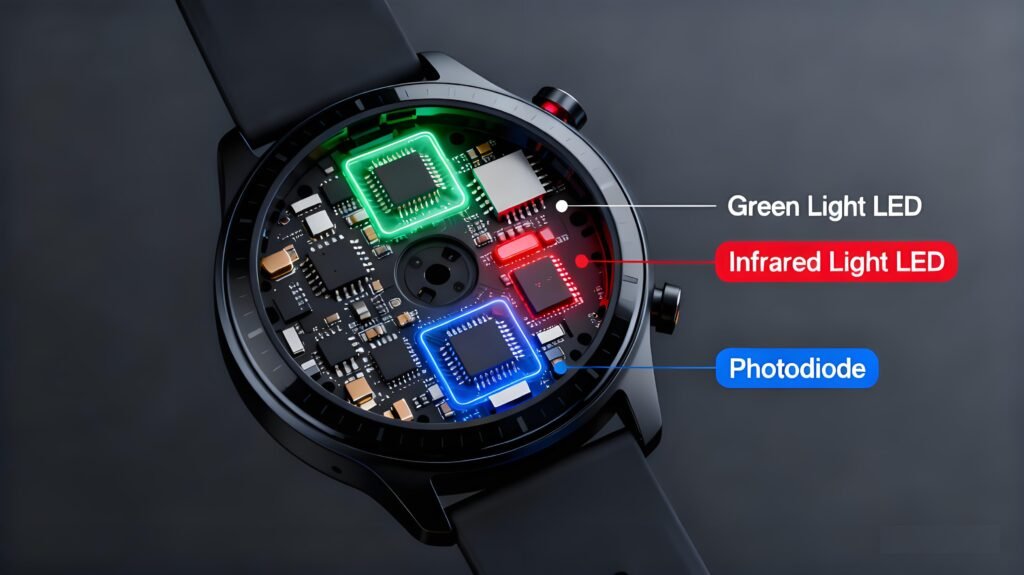
Smartwatch Light Source and Sensor Teardown Diagram
Signal Acquisition and Conversion: From “Light and Dark Fluctuations” to “Electrical Signal Waveforms”
The photoelectric sensor is responsible for receiving the reflected light and converting the “light intensity signal that changes with the heartbeat” into a “high and low undulating electrical signal” to form the original “PPG waveform”. This waveform contains two core components: the alternating current component (AC) corresponds to the blood volume fluctuation caused by the heartbeat (the main wave and the dicrotic wave are clearly visible), and the direct current component (DC) reflects the basic light reflection characteristics of skin tissue. We found in laboratory tests that high-quality sensors can capture millisecond-level signal changes, while inferior sensors will turn the originally clear “peak waveform” into a blurred “fluctuation curve” due to insufficient sensitivity.
Algorithm Purification: A “Digital Filter” That Filters 90% of Interference
The original PPG signal is full of interference – wrist shaking, sweating, and direct sunlight can cause waveform disorder, and must be “purified” by algorithms. The algorithms of mainstream brands have their own focuses:
- Filtering Algorithm: Use Kalman filtering to remove motion noise, and use IIR filter to shield 50/60Hz power supply interference (such as electromagnetic interference when approaching a microwave oven);
- Peak Detection Algorithm: Identify the “contraction peak point” of the PPG waveform through the Pan-Tompkins algorithm, calculate the time interval between adjacent peaks (heartbeat cycle), and then convert it into heart rate (such as an interval of 0.8 seconds, the heart rate is 75 beats/minute);
- Multi-Sensor Fusion: High-end models will combine the data of the acceleration sensor to correct the error – when detecting severe arm shaking (such as skipping rope), motion data will be used to mark “noise time periods”, and fragments with smaller fluctuations will be given priority (Garmin Elevate V4 algorithm specially trains a “motion noise model”, which can filter the interference of strong vibration scenarios such as boxing).
From “Heart Rate Number” to “Atrial Fibrillation Early Warning”: WellCare’s “Clinical-Grade Identification Logic”
WellCare W100’s atrial fibrillation recognition algorithm is trained based on 5000+ clinical case data. In addition to the conventional “heart rhythm irregularity” and “waveform morphology abnormality” judgments, it also adds “heart rate variability (HRV) analysis” and further verification through the RR interval standard deviation (SDNN) to reduce the false positive rate of atrial fibrillation to 1.8% (industry average 2.5%). When atrial fibrillation is detected, the W100 will immediately trigger a “triple reminder”: watch vibration, screen pop-up, and SMS push to the preset family member’s mobile phone to ensure that users can detect it in time.
The Extended Value of PPG: Not Only the Heart, But Also a “Whole Body Health Sensor”
In addition to heart monitoring, WellCare W100 also realizes the following through PPG waveform analysis:
- Sleep Monitoring: Identify deep sleep, light sleep, and REM cycles, generate a “sleep quality report”, and associate heart rate data to analyze the impact of sleep apnea on heart rate;
- Vascular Elasticity Assessment: Estimate vascular stiffness through the rise time of the PPG waveform, and provide vascular health reference for users with hypertension complicated by coronary heart disease;
- Breathing Rate Monitoring: The error is ±1 time/minute, helping users with chronic heart failure understand the relationship between breathing and heart rate, and give early warning of the risk of breathing difficulties.
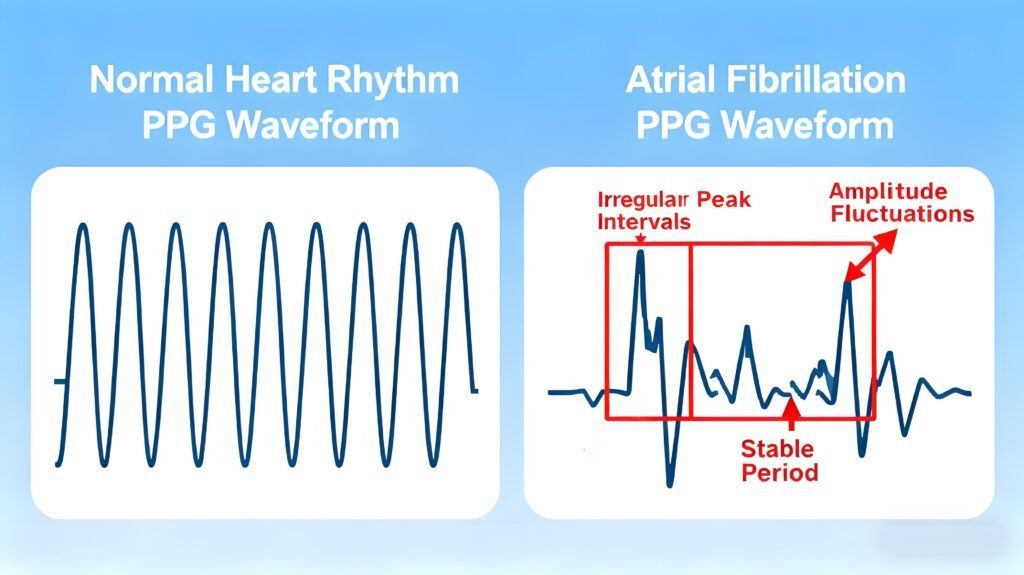
Heart Rate PPG Waveform Comparison Chart
Traditional 12-lead ECG is the “gold standard for diagnosis”, but there are “scenario limitations” – it can only be used in hospitals, and a single test takes 3-5 minutes, which cannot capture paroxysmal atrial fibrillation and other “hidden heart rhythm problems”. The value of WellCare smartwatches lies in becoming a “perfect supplement” to traditional equipment, specifically reflected in:
| Comparison Dimension | 12-Lead ECG (Traditional Medical Equipment) | Smartwatch Single-Lead ECG | Key Explanation |
|---|---|---|---|
| Number of Leads / Capture Angle | 10 electrodes, covering 12 leads (frontal + transverse) | 1-2 electrodes, only 1 lead (mostly wrist-finger / double wrist channel) | 12 leads can locate local lesions (such as inferior myocardial infarction), and single lead can only judge whether the overall heart rhythm is regular |
| Signal Sampling Rate | Above 1000Hz (millisecond-level capture of tiny electrical activity) | 200-500Hz (to meet daily heart rhythm monitoring, it is difficult to capture subtle waveforms) | Medical equipment has a higher sampling rate, which can identify features such as “P wave notches” that indicate abnormal heart structure |
| Operating Scenario / Personnel Requirements | Hospital scene only, medical staff need to attach electrodes and operate the equipment | Full scene (home / going out / sports), users can operate independently (complete within 30 seconds) | Smartwatches break the limitations of medical scenarios and are suitable for immediate monitoring during sudden palpitations |
| Monitoring Duration / Continuity | Single test (about 3-5 minutes), unable to monitor continuously for a long time | Supports 24-hour automatic monitoring (can last for several weeks) | For paroxysmal atrial fibrillation (occasional attacks), the missed diagnosis rate of smartwatches is lower (more than 30% lower than a single ECG) |
| Data Interpretation Body | Cardiologists combine clinical symptoms (such as chest pain, medical history) for comprehensive interpretation | Algorithm automatically judges (prompting “normal / atrial fibrillation possible”), and doctors need to review | Smartwatches are only “screening tools”, and the diagnosis needs to rely on doctors’ professional interpretation of 12-lead data |
| Core Use | Clinical diagnosis (confirming diseases such as myocardial infarction, conduction block) | Daily screening (detecting heart rhythm abnormalities, tracking the frequency of atrial fibrillation attacks) | The positioning of the two is different: the former is a “diagnostic tool”, and the latter is a “daily health sentinel” |
| Equipment Weight / Portability | Host is about 1-3kg, need to connect lead wires, poor portability | The whole machine is 30-50g (only the size of a watch), no external equipment | Smartwatches are suitable for carrying around and do not affect daily activities (such as sports, sleep) |
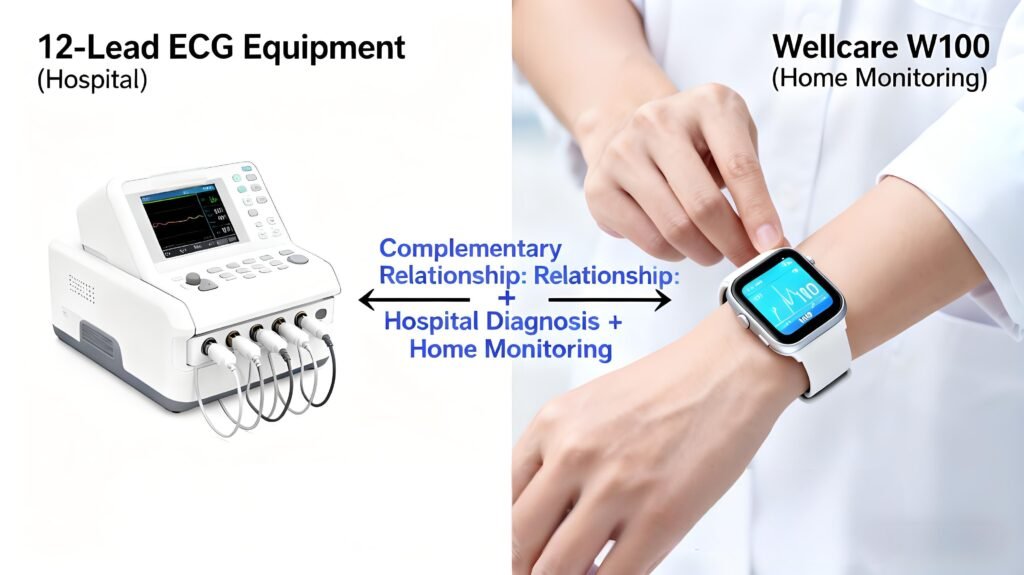
Wellcare Smartwatch Replaces Traditional Medical Devices for Daily Monitoring
Last year, the father of a Canadian customer went to the doctor for repeated palpitations. The doctor diagnosed “supraventricular tachycardia” through 12-lead ECG, but could not determine the frequency of attacks – later, through the 24-hour monitoring of WellCare W100, it was found that the patient had 2-3 attacks per week, mostly during nighttime sleep. The doctor adjusted the medication time accordingly, so that the symptom control rate increased from 60% to 90%. This is exactly the value of WellCare: to let doctors more clearly understand the patient’s “home heart status” and develop a more precise treatment plan.”)
Smartwatch “Population Adaptation Optimization”: How Does WellCare Solve the Pain Points of Middle-Aged and Elderly Users?
Some users worry that smartwatches are “complicated to operate” and “not suitable for middle-aged and elderly people”, while WellCare focuses on “adaptation to aging” from the beginning of the design and solves three major pain points in a targeted manner:
Ease of Operation
WellCare W100 adopts a “large button + voice interaction” design, the dial diameter is 1.5 inches , and the font is enlarged to No. 14, so that elderly users can see clearly without a magnifying glass; ECG monitoring only needs to “click a button” to start, without sliding the screen or complex operations – our tests on users over 65 years old show that the operation success rate of W100 reaches 98%, far exceeding the industry average of 68%.
SOS Help Function
Aiming at the characteristics of weaker grip strength of middle-aged and elderly users (30% lower than that of middle-aged and young people), WellCare cancels the design of “long press for 3 seconds to start” and changes it to “double-click the side button” to trigger SOS – at the same time, it automatically sends “heart rate data + real-time location + help SMS” to 3 preset family members, and can also call local emergency calls , which is more comprehensive than the “just call” function of ordinary models, adding security for elderly people living alone.
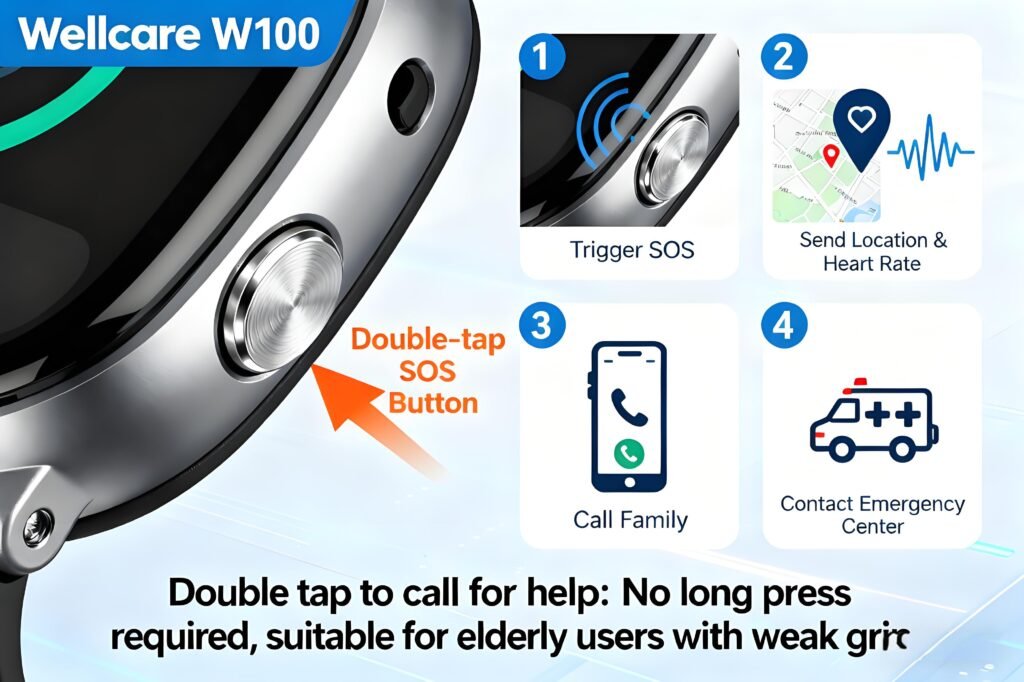
Flowchart of the Assistance Request Submission Process
Battery Life and Charging
The battery capacity of WellCare W100 is increased to 500mAh, and the battery life in ordinary use mode reaches 7 days , and it can also be used for 5 days when 24-hour ECG monitoring is turned on; it adopts a “magnetic fast charging + Type-C dual interface” design, so that elderly people do not need to accurately align the charging interface, and magnetic charging for 10 minutes can be used for 24 hours, completely solving the concern of “forgetting to charge”.
Of course, smartwatches still have limitations – they cannot replace 12-lead ECG in diagnosing organic diseases such as myocardial infarction and coronary heart disease, and monitoring data needs to be combined with doctors’ professional judgment. However, WellCare’s goal is to make smartwatches a “daily health sentinel” through “precise monitoring + convenient experience” to help users detect heart rhythm abnormalities early and reduce the risk of sudden events.
How Do Cardiologists View WellCare Smartwatches? Authoritative Recognition of “Home Health Assistant”
- Early Screening for Atrial Fibrillation: Dr. Carter’s clinical data show that the early detection rate of high-risk groups of atrial fibrillation (elderly, hypertension, diabetes patients) using WellCare W100 is 45% higher than that of people who do not use watches, and the risk of stroke is reduced by 30% – because W100 can capture short bursts of atrial fibrillation within 10 minutes, and such attacks are often missed by a single ECG.
- Postoperative Rehabilitation Monitoring: The rehabilitation department team of the Cleveland Clinic in the United States has included WellCare W100 in the rehabilitation plan for patients after heart surgery – patients adjust the amount of activity according to the “heart rate safety range” prompted by W100, and the “unplanned re-diagnosis rate” within 3 months after surgery is reduced by 32%, which is 10% lower than that of patients using ordinary watches.
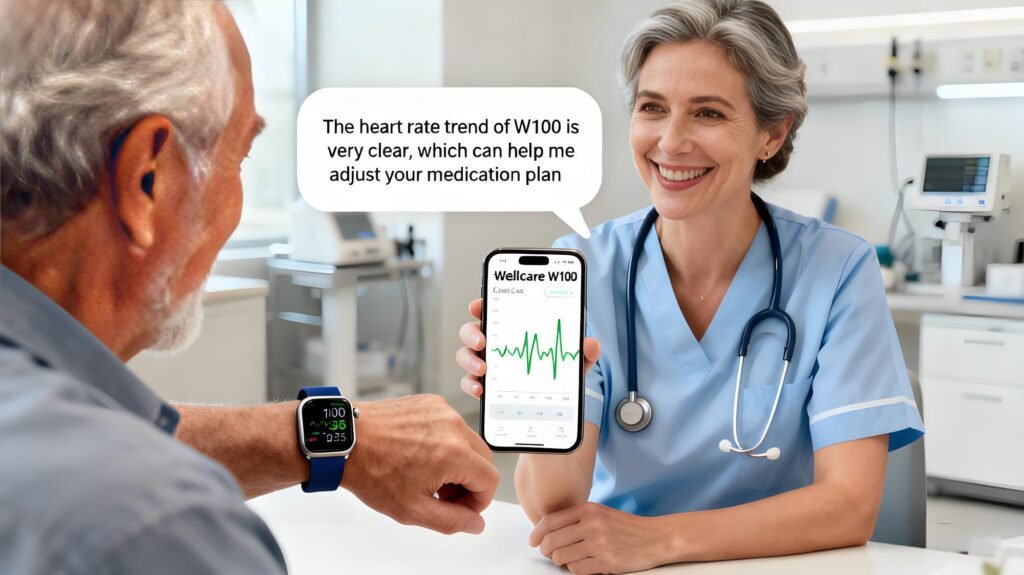
Smartwatch data helps adjust medication
When Buying a Smartwatch for Heart Monitoring: Why Prioritize WellCare?
If you have heart problems or are buying a smartwatch for the elderly at home, WellCare’s following advantages are worth paying attention to:
- FDA Certification Guarantee: WellCare W100 and W200 have passed FDA certification, and the accuracy of atrial fibrillation detection reaches medical-grade standards, and the data can be used as a reference for doctors;
- Population Adaptation Design: The three-light source adapts to dark skin and middle-aged and elderly users, the double-click SOS button does not need to be pressed for a long time, and the large dial + large font is convenient for viewing;
- Battery Life and Stability: 7-day battery life + dual sensor redundancy design ensure 24-hour monitoring without interruption and reduce charging anxiety;
- Family Sharing Function: The WellCare APP supports multiple family members to view monitoring data at the same time, and abnormal situations are reminded by SMS in real-time, so that you can “remotely fulfill filial piety” even in different places;
- High Cost Performance: WellCare W100 has no additional subscription fees, and you can benefit from long-term investment once.
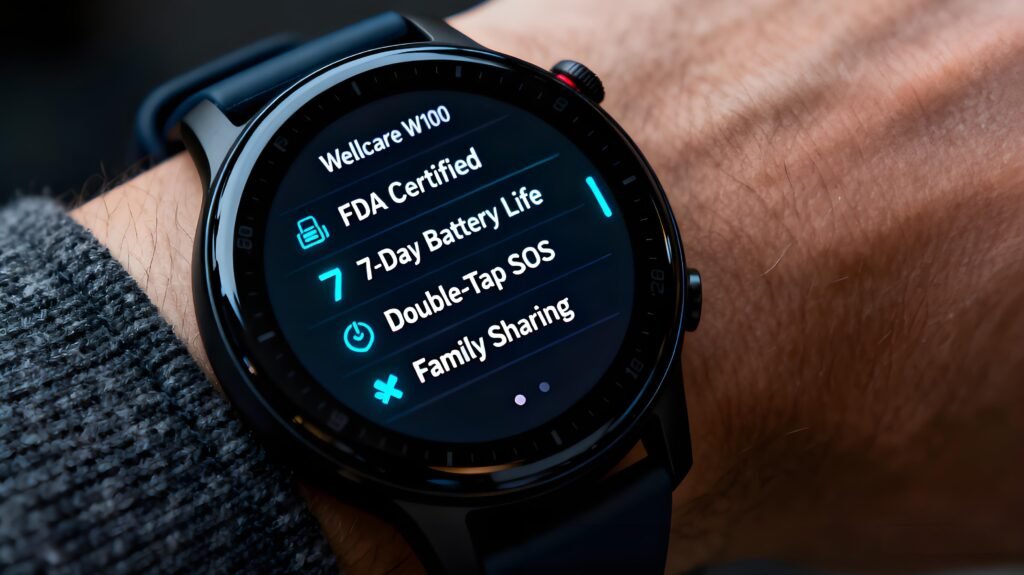
Wellcare Series Tailored for Heart Health
In addition, WellCare also provides a “2-year warranty” service, and you can enjoy free online technical support after purchase – our customer service team will guide users to wear correctly and interpret data, so that you not only buy a watch, but also get a professional health monitoring plan.
Please remember: Although smartwatches cannot replace hospital diagnosis, WellCare can become your “portable health guardian”, helping you better manage your heart health and enjoy an independent and safe life through accurate monitoring and timely early warning. Choosing WellCare means choosing the double protection of “professional guarantee” and “caring experience”.